The culturally-aware label Ong Shunmugam now sells more than clothes. It is also peddling “cloth with character”
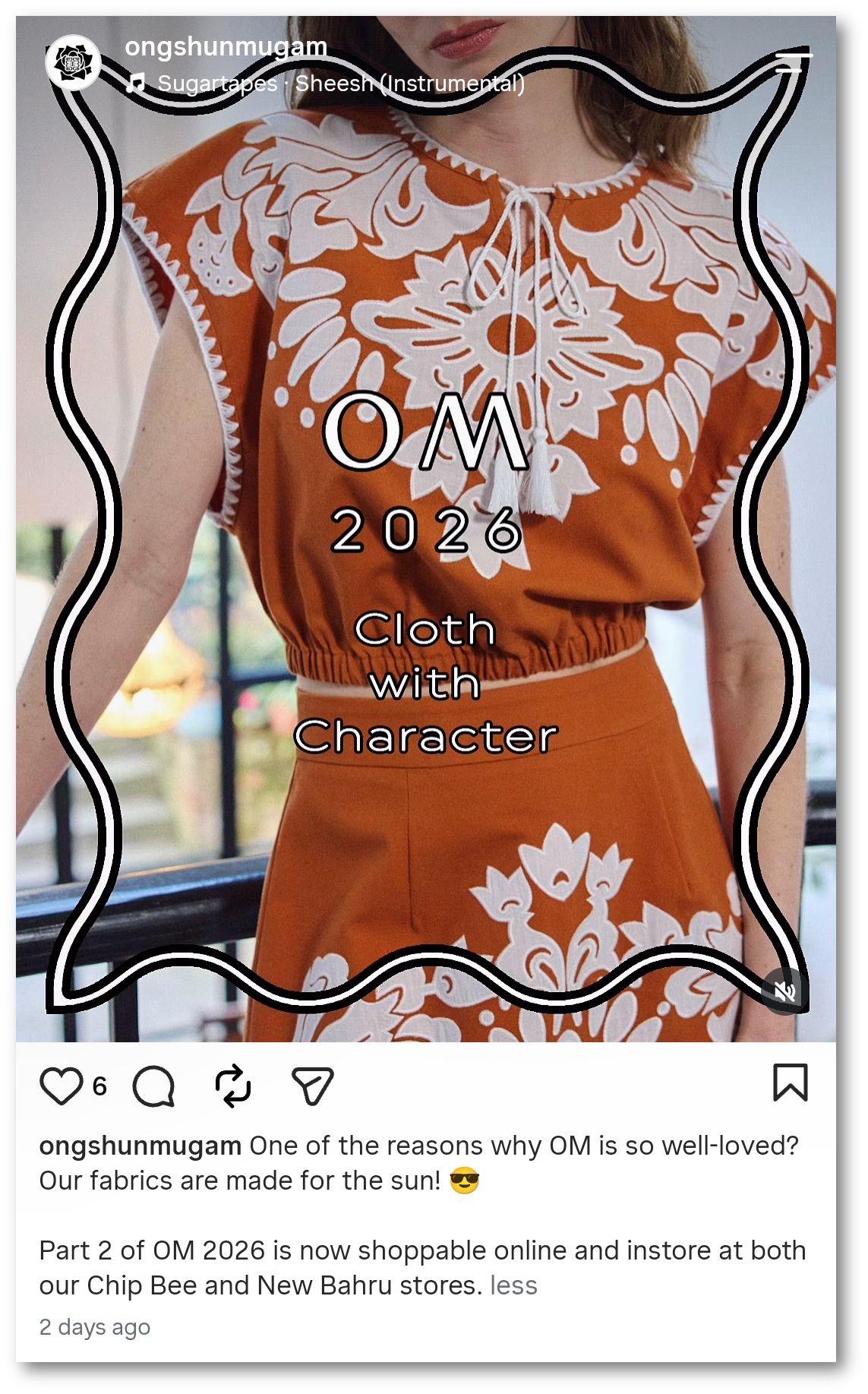
Ong Shunmugam’s latest post on Instagram. Photo: ongshunmugam/Instagram
We’d be the first to admit that we do not care for much of the algorithmic sludge fed to us daily via our smartphone. Yet we still find the occasional scrap of vapid marketing worthy of a good snigger. This morning, without warning, a Google Discovery card popped up to helpfully inform us that Singapore’s favourite ethnic label Ong Shunmugam is now hawking a very intriguing “cloth with character”. Always willing to discover the new, we clicked on the link and found ourselves in front of a post of the brand’s stunningly curated Instagram page. The accompanying carousel of photos showed models in completed garments, rather than a roll of uncut fabric. There was no “cloth”, whether with character or the appreciable aesthetic complexity of a blank wall.
There was, as we saw, more than one fabric used, but they were sewn into recognisably feminine Ong Shunmugam silhouettes. Calling the individual, finished garment “cloth” is a charming attempt to convince viewers that these clothes are made of something substantial, instead of just ego. It recalls Malaysian brand Private Era’s use of poetry in their social media messaging to sell unremarkable bags. There is admirable thinking in turning basic product identification into a guessing game—because nothing says fashion like making your customers work for the privilege of identifying what they’re actually buying. We don’t want to belabour a point, but cloth and a piece of completed garment are not the same. A bolt of fabric is raw material and a potential. A garment is a cultural object, shaped, cut, and contextualised. It’s like calling the durian “fruit of character” when you serve pengat. Food lovers don’t mistake ingredients for cuisine.
There is admirable thinking in turning basic product identification into a guessing game—because nothing says fashion like making your customers work for the privilege of identifying what they’re actually buying
Ong Shunmugam probably does not want to describe the cloth more than to inflate it into a mood, a vibe, a persona. “Cloth with character” just sounds better than the “100% cotton” or the various cotton blends that the brand later stated in the same post. To be sure, fabrics do have certain characteristics (durable, sheer, smooth) and tactile qualities that can be described by the very human ‘hand’, but that does not mean they beam with “character”. These are physical traits, not “character”, which implies agency, moral fibre, or narrative depth. So why graft human essence onto inert fabric? A plain weave is just that—plain. So, it is likely that the description applies to the surface treatment of the fabrics used. There is the appliqué and the cross-stitch that looks like a woven geometric folk‑art fabric, but these are surface treatment. Such motifs can naturally be cultural symbols. However, they don’t equate to “character” in the moral or personal sense. Staying with food, it’s like calling ketupat casings heroic.
If “cloth of character” isn’t enough, the brand tells us in the comments that they are “so well-loved” because “our fabrics are made for the sun!” There, the smashing second act of caption-speak inflation. When technical truths—cotton blends—are too banal or sound cheap, you reach out for celestial bodies after congratulating yourself. The sun is not a consumer, nor a design brief. Fabrics are engineered for climate, not the glowing star of the earth’s solar system. But the message sings on social media. As the garments flattened into JPEGs, the text must carry the illusion of depth. Ong Shunmugam do not choose words to describe, they prefer them to perform. They’re linguistic sequins—glittering, but stitched to nothing. The incomprehensibility itself becomes the selling point—if you don’t get it, you’re standing outside the brand’s niche fandom.

