Alexis Wilkins’s white suit for her performance at the Great American State Fair is a popular colour choice among female public figures, including Meghan Markle who wore the exact same two-piece for The Cut
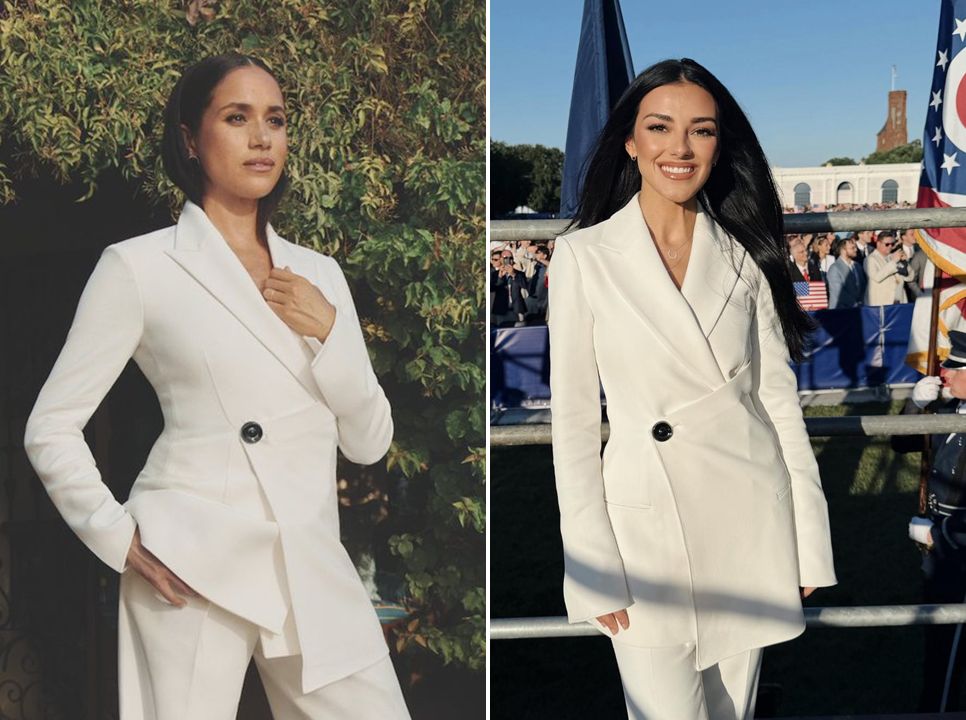
Two attracted to the same suit by Proenza Schouler: Meghan Markle and Alexis Wilkins. Photos: The Cut and alexiswilkins/Instagram respectively
In 2022, The Cut ran a cover of lifestyle entrepreneur Meghan Markle. In the accompanying feature, she was photographed wearing a US$$1,990 white suit by Proenza Schouler in an unidentified garden/porch, possibly her own in Montecito. It was the silhouette of premium autonomy that leaned into the crisp, high-status language of the modern influencer. She looked well arranged, left hand rested over her heart, with an expression that seemed to suggest: oh dear, it this okay? The blazer looked like a standard fit, with peaked lapels that were wide enough to suggest confidence. From the left side, under the arm, a panel of fabric swept across the waist, went over the right lapel, and was buttoned at the top tip, off-centre. It’s evocative of a saloon door or, perhaps, more accurately, a turnstile. Four years later, Kash Patel’s country-singer girlfriend, Alexis Wilkins, wore a complete look-a-like to sing the American national anthem at Donald Trump’s Great American State Fair.
Unlike an ice cream bar that isn’t good at meeting direct sunlight, Ms Wilkins emerged in the punishing June solar glare with pristine brilliance that screamed: “I haven’t been outdoors since the invention of central air-conditioning.” On Ms Markle, the suit and the pose were performative vulnerability. On Ms Wilkins, it was quite the opposite—a show of power or the adjacency to it. Her choice of the white suit for a state fair that’s a sweltering sprawl with nothing to see was an easy-to-ingest costume of legitimacy, solidarity, and spectacle. It was not Michelle Obama’s intriguing sleeveless version by New York label Monse, worn at the 2024 DNC. The Proenza Schouler suit was a triumph of the adequate—it did not require anyone to wonder, “Why?”. To be certain, Ms Wilkins wore that suit before, also to sing: at the opening ceremony of the Founders Museum near the White House in June, last year. Both events saturated with Americana, were, notably, brimming with that particular flavour of performative patriotism that usually requires a flag-waving checklist.
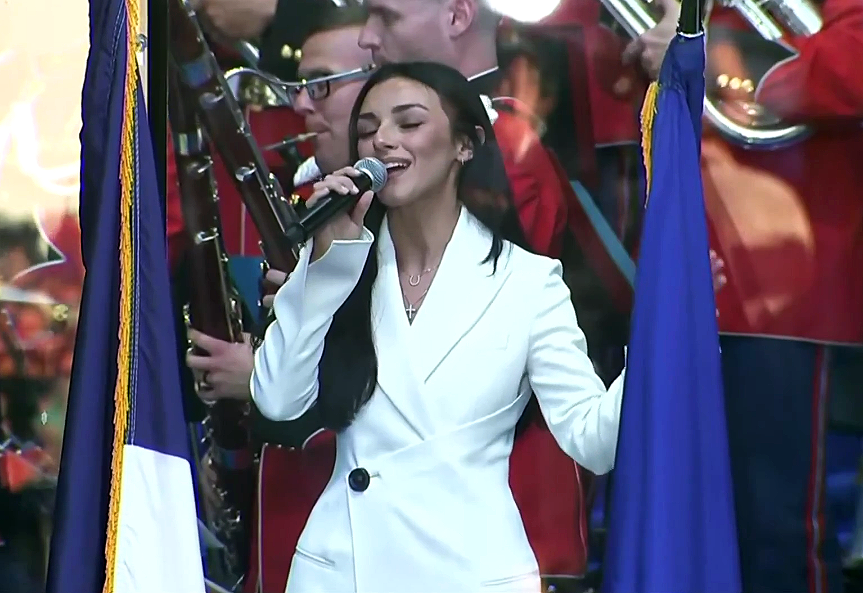
Alexis Wilkins doing her bit for her country in unmissable white. Photo: alexiswilkins/Instagram
Two of America’s most polarising women reaching for the same suit was not just about identical taste, it was about the semiotics of the garment, used to stage themselves. Both women, about 18 years apart in age, were tapping into the suffragist lineage, the angelic innocence costume as predestined aura. It’s a garment that carries ready‑made symbolism, so they don’t have to recreate a new visual language. Selecting a New York fashion label signals cosmopolitan credibility. It’s not just white; it’s curated white. That makes the gesture legible as both political and fashionable, possibly one more than the other. For figures already vastly disliked, the white suit is a defensive costume. It says: I am pure, I am inevitable, I am beyond reproach. You can’t overwrite the hostility more effectively than with providence. Admittedly, Ms Markle wore her suit well. While she managed to inhabit the tailoring, Ms Wilkins seemed to be actively haunting it. But it does not matter since she was likely not aware that the suit was a tad too big for her, just as she was oblivious to the fact that, standing on the stage at the Great American State Fair, there were shoes too big to fill.
It is already well noted that Ms Wilkins’s entire presence was just contingent, a replacement project rather than a headliner. That’s what makes the wedding-white suit so ironic: she wasn’t the star, she was the stand‑in. She only appeared because others—such as Martina McBride, a Grand Ole Opry regular, unlike Ms Wilkins who has never sung there—pulled out. Her presence was accidental, not predestined. The white suit reframes contingency as inevitability. It’s a rhetorical trick: I was meant to be here, rather than I was slotted in because the program collapsed. Critics wondered who paid for her performance and she hit back on X, “I have been a country singer for years now. I have had a successful career in both music and commentary/strategy. People don’t get to negate that for clicks or headlines. I was invited to sing the anthem on my own accord… I am not accepting payment for this great honour.” She opened beautifully with self-credentialing, then attacked her critics, and offered providence of claim and sacrificial purity. The white suit staged her as an angel while the statement as a self‑made, unpaid patriot. Her words and her costume did the same job: perform, which, considering the singing, was a merciful bar to clear.

