As much a mystery as a clandestine operation—unravelling the carefully engineered obscurity of Alice Huang
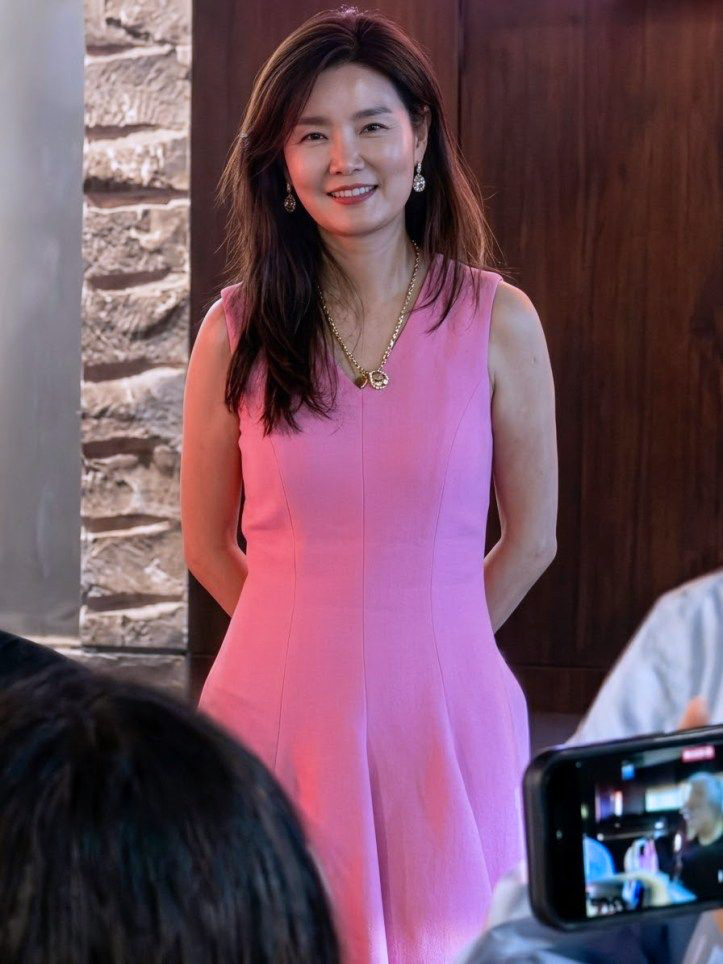
The woman at the heart of the vortex, Alice Huang. Screen shot: X
In one cut of the same reel now gone viral on social media, CEO of Nvidia, Jensen Huang (黄仁勋), and his alleged lover Alice Huang (黄乐)—unrelated despite the shared surname—were dining in the Taipei restaurant 三六食府 (sanliu shifu, former 36美食). This is an exclusive reservation-only 私厨 (sichu) or private kitchen, located in a quiet alley off 师大路 (Shida Road) in 大安 (daan) or Da’an District of Taipei. The street is named after National Taiwan Normal University (NTNU) or simply, 师大. This area is known locally as a 商圈 (shangquan), literally a shopping circle that is a mixed-use district for both residences and commerce. Ten to 15 years ago, Shida Road was what can be called a hipster enclave. But today, it is way past being the epicentre of Taipei counter-culture—bohemian indie cafes, underground punk/rock basements, smoky bars, and angsty student activism, coming across as a bustling, high-energy artery pulsing with life every single evening. This is a typical Taipei shangquan, with the nearby 师大夜市 (shida yeshi) or Shida Night Market on the parallel 龙泉街 (longquanjie) or Longquan Street. It operates exactly as Taipei intended—loud, unpretentious, and aggressively alive.
Sanliu Shifu is tucked away in a 巷 (xiang) or alley, specifically Lane 92. What makes it even more fascinating is that it sits inside a low-rise, slightly weathered residential apartment building, not in a standalone, purpose-built 轩 (xuan) or pavilion with a high view. The restaurant was originally founded by former culinary team members from the legendary 来来喜来登大饭店 (Lai Lai Sheraton Hotel). The kitchen is run by master chefs who specialize in refined, high-end classic Chinese banquet dishes, not, as one might think, Taiwanese 私家菜 (sijiacai) or home cooking. That is not a deliberate contrast. If you walked down Lane 92 without knowing any better, you would think you were in a completely ordinary, weathered Taipei residential neighborhood. There are no marble facades, no valets, no neon signs welcoming high society, and absolutely zero architectural prestige. Yet, Sanliu Shifu is known among the people of Taipei as a go-to among the capital city’s 政商名流 (zhengshang mingliu) or prominent political and business figures. Increasingly and visibly, it draws the 科技新贵 (keji xingui), the newly-minted elite aristocracy. This is Taipei’s ultimate urban paradox: where titans of global tech duck past cheap 大鸡排 (dajipai) fried chicken cutlet stalls to spend a student’s annual rent on a single dinner.
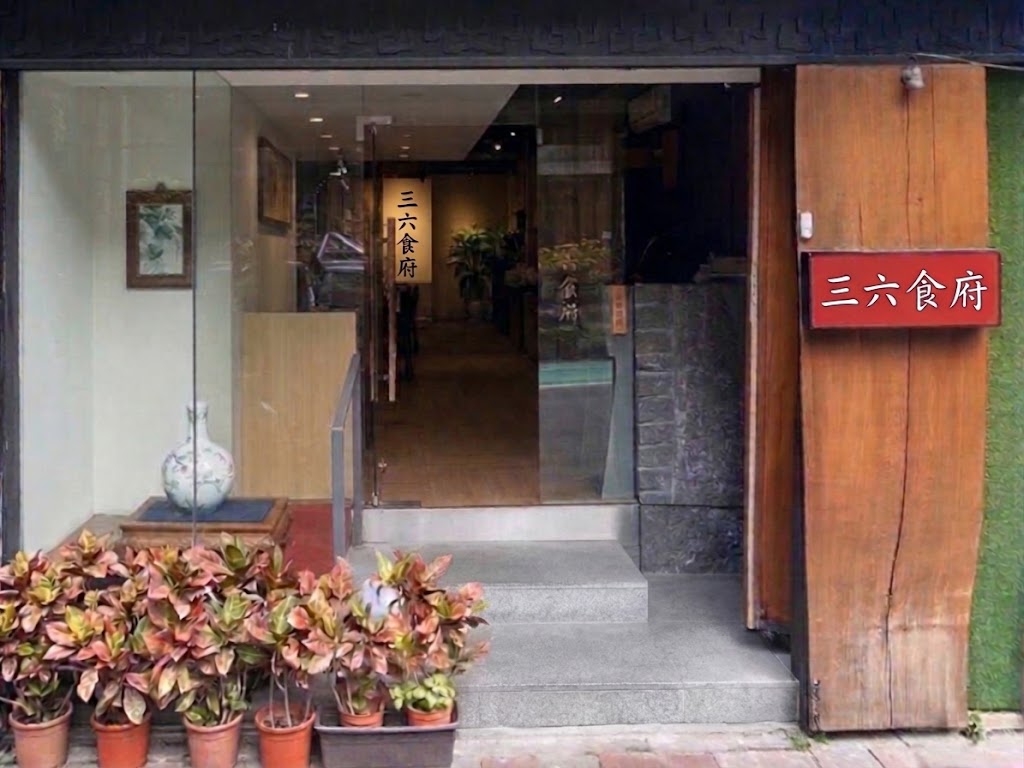
Sanli Shifu, where the action seemingly set off the biggest corporate scandal of 2026.. Photo: Xiaohongshu
Back in May, when Mr Huang made the fateful decision to dine at Sanliu Shifu, the Taiwanese media, setting up shop outside the restaurant, described Jensen Huang’s choice as evidence of his “私房美食地图 (shifang meishi ditu)” or secret gourmet map. But something far more clandestine was happening on that dining table that pivotal night. A billionaire in an alleyway, broke students on the main street, and a five-star meal hidden behind an ordinary glass door eventually gave way to what is now considered the biggest scandal of the year, defined by a convergence of personal, corporate, and national security fallout. Mr Huang—an avowed foodie—could hardly have anticipated that his choice of food and female companion would catalyse a counterintelligence inquiry into alleged foreign state tradecraft. What was initially dismissed as a typical high-powered executive outing during Computex of that month has escalated into an international crisis. The fallout has widened to such a degree that even our regulatory and law enforcement authorities felt compelled to launch formal investigations into the commercial operations of Megaspeed, the Singapore-registered entity Alice Huang sat atop
When the couple and their group left the restaurant, the media and fans alike were waiting for the Nvidia star executive. As he stepped forward to meet the rabid requests for autographs, while offering the crowd “炒面 (chaomian or fried noodles that he had 打包 (dabao, packed to go) although it was more likely the restaurant’s famous 椒麻拌面 [jiaoma banmian], Sichuan peppercorn noodles), As he handed the noodles packed in a white, unmarked plastic bag, he remarked in 闽南 (minnan) dialect, “真好呷 (chin ho jia or very delicious)“. Ms Huang took slower steps so that she was more than an arm’s length behind him. There was no visible security detail. She did not join him on the road to receive his admirers. She stood on the pavement and scanned the fan-zy before her, with the watchfulness of a mother hen. Earlier, she had placed a protective (or guiding) hand on his waist as they ascended the steps to enter the restaurant. Now she seemed to keep that same protective stance about her, looking calm and smiling with the serenity of someone who had just successfully replaced all the family decaf with full-strength espresso.
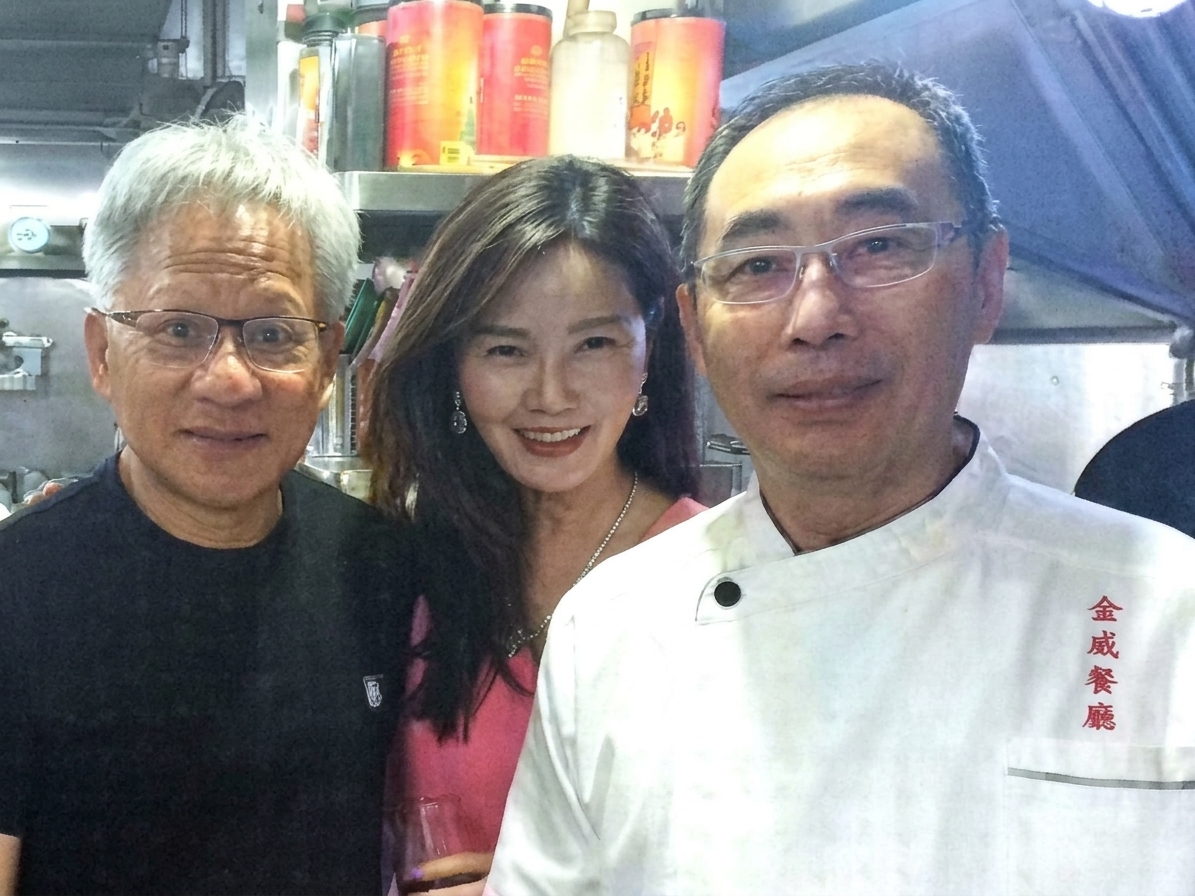
Happy diners: (from left) Jensen Huang, Alice Huang, and executive head chef 余陳本 (also Yu Chen-ben) in the kitchen of 三六食府. Photo: X
Inside, during the meal, Taiwanese lens feeds had caught Mr Huang leaning in close to accept a warm peck on the cheek from her—though precisely what he did to earn the reward remains unrecorded. Did he give her a chicken wing that he had wanted for himself? A cheek kiss is usually a sign of affection or, at least, familiarity. Therefore, they appear close. Or, as the Taiwanese media, looking back at their coverage in May, now describe what they saw as 举止亲密 (juzhi qinmi or displaying closeness). That’s a fairly ordinary inference. This is, for most people, a PDA (public display of affection), to use a popular again acronym. Of course, it doesn’t automatically imply a sexual relationship, but it is not usually categorised as a neutral corporate interaction either. Nor a 敬老尊贤 (jinglao zunxian), respect-the-elders-and-venerate-the-worthy gesture. But the sequence of events does say something: that revealing video emerges, the media characterised the interaction as “displaying closeness”, and Jensen Huang sent a memo to his staff admitting: “I have been unfaithful to my wife”.
As she stood carefully modulating her exposure to the cameras outside Sanliu Shifu, her full frame came into view. Alice Huang, 42, possesses a rather broad, squared jawline and full cheeks or what is generally known in China as 富贵相 (fuguixiang)—a look of wealth, prosperity, and good fortune, but without the classical Chinese beauty of 解语花 (jieyuhua) or a flower that understands human speech. Nor does she own the round, sparkling eyes and the sharp chin of a 网红脸 (wanghonglian) or the face of an influencer, also known as a 辣妹 (lamei) or what the West calls a “baddie”. That means nothing like the social media sensation 小雨 (Xiaoyu), before her tragic and costly plastic surgery. Ms Huang wears her long hair in as unapologetic, untreated cascading asset. That night, her unruly locks functioned as a sort of signal; she spent an exhausting portion of the video preventing them from their forward fall—with both hands, and a toss of the head backwards, like a swimmer might have emerging from the pool, leaving viewers none the wiser as to the keen signalling.
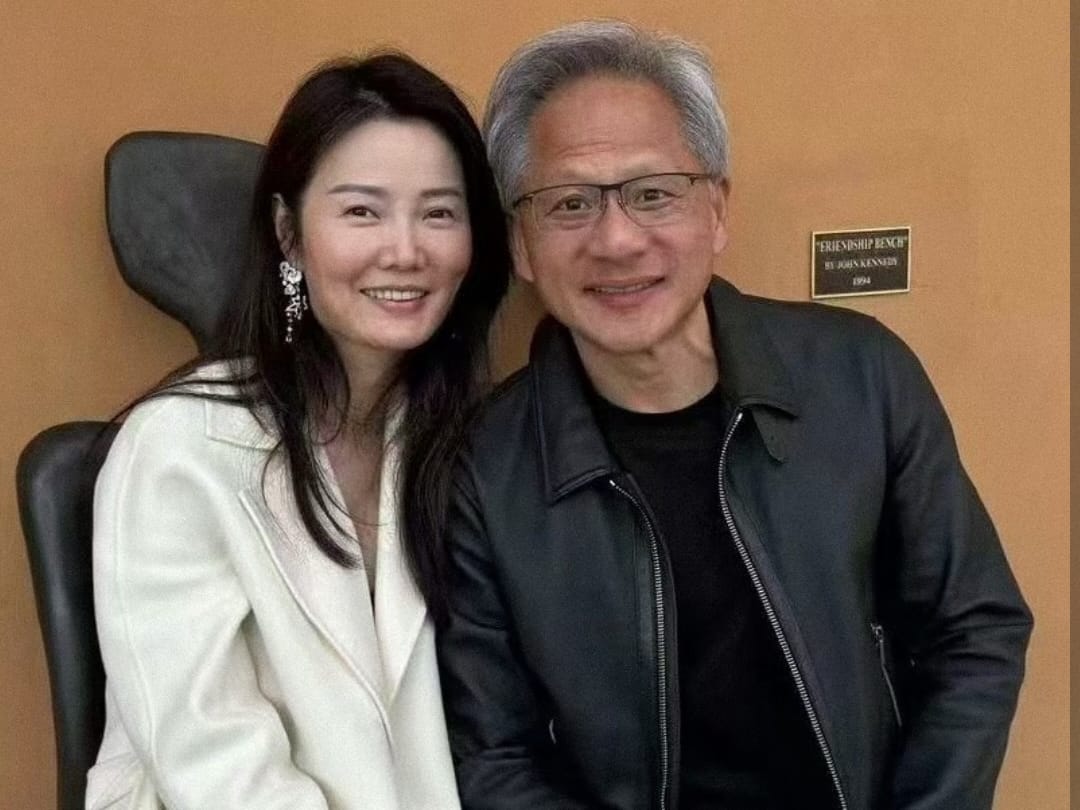
Alice Huang and Jensen Huang seated on American artist John Kennedy’s bronze sculpture, Friendship Chair, in what is believed to be Birch Street in Brea, north of Orange County, California. Photo: X
By stripping herself of the typical Chinese influencer aesthetic, she had, many observers thought, amped up her mature femininity and played against the traditional archetype favoured by older, high-level Chinese businessmen, such as seen in the other extramarital scandal involving the married executive director of Huanqiu Project Management (Beijing) Hu Jiyong (胡继勇), who was similarly photographed in public in Chengdu, but with a far younger woman. In the Shida Road restaurant in Taipei, Ms Huang wore a pink dress that offered zero concession to quietude, or standard restaurant incandescent temperature. The kind of intensity that earned this particular pink the descriptor “hot”. Essentially, it belied the age of the wearer. It was sleeveless, had a V-neck that did not plunge, and of a knee length that flared from the fitted waist many forty-somethings like to adopt to look girlish. It featured uninterrupted princess seams that curved over the bust and flowed straight down to the hem, creating a long, streamlined silhouette, but on her, it showed a mismatch between the garment’s curve and the wearer’s body. If what Mr Hu’s companion, Dong Sijin (董思槿), wore in that photograph—also pink, but floral and body-enhancing—was dubbed by the media as the “免职裙 (mianzhiqun)” or, literally, dismissal dress, since both of them were eventually fired from their jobs, what might lie in store for the two Huangs?
Despite the clever corporate-extramarital costuming, Alice Huang’s plain dress seems to make Jensen Huang’s own wife Lori Mills look like an adrenaline junkie in a vintage shop. She may not be Lauren Sánchez, but she is no Priscilla Chan either, even if the latter enjoys shared front-row credentials with her husband Mark Zuckerberg at the Prada autumn/winter 2026 show, seated next to Prada Group executives Lorenzo Bertelli and Andrea Guerra. Ms Huang strangely eschews looking like the stunning woman a married man of means seeks solace with. The middle-brow reality of high-stakes corporate infidelity is all too real. Perhaps back-alley, geopolitical,tech-world affairs did not require front-row Prada polish. Many mainland Netizens’ comments on Alice Huang place the emphasis on her body type, saying she is surprisingly not as voluptuous as the typical 小三 (xiaosan) or mistress, even comparing the vibe she emanates to a “大妈 (dama)” or, literally, an auntie, fuelled by the unflattering bodice of the pink frock. Perhaps the ultimate scandal: committing infidelity while encased in an ill-fitted dress that could have been picked up at 师大夜市 (shida yeshi) or Shida Night Market.
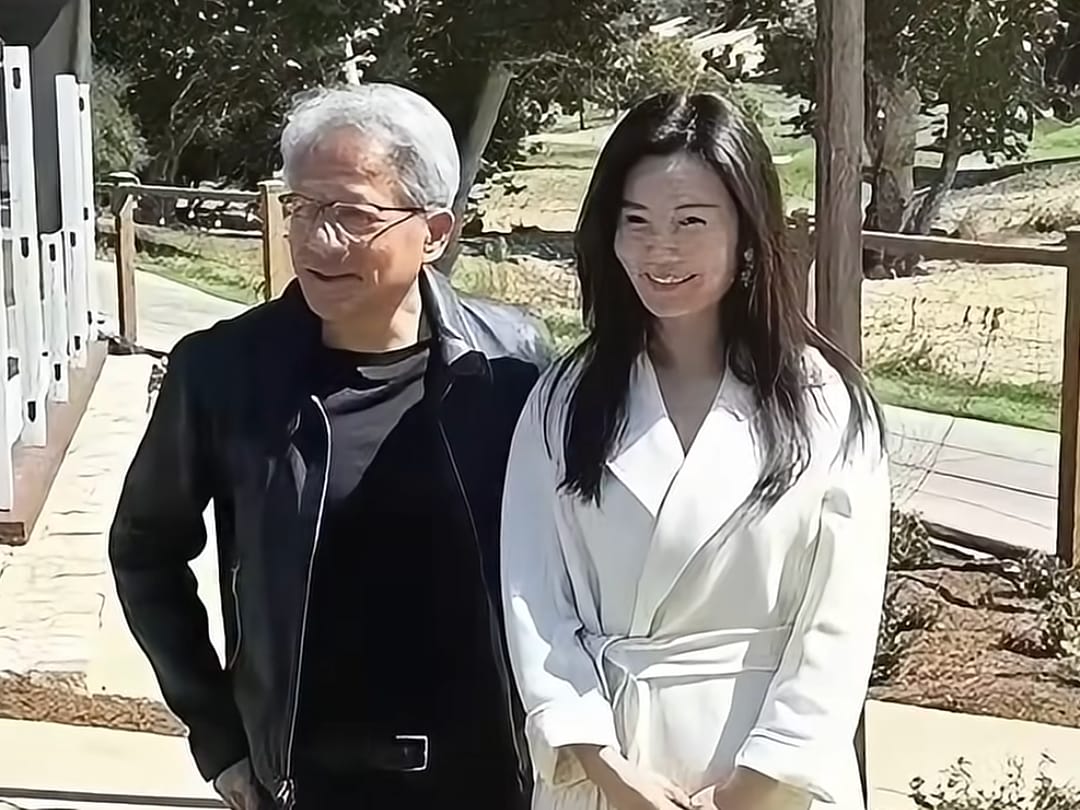
The couple in Cordevalle report and golf club in San Martin, California
Oddly, with Alice Huang headlining the media, the total sum of public enlightenment remains precisely where it started: in the dark, awaiting the Internet’s inevitable archaeological dig. From media reports and social media assertions, this is what is known. According to Hong Kong and Chinese media, Ms Huang is born in 云南 (Yunnan). High school class records—pointing to one 贵港市江南中学 (Guigang Jiangnan Secondary School)in Guangxi and subsequent ties to Xiangtan (湘潭市), famously the birthplace of Mao Zedong (毛泽东)—suggest an upbringing rooted in China’s south-western hinterlands. The geography further dismantles the popular trope that Hunan women are universally of the dianxing lamei (典型辣妹)—the stereotypical “spicy girl”—stock. About 20 years ago, she enrolled in the School of Communication at Hong Kong Baptist University, where she earned a Master of Arts in media management. Studying and subsequently working in Hong Kong later enabled her to obtain Hong Kong permanent residency and, interestingly, issued a Hong Kong passport. Crucially, according to Taiwanese authorities, it was that very passport that facilitated her entry into the island, allowing her to take her seat at Sanliu Shifu that revealing night.
What is striking is not that fragments of her biography are emerging. That’s normal. Once someone becomes the subject of intense scrutiny, people start finding schools attended, old photographs (and many are emerging), or social-media traces (which are surprisingly limited). What is striking is that the professional narrative remains oddly unstable—it is nearly impossible to paint a picture of her powerhouse pedigree. Much of it cannot be corroborated. Even among reports that broadly agree on the outline, there are repeated qualifications: an alleged journalist who reportedly worked at CCTV (who offered a non-committal silence) and Hunan TV (who disavowed any employment record of her), private-investment biographies of uncertain provenance, opaque ownership structures around business ventures, and, crucially, uncertain chronology in parts of her career. We can’t, of course, conclude there was anything sinister. The personal story is easy to imagine: she met a man, they hooked up and are possibly in an affair. But the professional trajectory is, to put it simply, strange.
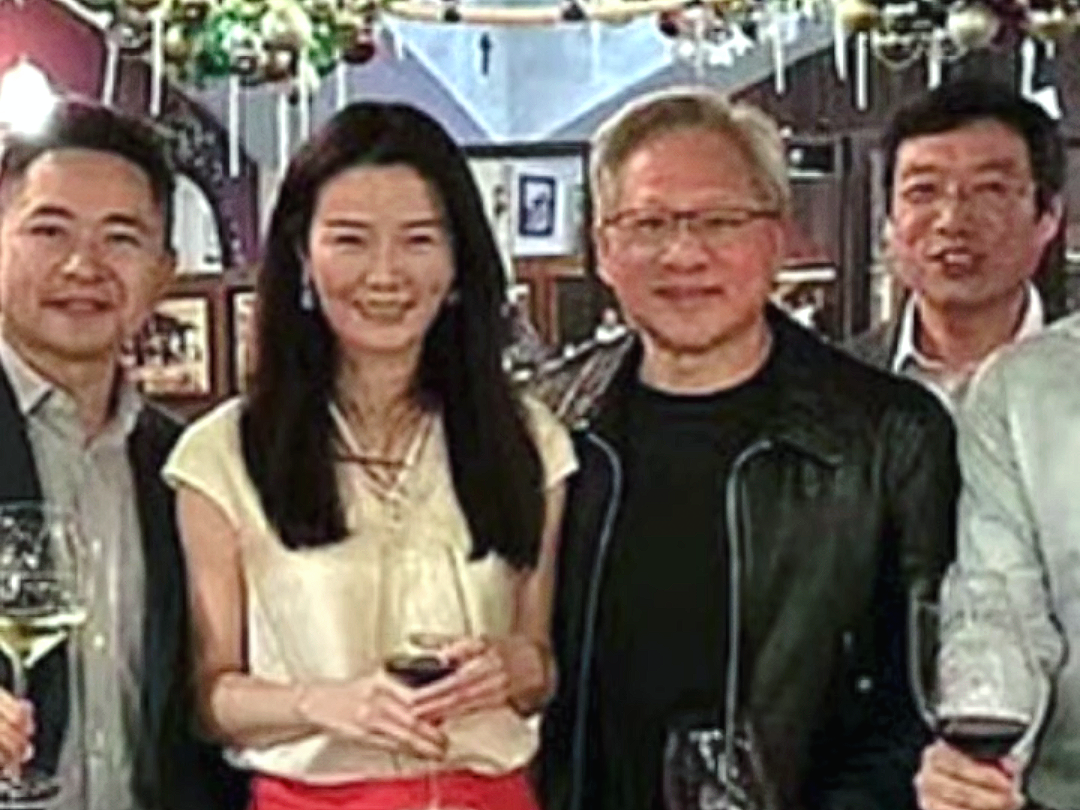
Alice Huang and Jensen Huang, and others in an Italian restaurant reportedly in Singapore. Photo: X
Alice Huang’s career invites curiosity because it is not as intuitively clear as an engineer rising through R&D to step into the CEO’s suite. Spanning broadcasting, banking, and tech, its common thread is hard to make out, even if more people are quickly drawing the tenuous connection. It is no longer which school she went to or even who she worked with, but how she got where she was—the proximity to one of the most important men in the chip-making world, close enough to plant a kiss on the architect of the AI hardware revolution’s 63-year-old cheek. The emerging school details and class photos allow her to be the ordinary Hunan girl. But the gaps in the professional timeline make her seem less so. How does one reconcile the mundane school history and a blurry career trajectory? And now, we are confronting the strange possibility that she is an international spy, which would at least explain why her calendar is less transparent than the Forbidden City at 三更 (sangeng)—the dead of midnight.
Despite the Chinese government’s denial that there was any espionage involving Alice Huang, the spy story is growing wings. To make matters worse, Ms Huang is reportedly missing. The press has proven entirely unable to contact her. Yet, the disappearance is mostly suggestive, not diagnostic. Her sudden lack of visibility is consistent with many possibilities, including public humiliation and, of course, espionage. The problem is that “consistent with” is not nearly the same as “evidence of”. Even Donald Trump stated that he spoke with Jensen Huang, who completely denied knowing that Alice Huang was a suspected foreign intelligence operative. The story is not really a mystery about sex, nor even about espionage. It is an intrigue about interpretation: Everybody can see fragments of the relationship, but nobody can confidently explain what role Alice Huang actually occupied in Jensen Huang’s life. That gap has become a magnet for every available narrative: romance, betrayal, ambition, intelligence operations, and tragedy. Those who call her 大妈 are even more perplexed because she was miscast, but the real mystery is really her career, not her face.
Note: Biographical particulars cited in this piece reflect details currently circulating across Asian news outlets and social media channels. In keeping with the subject’s engineered obscurity, these claims remain unverified by independent primary sources

