She may be in her “private era”, as she calls it, but Vivy Yusof continues to publicly peddle vegan leather-bound storage that is good at openly holding emptiness
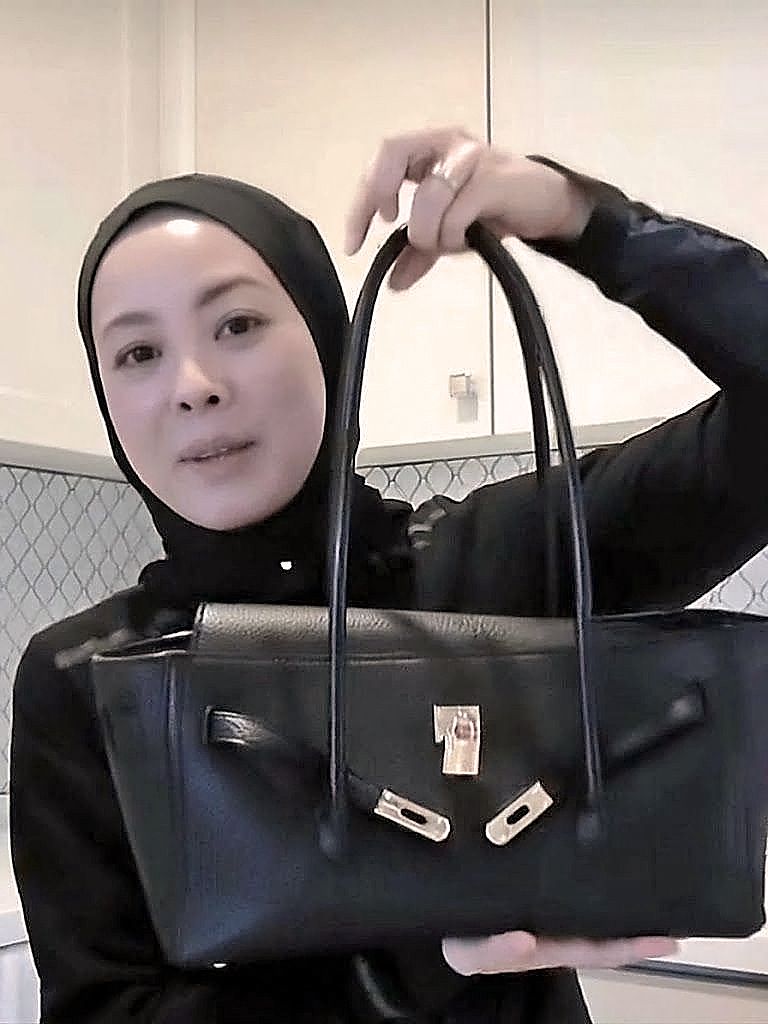
From fashion mogul to high-stakes floor salesperson in her own digital boutique, Vivy Yusof has acquired many skills. Last night, she took to Instagram to sell her Private Era bags, personally. She is proud of her output. Holding one up to shoulder level, she squealed to the camera: “I love it.” That was four times in slightly under four minutes—a rate of roughly one plug every 58 seconds. Luxury, as we saw, can really be this quiet. Nothing wrong with declaring one’s ardour for one’s output, but the affected Americanised “I love it” is a pure influencer model of communication, reminding her followers that despite the many hats (or tudungs) she wears, she is a content creator at heart. It recalls the social media grammar that suggests consumption was not only conspicuous, but also theatrically endorsed: adore, obsess, glorify. You cannot be less descriptive. The object is never allowed to sit quietly and speak for itself. A bag, as private as it is, must be accompanied by a spoken vocal track.
She then went on to describe how Private Era, launched last March, came about, and this is when things get fascinating: “You guys know I love handbags,” she enthused, “like I get into trouble because of that, like people know it, people judge it, and I am like, I have my own bag [brand].” Instant recall: Ms Yusof and her husband are facing charges of criminal breach of trust involving millions in state-backed investment capital. When the case broke in 2024, netizens were circulating https://styleonthedot.com/2024/11/06/bag-lash/s, plucked from her IG page. The visual rhetoric was powerful because it required no interpretation. An almari (closet) of luxury bags is one of the most legible status displays imaginable. It communicates accumulation instantly. But when the scrutiny intensified, the rhetoric changed. First, the images were removed. Indication of success suddenly risked functioning as evidence of excess. Then came the unexpected announcement that those bags would be sold.
It recalls the social media grammar that suggests consumption was not only conspicuous, but also theatrically endorsed: adore, obsess, glorify
Private Era’s origin story is, as Vivy Yusof tells it so ardently now, rather amusing. The criticism two years ago was, in part, that too much public attention was devoted to luxury consumption. To be certain, it is still about luxury consumption, but now cleverly framed through the admirable quality of self-awareness. Taking note that she got into “trouble” because of her love of bags is almost like a pre-emptive inoculation, more effective than a shingles vaccine. Own up before you get hit again: Yes, people judge me for my handbags. Anyway, let’s continue to talk about them. The handbags just won’t leave the continually lit stage and the unceasing telling. They appear at every act: as symbols of success and excess, as objects of criticism and resale, and as proof of personal passion. The handbags survive every narrative twist. And, it must be noted, they also serve as inspiration for a new bag design. That is, surprisingly, not private.
Even if sold, those luxury handbags are not simply the possessions of others; they remain essential to the story of Private Era. Explaining her design references, she revealed, “I took elements from my favourite designer bags, put it [sic] in one bag.” That is funny, but the hilarity is not the borrowing. Designers frequently borrow and fashion is essentially organised borrowing. What is more telling is that her source of authority is not a design philosophy (the brand’s poetic musings are positively not), or a craft tradition, or a lost fabric weave, or a technical innovation. The origin story is essentially I like these luxury bags, extracted the bits I like, I combined them, and voila… bag. Even more fantastic, she followed confidently with, “I don’t care what people say, but I think it’s the most gorgeous bag ever.” Gorgeous? Is that not what Victor Frankenstein said about his composite monster? No, he used a humbler word: “Beautiful”.

