Window shopping in the French capital now requires onlookers to peek through the perforation of metal grilles
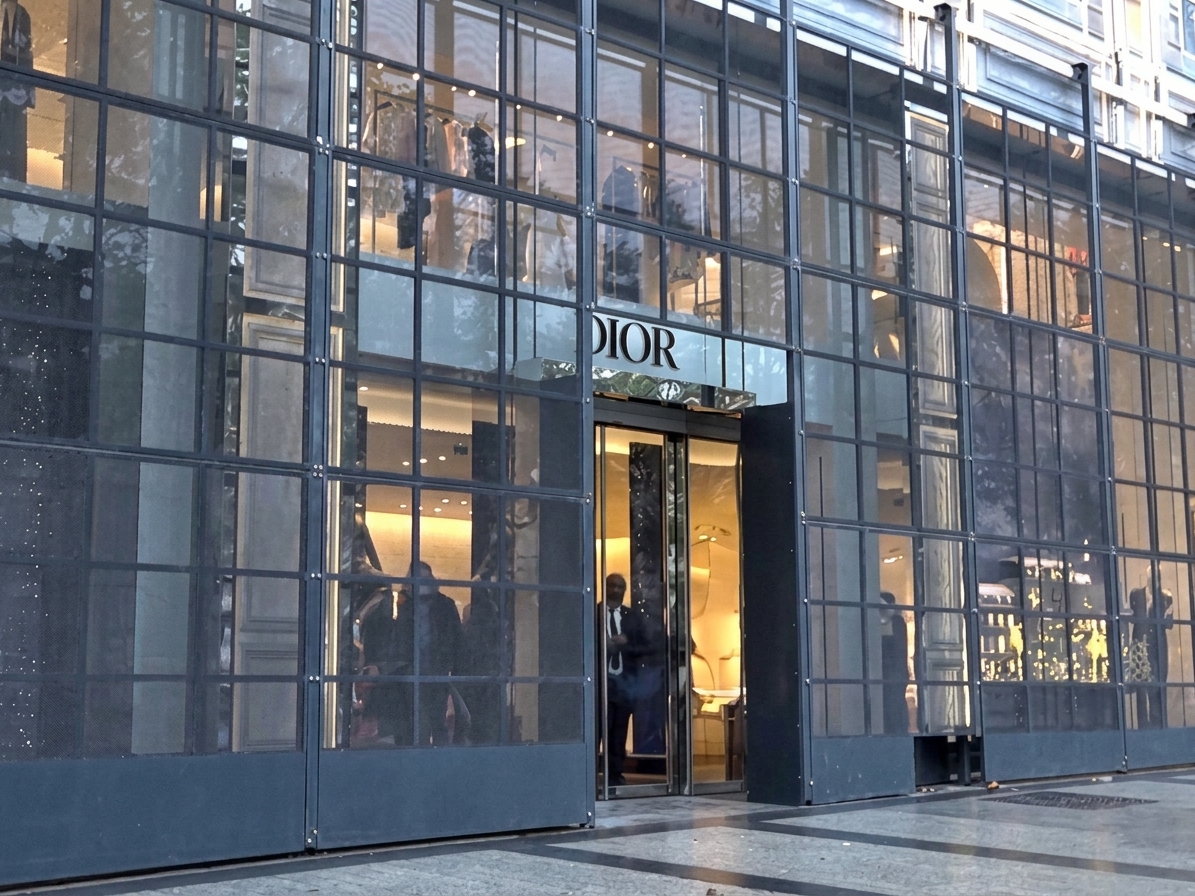
The Dior store on the Champs-Élysées, Paris. Screen shots: apt_news/YouTube
After the riots and looting of last weekend, Paris is no longer the same. In calmer times, luxury visual merchandising operates as a form of urban staging. Seasonal installations and lighting schemes are devised to pull pedestrians toward the glass, transforming window shopping into a passive act of desire. But now, stores are caged up. On the Champs-Élysées, the Dior store has added an additional layer of defence: a tulle of heavy-duty external grid, consisting of what looks like modular, interlocking metal security screens anchored firmly into the sidewalk and the store’s structural pillars. It is powder-coated in a dark grey rather than the standard black, possible to better match the Dior Grey. Looking at the fortification, it is easy to mistake it as a detention facility, fitted-out by a couture house.
The French practically invented the modern shop window—the vitrine—as a psychological, urban weapon of seduction and desire. To be sure, the structure of the glass showcase that led to the birth of window shopping was invented by the English and then scaled up by the Americans, but it was the French who made it a ritual. They even had a phrase for it: faire du lèche-vitrines, literally ‘window licking’. It captured the image of someone standing so close to an enticing display of fashion or pastry their face is practically pressed against the glass. Additionally, the historic arc of Parisian retail relies on the 19th-century flâneur: the unhurried observer strolling down Rue Saint-Honoré or Place Vendôme, indulging in spatial liberty and visual desire without immediate obligation. And it was the flâneur that Jonathan Anderson spotlighted for the men’s spring/summer 2027 show.
Looking at the fortification, it is easy to mistake it as a detention facility, fitted-out by a couture house
Shortly before the first drop of that season’s pieces appears in stores;, to flâner did not catch on, to loot did. Lèche-vitrines gave way to window shattering. At the height of the riots, the media reported that more than 3,000 shops and businesses were attacked or ransacked across the country. The whole world saw the destruction. Stores belonging to Dior, Louis Vuitton, even Hermès were destroyed and looted. In response to further protests this weekend in Paris, luxury brands have doubled their efforts in store-front security, requiring shoppers to enter without the joy of looking first. Contemplation is no longer encouraged, transaction is. Dior is so severely fortified that, while the maison recently commodified the myth of the unhurried urban stroller on the runway, it is now physically repelling the same stroller on the pavement outside. The narrative of flânerie ends abruptly at the threshold of private security.
Luxury brands have, for decades, sold the idea of experiential shopping, but it is doubtful that there are shoppers willing to step into a cage to buy anything that is not essential. Even chickens reared for their eggs are not so cooped. Retail environment design relies on a carefully calibrated illusion of hospitality. But now, the shopper has to deal with not just surveillance—which has always been there—but also containment. The brands will say that the interior of their stores has not changed, nor the merchandise. But once inside a store sealed behind grilles, the interior atmosphere changes. Looking out, everything is blurred by the metal grille. It is imaginable that instead of feeling exclusive, the space takes on an aura edging closer to claustrophobic. Are you in a boutique or a panic room? When a store looks like a cage from the pavement, the natural instinct is not to walk right up to it and step inside, but, as Dionne Warwick sang, walk on by.

