Tomorrow marks a decade of the social movement Keretapi Sarong in Malaysia, to be commemorated appropriately with a collaboration alongside Behati—the vanguard asal of ketupat kutior
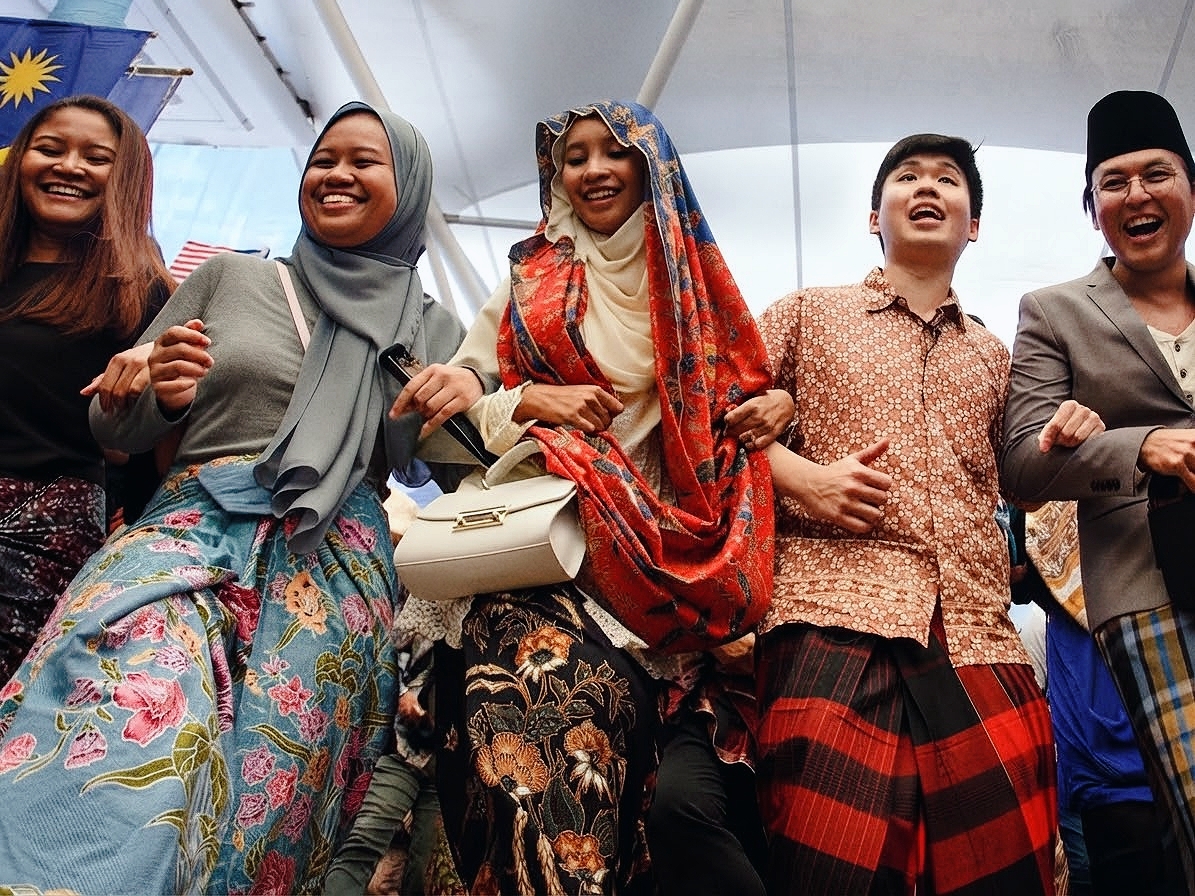
Promotional image of Keretapi Sarong shared on social media
Malaysia is quietly carving out a rather distinct little identity on the regional fashion design map. It is quite a feat to manage not one, but two fashion weeks, alongside a genuinely lively street-wear scene that seems to have captured the local imagination (including the use of road rage and hijacked stock ruse). Not, of course, discounting that remarkable cultural fascination with a single piece of clothing that has somehow turned into a full-scale movement named after a classic mode of mass travel—Keratapi Sarong (or Sarong Train). Now in its tenth year, the event is celebrated on Malaysia Day, observed on 16 September to commemorate the establishment of the Malaysian federation in 1963, which united Malaya, North Borneo (Sabah), Sarawak, and Singapore. If the architects of statehood could see Keretapi Sarong today, they might be surprised that the lasting legacy of their constitutional negotiations is thousands of people riding keratapis in colourful sarongs.
When Malaysia was proclaimed on 16 September 1963, the celebrations revolved around official ceremonies, rallies, marches, air displays, and government-organised public events. The star fabric of Malaysia Day was probably the bendera (flag)—it saw the appreciable coming together of states. But through the decades, Merdeka Day (Independence Day) on 31 August had dominated the spotlight. Hari Merdeka has long occupied the symbolic centre of the national story, tethered to one famous cry of “Merdeka!”, parades, flags, independence, anti-colonial struggle, and the strive towards the birth of self-rule. Malaysia Day itself, while still a public holiday, tends to bypass weighty constitutional lectures in favour of a much simpler brief: showcasing what contemporary Malaysian culture actually looks like—on the ground. Today, its key event, Keretapi Sarong, is not a sentimental callback to the signing of the birth certificate of a federation. The founding fathers gave Malaysia Day a proclamation, but later generations gave it a dress code
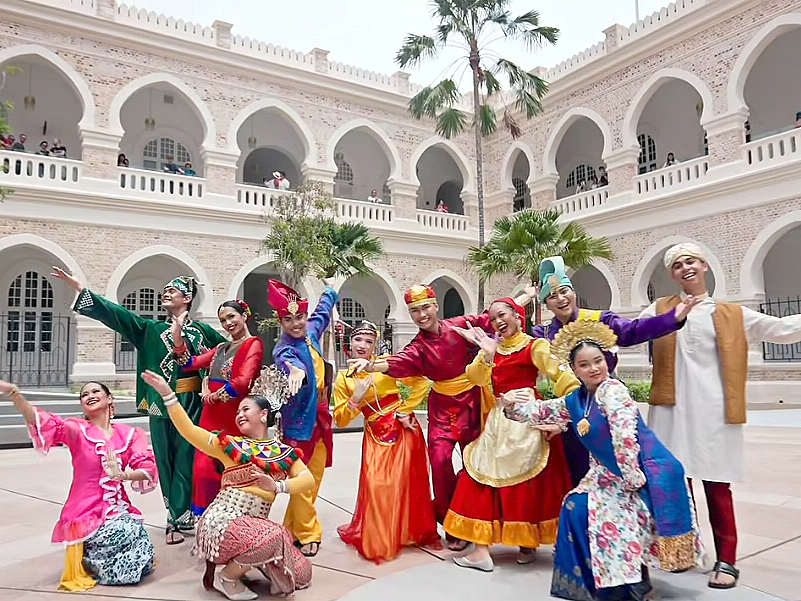
Screen shot from the music video of theme song Joget Sarong
Keretapi Sarong started on a very simple premise, wear your tubular kain with pride publicly, turning the daily roar of the commuter line into a moving gallery of heritage. There is also a jom, balik kampung (come, let’s go back to the village) vibe about it, which means your favourite sarong no longer has to suffer a three-hundred-and-sixty-four-day hibernation between Hari Rayas. Keretapi Sarong was initiated in 2012 by the non-governmental social enterprise Random Alphabets, who were inspired by global public-transport flash mobs, in particular the viral New York joke, put together in 2002 by the “prank collective” Improv Everywhere. Seven men boarded a subway in the middle of winter without wearing any trousers, while acting completely normal. The curious joy ride curiously turned into a repeatable global stunt. By 2013, the event reached its peak, with tens of thousands of people taking off their trousers in over 60 cities across several dozen countries. One of them was Malaysia, but no seluar (pants) was removed. Instead, the sarong covered limbs.
Random Alphabet organised that one flash mob in 2012. It next sashayed back to the stesen half a decade later, when the event planner LOCCO revived and expanded the sarong-on-rail into a massive nationwide celebration. The growth was exponential, going from a small Kuala Lumpur gathering of 500 people to tens of thousands across multiple states of East and West Malaysia. Ten Keretapi Sarongs later, the organisers are celebrating the anniversary tomorrow with not just a turnout that is expected to be the largest, but also train rides to unknown destinations, and showing how a grassroots transit event gets co-opted into showbiz territory. This year, they finally strike a chord—they’ve got their very first theme song on board, Joget Sarong (the Sarong Dance), sung by unofficial event ambassador Aina Abdul and the rising singer-composer Didie Shazry. And, it is all heartily sponsored by convenience-food brand Maggie, hawking their Sup Ayam Berempah. Hirthero, the train is a consistent motif. To be sure, Keretapi Tanah Melayu (KTM) is not the Japan Railway Group. But Keretapi Sarong succeeds because the train is not normally experienced as the unquestioned centre of national life.
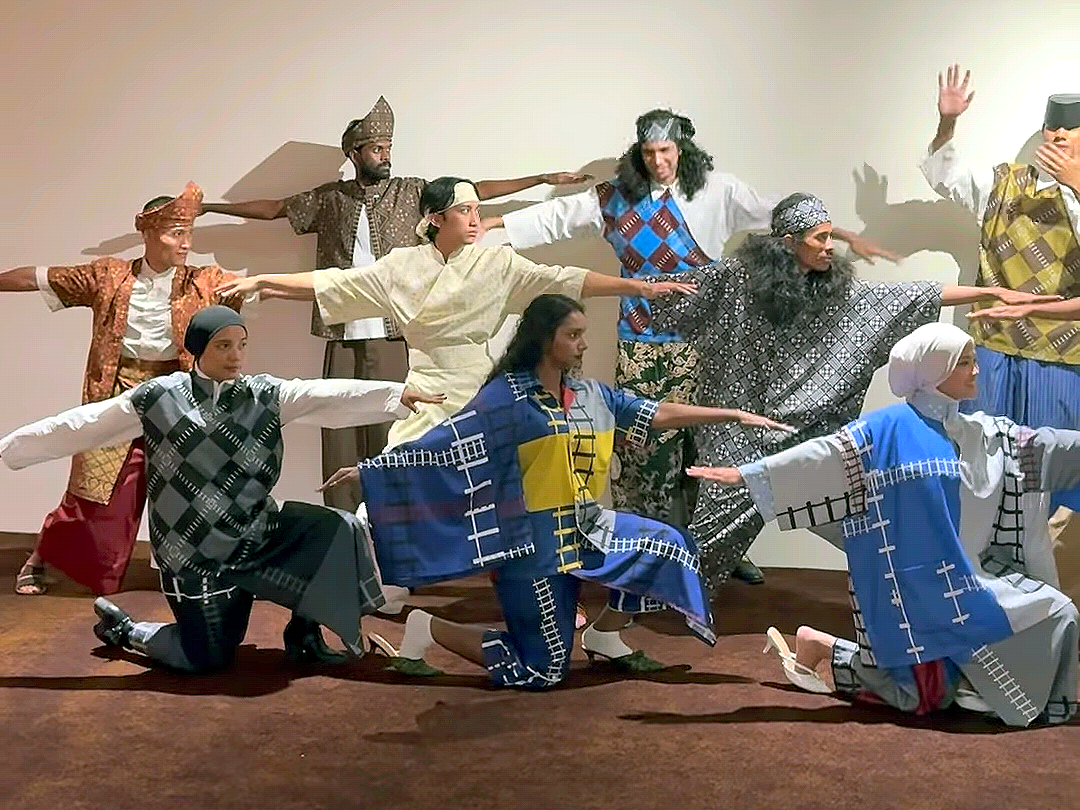
Behati “reimagines the sarong… for the modern day train traveller”. Screen shot: kel_wen/Instagram
Keretapi Sarong has quietly become the barometer for the nation’s cultural pulse. And naturally, no other brand is currently monetising that throb quite like Behati. It takes the kind of bomoh imagination usually reserved for matching pulut hitam with santan to foresee this entirely unsurprising pairing. On his Instagram page, designer Tan Kel Wen (陳楷文), riding high on the crest of his Bangsawan (nobleman) collection for the recent KLFW, shared that he “reimagines the Sarong through innovative tailoring for the modern day train traveller, reconstructing Sarong as trousers and tops.” What exactly was reimagined is not easy to fathom. Turning a rectangular piece of kain into another garment category is not inherently a conceptual breakthrough. Have sarongs not been converted into dresses, skirts, shirts, trousers, jackets, and countless hybrid garments by designers, tailors, and ordinary wearers for decades? Self-marketing loves the word “innovative” because it allows a designer to claim technical advancement without demonstrating it. But the favourite has to be “the modern day train traveller”. Is there a distinct sartorial crisis affecting passengers between 7am and 7pm that disappears after sunset? Or, worse: Does the garment cease functioning on the 10:45pm KTM service?
Keretapi Sarong itself is already about encouraging the Malaysians of today to proudly wear sarongs on trains. The organisers are not recreating a vanished railway culture from 1890. The participants are already modern. The travellers are already modern. The trains are already (fairly) modern. The event is already happening in the present, before ketupat kutior decided to pitch a tent on its platform. So “modern day” doesn’t modernise anything. It seems that Tan Kel Wen is celebrating the sarong’s relevance while simultaneously suggesting that it requires translation into Western garment categories before it is truly fit for contemporary mobility. Was the sarong somehow adequate for generations of actual train travellers, but suddenly became inadequate only when a fashion collaboration sampai (arrived)? Malaysia has no shortage of fashion rhetoric. And definitely not the message of unity. The state has spent decades talking about multicultural harmony. Keretapi Sarong does something different. It turns ordinary infrastructure into a fesyen moment, a theatre. And Behati is ready to joget.
Photos: keretapisarong/Instagram

