How minimalist styling degenerated into front-row street brawl at the COS show during New York Fashion Week
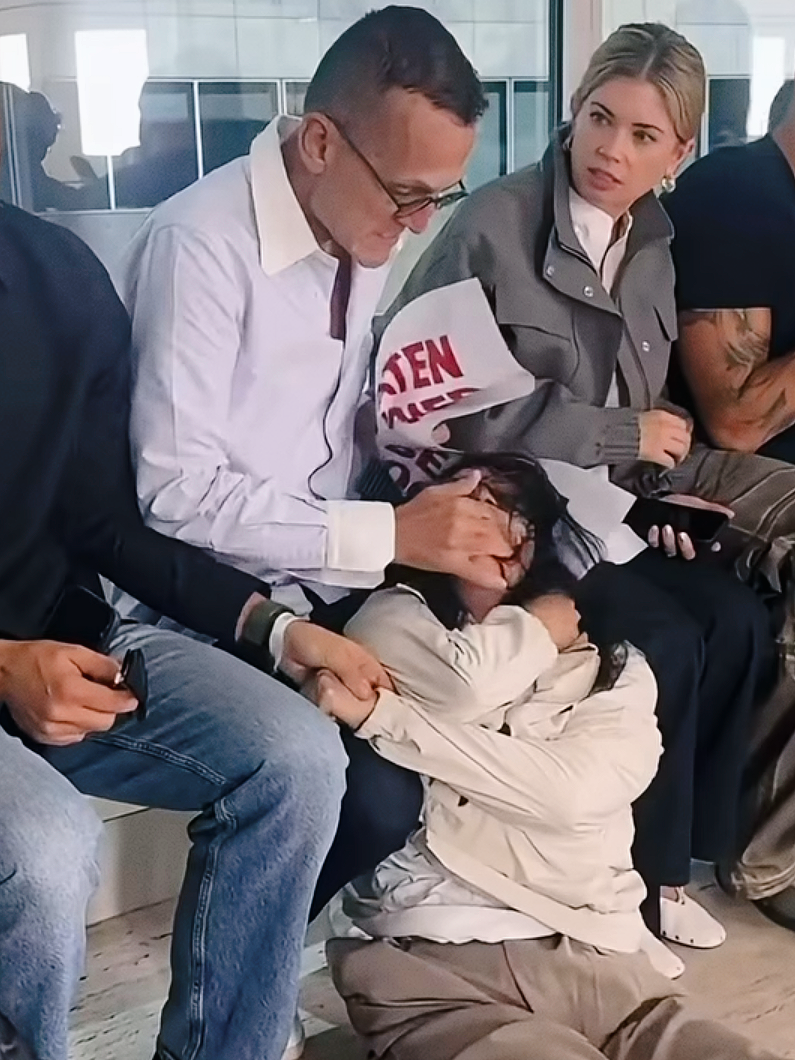
Steven Kolb (left) suppressing a protestor. Screen shot: fashionista/YouTube
COS has made a name as a brand that whispers its Scandinavian-adjacent restraint. But at their fifth New York Fashion Week (NYFW) presentation yesterday, something unexpectedly unquiet happened. Somehow, protestors from the ever-active PETA managed to infiltrate the show venue: the WSA Building on Water Street, in Manhattan’s Financial District. COS deliberately shifted from last season’s Brooklyn’s Greenpoint Terminal to the downtown venue to align itself with corporate modernism and financial‑district authority. The WSA Building’s stark, industrial interior was meant to reinforce COS’s minimalist tailoring and sustainability rhetoric. But the PETA protestors effectively broke all that. And even more so, the shockingly violent action of one the key players of NYFW, Steven Kolb. It was a Cornelius Fudge moment—proof that even a fictional Harry Potter minister suffers from chronic management panic.
PETA protests during NYFW are nothing new; they are, as one regular told us, “quite standard”. We remember them targeting Anna Wintour several times at shows, especially the flour shower, during her more-than-three-decades career at Condé Nast. But the physical reaction from an industry executive was not. And if you were the CEO of the Council of Fashion Designers of America (CFDA), who organised NYFW, it arrives with the shock value akin to a Thai monk enjoying a temple regular on a dining table. WWD reported that at the COS show, Peta managed to infiltrate the event with “five or six” of their enthusiastic operatives suddenly joining the models to walk the runway, but shouting their protest cries. The show’s paid security did move in quickly with what the industry typically describes as “passive de-escalation”. But somehow, one woman in particular, was able to carry on, holding up a paper sign that read on one side: “Sheep beaten and bloodied for wool. Don’t buy it.”
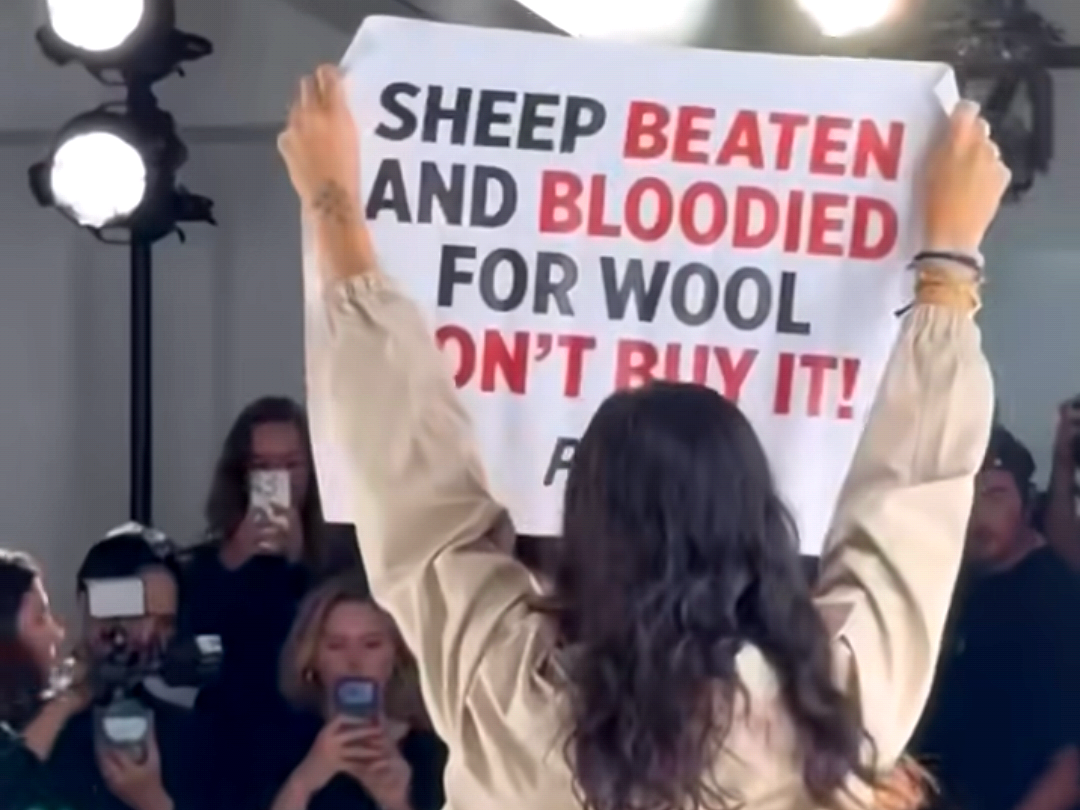
The protester with her message. Screen shot: wwd/YouTube
The woman filed past Mr Kolb, who, possibly unable to suppress his disgust, lurched at her. He ripped the sign of her hands, and when she tried to take it back, he grabbed her, pulled her back to his seat, where she slid onto the floor. He secured her head between his thighs, and smothered half her face with his right hand, all with the instinctive ease and nonchalance of an ICE officer. The woman to his immediate left looked at him horrors and disbelief. Second to her left, a man appeared to tell him to let her go. He released his hand, and swung his right leg over her to lock her in place. Was it security or blind rage? The woman screamed louder—not in pain, but with the urgency of her message. She admirably cared more for sheeps‘ lives than her own. She evidently decided that her vocal cords were a fair price to pay for woolly welfare. A good flock is hard to find
Mr Kolb forgot that people attend fashion week shows with their smartphones in tow, and it is safe to say that everyone recorded him and shared the reels on their social, no less WWD (that’s how we learned of the instant disgrace) and Fashionista. His startling kinetic snap was taken in with shock by front-row celebrities, including Lupita Nyong’o, Sharon Stone, and Michelle Williams—their jolted reactions became part of the viral narrative. In fact, before the spectacle even limped to its close and the lingering aftertaste of that wretched interruption had cleared, the ringside was already broadcasting the spectacle to the world. The condemnation arrive with the predictable punctuality of the Shinkansen. Most expressed sharp criticism of Mr Kolb’s behaviour, amplifying PETA’s message. Nothing quite like throwing a fit on a fashion week runway to permanently index the exact voice you tried to smother.
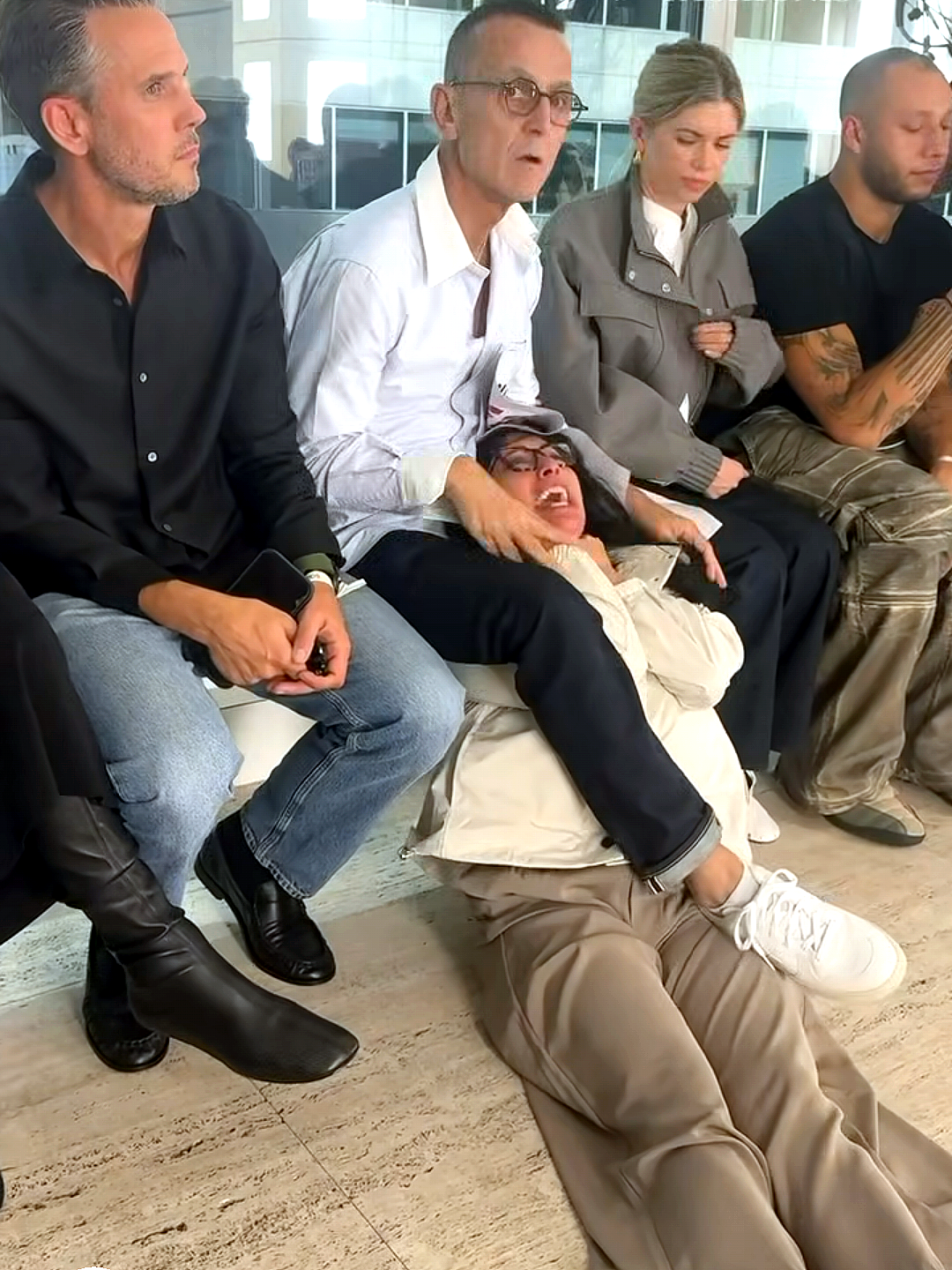
Steven Kolb with his entire leg over the protester. Screen shot: fashionista/YouTube
But that woman was merely the sequel. Other videos that appeared online concurrently showed him muzzling a man with his entire palm over the chap’s face. The guy could only struggle, and was initially unable to extricate himself from the aggressor’s grasp. It is hard to fathom what went through Mr Kolb’s mind. Apparently, public suffocation was his preferred method of front-row stress relief. Following the public outcry, he shared an Instagram post that was eventually erased. Mr Kolb wrote: “I reacted inappropriately to an incident at a show earlier today. It wasn’t my place to do so. I should have let the security team handle the situation.” The startling terseness and non-apology was also shared with WWD. The statement carefully avoided the useful words ‘apology’ and ‘sorry’. It only said, “I reacted inappropriately,” which sounded like a procedural admission, not an emotional one. Turned a runway into his person MMA “Claw”, then reduced it to a vague, forgettable misstep. There was nothing that suggested genuine remorse.
Steven Kolb has, in fact, ties to our island. In 2015, he was here together with the then president of the CFDA, Diane von Furstenburg, to launch the short-lived Fashion Futures, which was then described as a “business development program”. Three of our designers were picked and featured in New York that July: Sabrina Goh, Chelsea Scott‑Blackhall, and Priscilla Shunmugam. Each received S$50,000 funding and, apparently, introductions to the New York fashion industry. Within a few years, Fashion Futures fizzled out. In fact, there was no second cohort after 2015. The initiative was effectively a one‑off showcase rather than a recurring incubator, dreamed up by the organisers of Singapore Fashion Week (formerly Audi Fashion Week), Mercury Marketing & Communications. They were desperate to tether the event to global legitimacy. By partnering with the CFDA, and bringing Steven Kolb and Diane von Fürstenberg to Singapore, they hoped to symbolically anchor Singapore’s fashion week to the authority of New York. It was an aggressive, unscheduled descent towards reality.

Steven Kolb (right) muzzling a man. Screen shot: fashionista/YouTube
By most accounts, Mr Kolb is not known to be an aggressive person. He has generally maintained a reputation as an administrative bureaucrat and steady institutional fundraiser rather than a hothead. Shaped by two decades at the helm of the CFDA and an earlier chapter in public health non-profits and HIV/AIDS advocacy, his career has long stood at the intersection of corporate diplomacy, high-stakes boardrooms, and complex donor relations. Industry folks are accustomed to seeing him give polite opening remarks at the annual CFDA Fashion Awards or manage backstage logistics, not snap under pressure and revert to physical combat on a runway floor. It seems that Mr Kolb’s aggressive intervention during the COS show was reputational flex to protect a NYFW, declining in importance. NYFW has long been contested terrain, with activists, critics, and brands pulling it in different directions. Mt Kolb’s physical outburst was likely a desperate attempt to reassert control when institutional authority was visibly failing. With a European brand on the runway (COS is part of H&M), he was dramatising that NYFW can still police its own stage.
That the runway occurrence transpired precisely when the United States was treating the global stage to a prolonged, unprompted exhibition of its provincial underbelly is, frankly, tiring enough. We now see institutional power under pressure either erasing or suppressing dissent, but rarely engaging it. The Met’s CEO Max Hellein comes to mind. Like Mr Kolb, he issued a terse statement to announce the cancellation of the John Galliano: Horizons exhibition, largely making the subject of the show the fall guy. Mr Kolb’s violence is the physical mirror of Mr Hollein’s bureaucratic silence—both are evasions that expose collapse. When cultural and fashion institutions operate that way, accountability is just a polite fiction. Much of America’s cultural and fashion export is. Increasingly, a discernible collapse of legitimacy is taking hold. In a 2014 interview with Men’s Folio (who somehow managed to misspell his name), Steven Kolb said, “It is rewarding to be surrounded by creative people”. He did not mention creative protestors. But it was now for all to see that when authority must shove or silence, it is already hollow.

