What’s with the impaling of breasts?
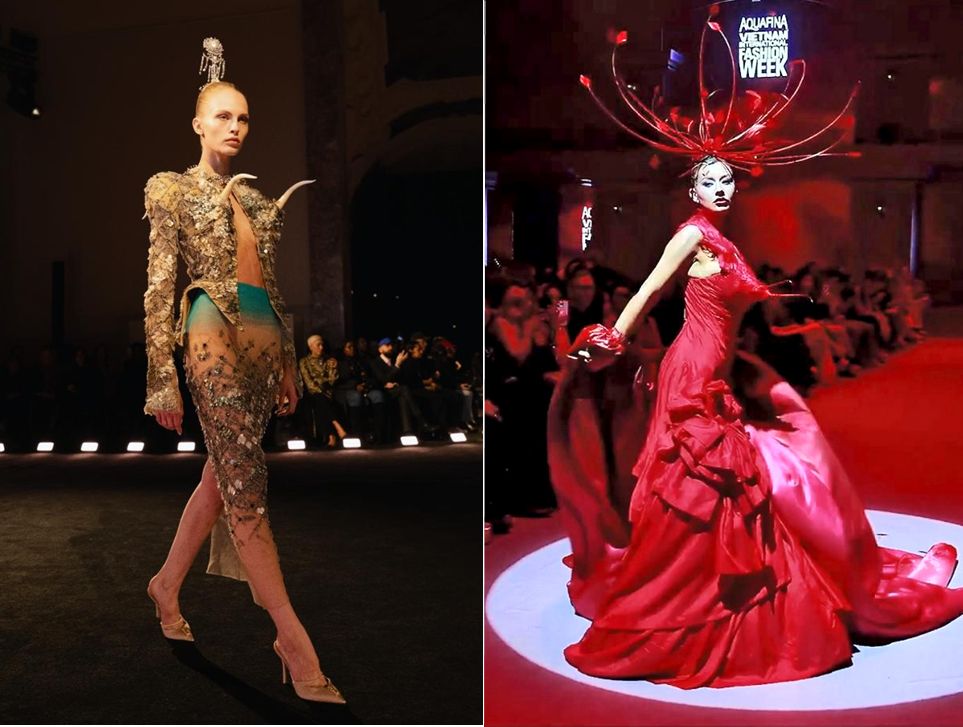
Making a pointed statement: (Left) Schiaparelli and (right) Frederick Lee. Photos: Schiaparelli and vninternationalfashionweek/YouTube
At the 21st Aquafina Vietnam Fashion Week (AVFW) last month, a regular, non-native fixture, Singapore’s favourite couturier, Frederick Lee, showed a collection titled Cult. With seven AVFW showings under his stunningly feathered wings, Mr Lee seduced the Vietnamese, bringing a fatuous, dark, red-diode-lit and fake lightning–struck theatrical atmosphere to the runway. This could have been a couture-fied The Sacred Riana BGT performance. The designs featured heavy use of dramatic black and red palettes, layered floral structures, and stratified feathers that—again—drew comparisons to classic Alexander McQueen, just as the stripped ostrich quills aplenty suggested Richard Quinn. But perhaps most evocative were the spiked breasts of two gowns that immediately brought to mind (also) two Schiaparelli jackets from the couture spring/summer 2026 that sprouted avian bills where the breasts would normally be. In the spirit of couture, to physically puncture the idea of subtlety?
We can see that vicious is an underutilised silhouette. It seems that if you can’t attract the eye, you might as well threaten it. In the case of Mr Lee’s gowns, the aesthetic value of the spikes is not clear. Skinny and spindly, they looked like unwound strips from a spring coil piercing through a budget mattress suffering from a midlife crisis. To be sure, designers with architectural backgrounds or those influenced by the movement often prioritise geometry, using the bust to create a hard, geometric silhouette that disrupts the traditional soft curves of the body. But this was not that. Mr Lee was effectively creating a poke line on an ungainly, horizontal mount of fabric and a thrust parallel to the floor that effectively broke the smooth continuity of the body’s own silhouette to challenge the usual function of the bust—to contour, contain, or accentuate. It destabilised the bust’s role as a frame of allure, turning it into a site of confrontation. It took the figurative “pointed bust” of the ’50s and made it a spear. The mind boggles: what was Mr Lee really projecting when his gowns delivered projectiles? Who needs a bullet bra when one skips straight to the bayonet? Maybe a cult of combat?
Five months earlier, at the Schiaparelli couture spring/summer 2026 show in Paris, Daniel Roseberry showed a collection that did not reference a cult, but was a visceral exercise in The Agony and The Ecstacy. It fused beauty with the beastly, crafted with atelier virtuosity in lace, silk feathers, neon tulle, even rigid resin. The clothes themselves were hybrid creatures, what Mr Roseberry called “infantas terribles (terrible princesses!)”. The silhouettes evoked scorpion tails, stingers, snake teeth; many part reptile, part arachnid. But it is the anatomical hybrid that we are interested here, two jackets in particular. Both sported beaks sticking out of the breasts of the garment. There’s the black, which looked like it belonged to a bird of prey, then an ivory, which seemed to suggest baby husks or even immature antlers. Either way, both were resin‑sculpted couture prosthetics set on a bodice of silk, hand-painted and airbrushed to mimic plumage. The collection explicitly refused the use of animal products. Beaks without birds was more compelling as the uncanny appendages destabilised the jacket’s silhouette. The difference between the gowns and the jackets could not be sharper (literally): one is menace, the other is mutation.

