It’s water everywhere at the Louis Vuitton show, but nowhere to anchor. All the weight of the tidal, with none of the wave
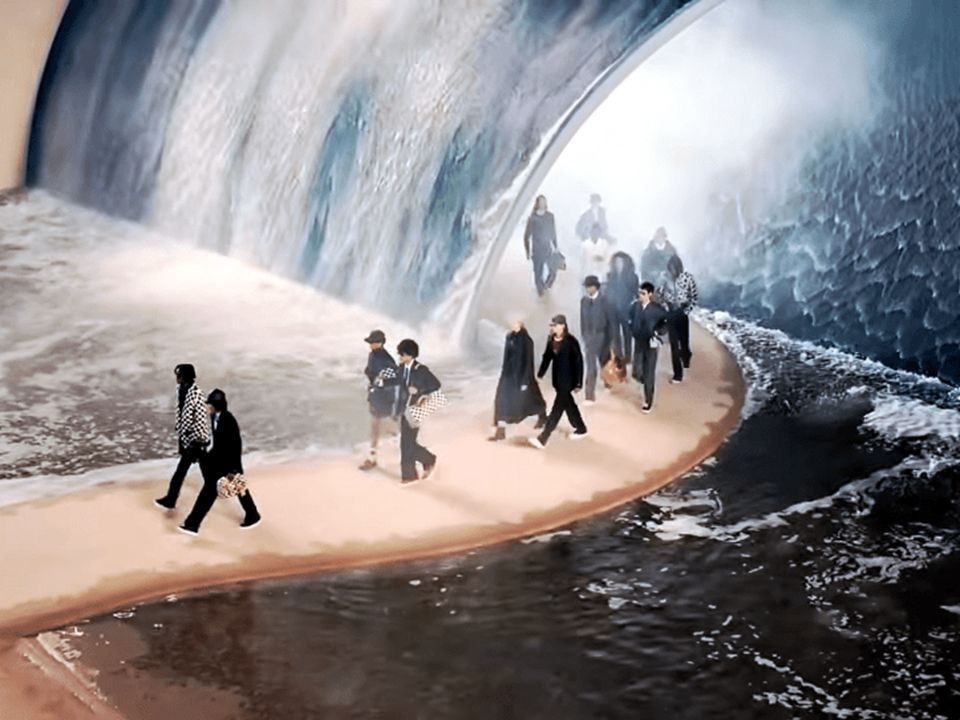
It was really not about the clothes, less the prêt-à-porter than the production. That is indeed characteristic of Louis Vuitton under the artistic direction of Pharrell Williams. This menswear season, Mr Williams has decided to scale up by building a temple-high walled city and then within it, enough water to bring about a biblical flood, except that now, we live in an era of better plumbing, so the water had somewhere to drain, recirculating in a grand, artificial loop. But the wash of the water—as if discharged from a giant waterfall faucet—was no less grand. In fact, we sensed that it was not a flood that Mr Williams was hinting at, but the most biblical, the most impressive, imposing, intense scene of the book(s): the Parting of the Red Sea—in reverse. The cascading water appeared to be ‘parted’ as the models emerged from a dry passage onto a runaway made to look like a drained waterbed, just as Moses and fellow Israelites did. It was a deliverance we did not know Louis Vuitton needed. Mr Williams may not be a designer the way his colleague Nicolas Ghesquière is, but he sure could stage a pseudo-miracle.
The presentation had all the subtlety of a hole in a levee that cannot be plugged. It was, no doubt, designed to be more impressive than even Karl Laferfeld’s during his Chanel years (or Matthieu Blazy’s). Those sets at the Grand Palais, while impressive, were playful, even kitschy, rather than dead serious. LV’s, by contrast, was designed to make you text your mother to tell her you love her. The Sunday-school-in-4K vibe was further strengthened by a live band (L’Orchestre du Pont Neuf) and a gospel choir (Voices of Fire), imported from an increasingly embarrassing America. This is the brand’s recurring motif, at least for the menswear: the reliance on high-energy, American-coded cultural signifiers to flashily bridge the gap between luxury and mass appeal. Mr Williams was so awed by this own excess that, after taking his typically protracted bow at the end of the show and greeting his family and some of his pals seated front-row, he pointed to the real waterfall-backdrop, gesticulating to suggest, “can you believe this?” Even veteran reporter Luke Leitch was duly impressed, opening his Vogue Runway review with: “The set was amazing.”
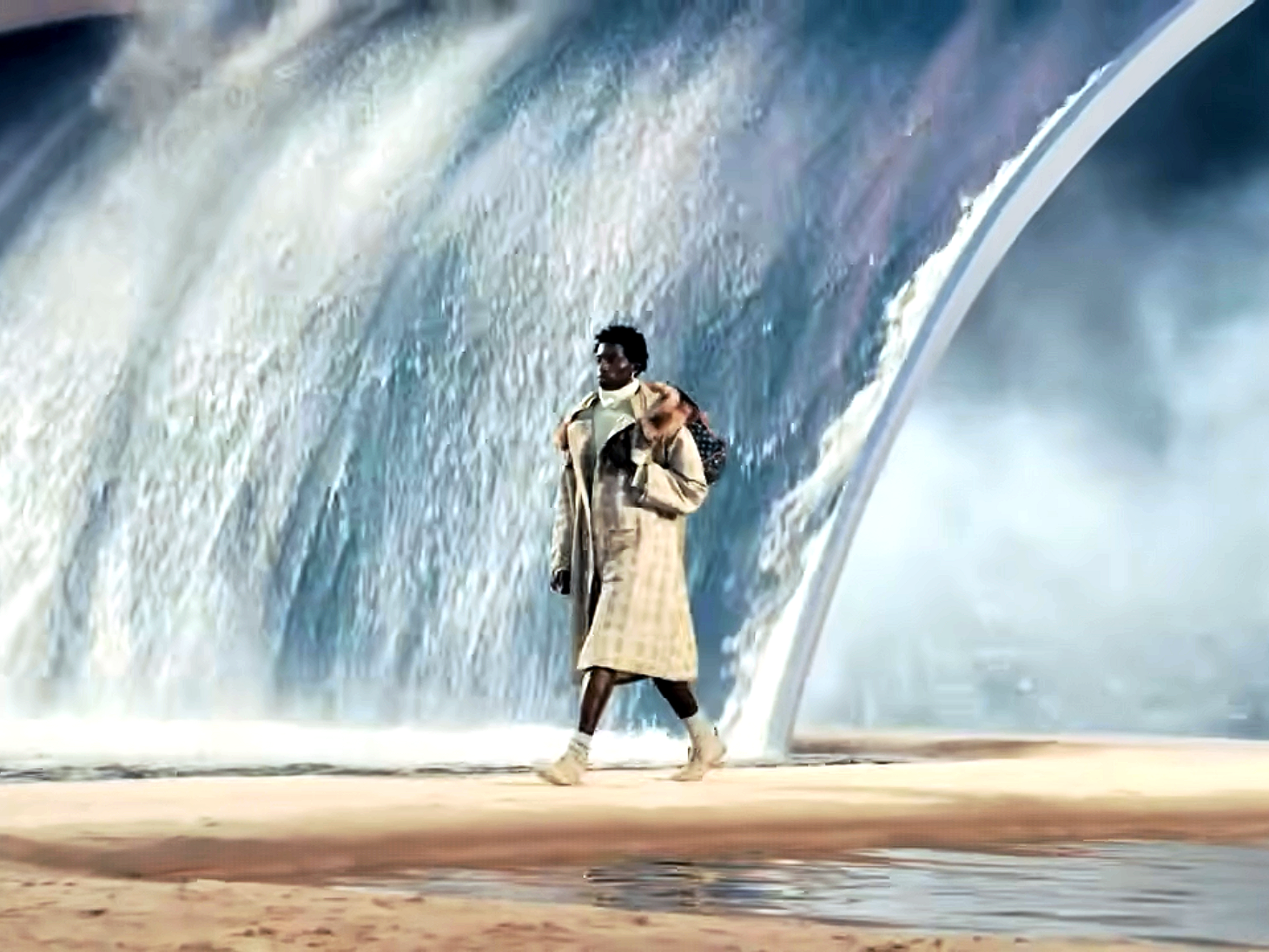
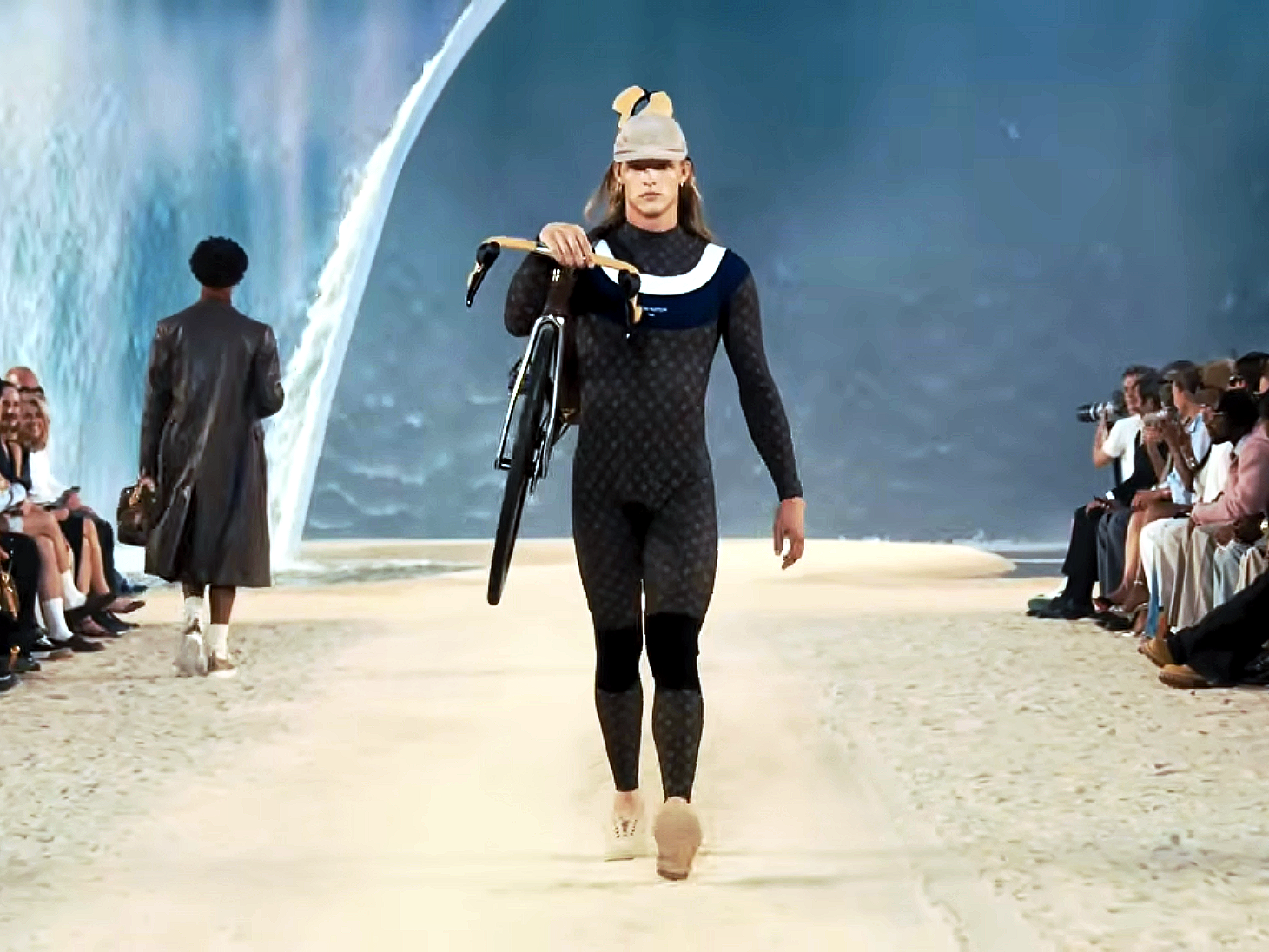
In their quest to be the world’s cultural arbiter, Louis Vuitton has snubbed Chanel’s fashion-as-theatre for its own fashion-as-evangelism. However, there is the ambient reality of the show that the brand cannot write or rewrite: the heatwave. It occurred during a period of extreme, record-breaking temperatures in Paris, with daytime readings peaking near 37°C to 41°C. Watching the gushing water was classic placebo effect, though it remained stubbornly indifferent to the fact that guests were melting. The audience and models were sweltering in the heat while watching this artificial loop of water. The miracle needed at the nearly 20-minute show was more than water, but a real heavenly intervention. Even just watching the models on our smartphone, half a world away, was enough to make us sweat. The clothes were mostly and curiously thick-looking, and many of the ensembles were layered: of the 78 looks shown, only about 8 of them were not. There were sweaters galore and even bubble coats. Were these shown for those living in the Southern hemisphere? Or has spring become longer and colder? With occasionally up to four layers in a single look, it is likely LV was just dressing up their profit margins as a fashion statement.
In an increasingly bewildered retail cycle, Louis Vuitton needs to put out ‘merch’ and sees what sticks. So, there were surfer looks, monogrammed wet suits (teamed with long coats), and actual surf boards (also logoed to the hilt—subtlety is never surf culture’s strong suit, anyway), both a first for LV, all reflecting Mr Williams’s Atlantic-Ocean-facing Virginia Beach roots. For some reason, he loves his summer to sway to an Hawaii-cana rhythm and so there were more palm prints for shirts and shorts, and embroidered on knitted vests to delight wealthy spring-breakers. And for his hip-hop community, more hoodies to look as bundled as Kanye West in summer. As usual, there was the tailoring that Mr Williams prefers: snazzy enough to swagger in. The looks, whether for the crowded beach or the music mogul’s boardroom, were all dappled with a chroma of Black dandyism that he—and his predecessor, the late Virgil Abloh—has been avidly advocating. But these are not clothes to change the world, as their respective appointments have. The hip-hop references are clear, but hip‑hop fashion’s DNA is stitched from thrift racks, not ateliers. The look was less about coherence than about layering disparate finds into a statement. When Run‑D.M.C. rapped My Adidas in 1986, they flipped the thrift aesthetic into a brand anthem. Adidas didn’t discover hip‑hop; hip‑hop discovered Adidas in the thrift‑store logic of making do. Conversely, Louis Vuitton was not pursued. They sought hip-hop. It was not just about survival—it was about dominance, and still is, whether it’s outside or not.
Screen shots: louisvuitton/YouTube.

