The spectacle-maker CJ Hendry truly plays the main character to the hilt. She demands her critics to “get well read” before daring to say anything about her, while she treats her own source material with the casual indifference of someone who hasn’t bothered to read it at all
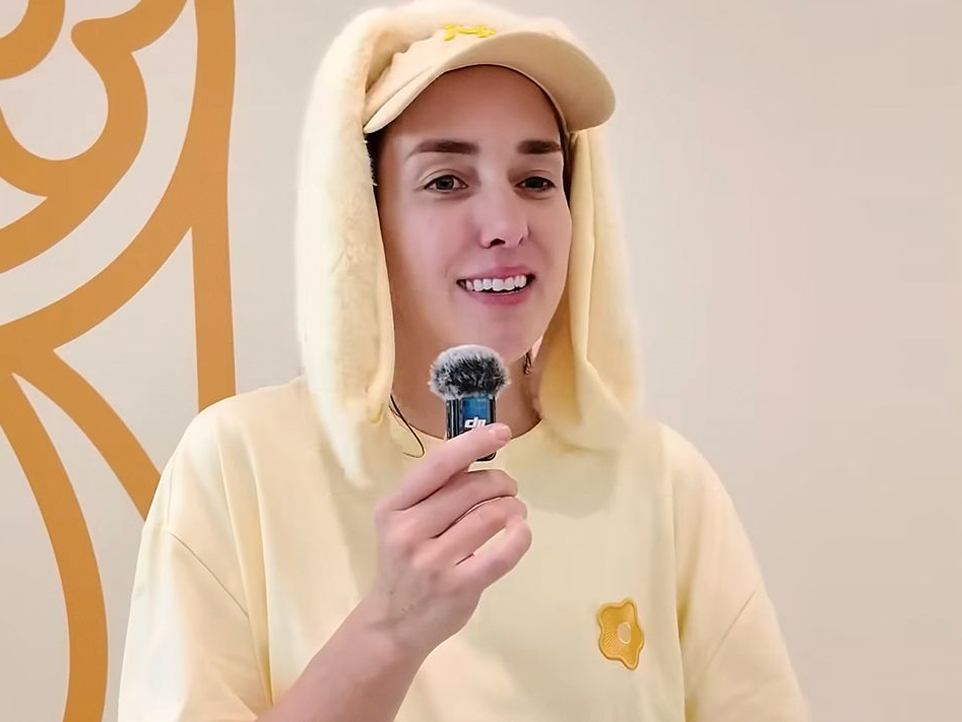
CJ Hendry answering questions from the press. Screen shot: cna/Instagram
There is a clear asymmetry in engagement when, at her installation, an artist invites the audience to look, but actively recoils when they choose to think. Five days after the end of the initially chaotic CJ Hendry’s Flower Market, the Australian artist is back with Juju World—a single character Pop Mart on steroids. While an entry into Pop Mart is free, Juju World (also at the IMBA Theatre at Gardens by the Bay) wants you to cough up a S$15 toll for adults to enjoy the privilege of entry (or S$10 for children between three and 12). After visiting the event, one Instagrammer shared a reel that pondered: “CJ Hendry just admitted that she designed Juju with AI and I have some thoughts about that”. But those thoughts and kindred others were not to be voiced, even if they were fair questions: if “Juju is meant to be a commentary about Labubu… What is that commentary?” or “Are you trying to poke at consumerism?” or “What is this (the ‘prompting’) meant to represent?” or “How is this meant to show your artistic value?” Reasonable inquiries, but the artist viewed them with all the enthusiasm of a bunny being offered a bath.
CJ Hendry replied in the comments portion, all lower case, via her official IG account: “i love using all forms of technology for my artistic practice. get well read before launching on your high horse.” It is unambiguous that the South Africa-born, algorithm-dependant spectacle-maker has created an event that is hype-driven. It’s all about the spectacle, never mind if the affair offers all the nutritional value of cotton candy and about as much air. Her use of technology as shield is a lazy and vague platitude. It avoids specificity—what kind of AI, how it shapes design, what artistic value emerges are left unsaid. Technology is invoked as aura, not as craft. But what was most grating was her telling the Instagrammer to “get well read because launching on your high horse.” It was not sufficient that she insulted the person’s lack of knowledge, she aggressively said that her art is prefaced—it is the viewer’s duty to peruse it. Don’t waste her time. What was asked were legitimate, even necessary, questions in the space of art. The insult wasn’t just personal. She was effectively saying, in her art, there is no space for thought.
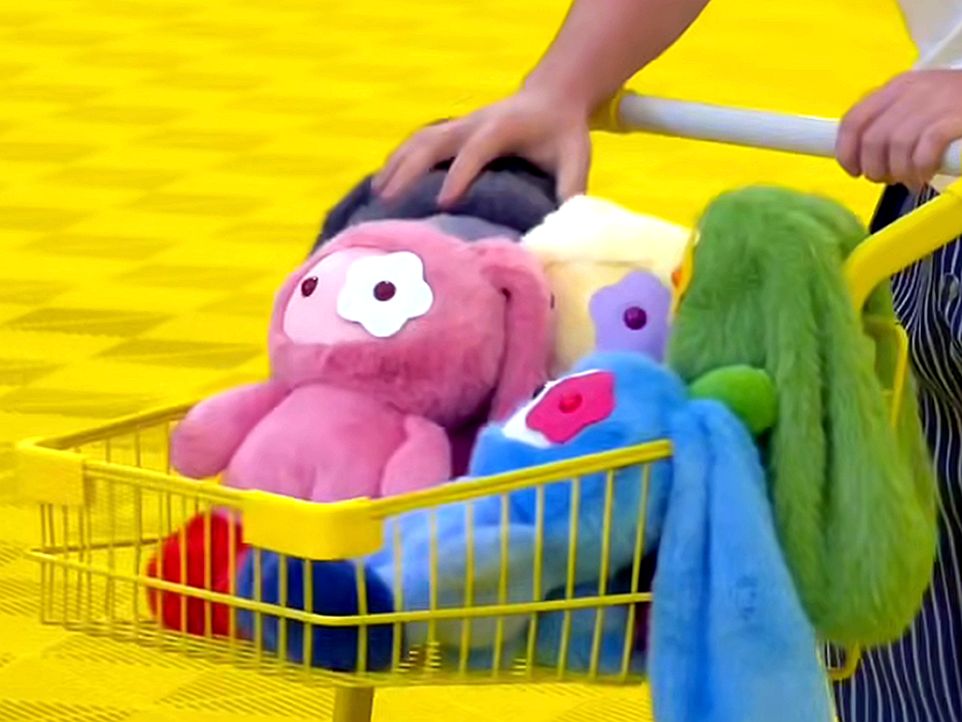
The Jujus. Screen shot: be.imba/Instagram
Her self-styled role as the narrative artist requires her to tweak history, specifically the erasure of the storytelling that she believes does not exist in the Labubu phenomenon. Dressed in her casual oversized T-shirt with the Juju World logo that could be easily mistaken for a flower from Marimekko’s Unikko, she told CNA with relish: “I don’t see Labubu as an idea or concept that’s particularly long-lasting and has a lot of story-telling.” It was not enough she insulted a visitor to her installation, she had to look down on a peer, too. She should “get well read” as well—it is a serviceable remedy for a mind that seems to be running a permanent fever of hitting out at others. To say Labubu lacks “storytelling” is factually incorrect. Lung Kasing (龙家升 or Long Jiasheng) didn’t just design a toy; he spent years building a complex, Nordic-folklore-inspired universe called The Monsters. Labubu, as fans well know, isn’t an isolated commodity; she is part of a tribe with distinct social dynamics, relationships, and histories. Each has a defined backstory and personality. Together, the characters have been expanded through picture books and illustrated series since 2015. That’s more than a decade ago. Juju was born in November 2025. Could there be more story telling in eight months than 11 years?
Mr Lung’s work is rooted in European picture-book traditions. He was the first artist of Chinese origin to win the European Picture Book Competition in 2003. Rather than the easy-to-reach prompt-and-pray shuffle, his process is a deliberate exercise in old-school wizardry: he actually reads books, wields an analog pencil, and develops characters with more emotional depth than the latest algorithmically churned-out sludge. This is not about Ms Hendry’s choice of medium. It is a fascinating display of audacity: a person relying on a chatbot for their thinking now belittles a peer who actually did the work. Labubu has a far more expressive face than Juju. It even has a set of teeth on which ‘dentures’ could be applied. Ms Hendry’s AI-created critter looks like an amalgam of Miffy, My Melody, Hello Kitty and Cinnamoroll! Juju has only one eye (an i-D mag cover in the works?) and is as mouthless as Hello Kitty, but it is the cat with more stories to tell than Juju. Yet, it is, according to Ms Hendry, Labubu who pathetically has none to share. Only a Macy’s Thanksgiving Parade to quietly leave behind. It is seemingly bleached of character. Is that what her grand “commentary” on Labubu is about—to signal to the world that, when it comes to Juju, she has absolutely nothing of substance to say?
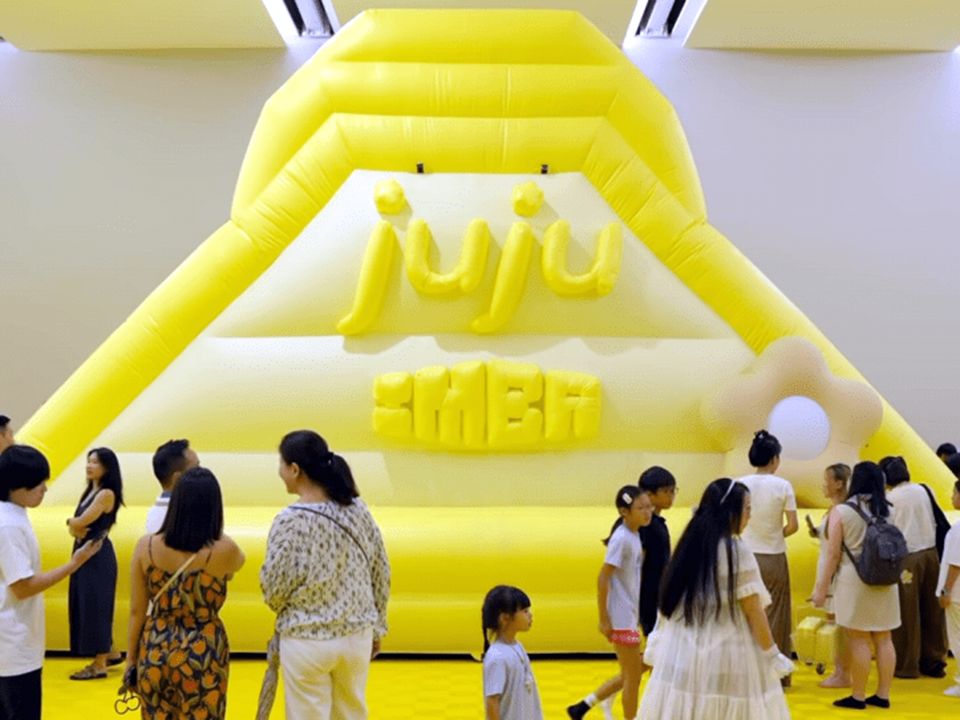
The front of the giant slide. Screen shot: be.imba/Instagram
In 1964, well before the digital-first era in which Ms Hendry operates, Andy Warhol debuted his Brillo Boxes at the Stable Gallery in New York. It completely scandalised the art world. Both critics and the public were furious, accusing him of being a con artist who was destroying fine art. Yet, Mr Warhol never insulted the intelligence of his audience or his peers. Warhol was completely transparent about his commercialism. He did not put Brillo boxes in a gallery and pretend they possessed deep, ancient storytelling. He didn’t claim his boxes were spiritually superior to those on a supermarket shelf. He was holding up a mirror to American consumerism and letting the audience think for themselves. Ms Hendry, however, attempts to play both sides disingenuously. She builds a massive commercial hype machine, sells blind boxes (the very item she allegedly also wanted to critique), and uses corporate mechanics, but then throws on an elitist “fine art” cape to insult a peer’s lifework for lacking “storytelling”. She appears to moralise about consumerism while actively profiting from it. Sensational profit-driven piety.
It is hard to tell what JuJu is really about other than that she resides in a “world”, which—when decamped to Singapore—turned yellow, a shade that a computer programmer with poor colour sense would choose. According to the event’s press release, “No one quite knows where juju came from—only that it appeared quietly”—like Teddy, Mr Beans’s trusty companion? The real story Juju World tells is not about bunnies with a flower for the left eye; it is a story about the power of the artist as an influencer, who has said that she is essentially doing these large scale events because her expensive art are sold to collectors and nobody sees them after that. By framing her pop-up playgrounds and S$39 blind-boxed toys as a generous act of making art accessible, she is operating on a deeply condescending premise: that the general public is locked out of the high-class world of art, and she is doing everyone a massive favor by lowering herself to build an amusement park for them. Except, no one asked her to. Juju World is really a tale about how you can take an AI-generated prompt, scale it up into an inflatable, charge for entry, and then deflect all criticism by dismissing your own audience as “new here” or “not well read”. CJ Hendry has clearly showed that the ‘point’ of art is in its circulation, not, curiously, its interpretation.

