The protagonist of that viral holiday dispatch—the one who graced us with her colourful critique of the local population in China—has officially entered the legal phase of her celebrity. She served up a lawyer’s letter, finally providing us with a name and a description of the scene she managed to cause. And then, an ‘apology’
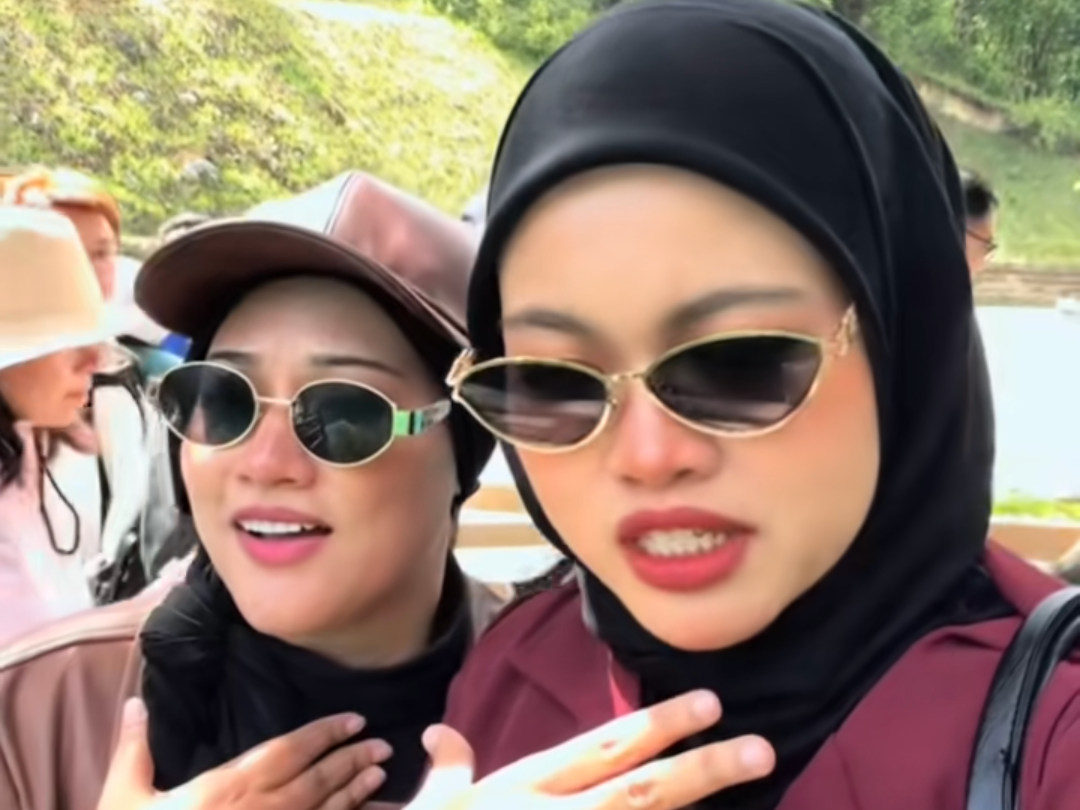
‘Ekyn.wong’ (right) and one of her companions enjoying themselves in China. Screen shot: ekyn.wong/TigkTok
Instead of allowing the digital dust to settle, she opted for the procedural equivalent of a tantrum: the lawyer’s letter. Once we had just a TikTok handle (ekyn.wong), now we have a nama (name) found on an IC: Nur Asyiqin binti Dalil. Netizens have been wondering about her username, but the “Wong” affair is a puzzler no more. The “busuk” (smelly) spectacle has hungrily consumed her anonymity. Ms Asyiqin possibly felt that the public conversation required a less nuanced and more formal, billable intervention, transforming a provincial superiority into a permanent fixture of legal correspondence. Yesterday, she posted a lawyer’s letter but the move wasn’t just about defense; it was a performance of authority. It hinted: “I have institutional backing, I can formalise my outrage.” One can only admire the dedication to keeping one’s own scandal on life support. But when you act with cruelty and then try to hide behind legalistic threats, you lose the right to claim vulnerability later, no? It’s a rather peculiar form of martyrdom, yet it is only the second act.
The lawyer’s letter was meant to project strength, but it only intensified scrutiny. No one has been able to unsee or unhear the B-word uttered gleefully in that TikTok reel; no one was able to not say tingkah laku busuk, er, buruk (ugly behaviour). Likely under legal counsel, Ms Asyiqin’s next move was posting an ‘apology’ on TikTok just past noon today. Within 25 hours, she went from wicked queen to poor princess. In switching costumes mid-play, she hoped the audience would forget the entire opening act: the appearance of the first “kenyataan rasmi (official statement)”—effectively a preface to the legal notice posted after. And then, lastly (for now), the “kenyataan permohonan maaf” or, as simply as this can be translated, a formal statement of a request for forgiveness. There is a judicial tone about it, not the minta maaf (literally ask to be forgiven) variety. The rhetorical shift is very strange. When the video went viral, she was in the register of contempt (“busuk”), then legal defence (lawyer’s letter). Now she’s in the register of supplication. Each stage escalates the formality, moving from insult to law to ritual apology. Ms Asiyiqin has outsourced her humanity to a template.
When the video went viral, she was in the register of contempt (“busuk”), then legal defence (lawyer’s letter). Now she’s in the register of supplication
Dropping minta maaf for kenyataan permohonan maaf is skipping a human act for the bureaucratic process. Strengthening that strategy is the language adopted for all three of the written documents shared on TikTok: they are not just written in Malay, but Malay legalese. From the first line of each, nothing comes from a place that’s close to the heart or head. A lawyer’s letter is inherently not written as an emotional plea. Their job is to protect the asset, not to cleanse the soul. Why Ms Asyiqin thought that the stiff, legalistic idiom of permohonan would be able to do the necessary song and dance on TikTok to clear her name is as opaque as her PR strategy—and twice as dark. Two words stand out in the last two documents: “reaski spontan” or spontaneous reaction. It’s the official explanation for her behaviour. But it’s really hard not to notice how slippery that is. In legal discourse, reaksi spontan is a stock phrase used to reduce culpability. It suggests absence of intent, lack of malice, and therefore diminished responsibility. But, as most who saw the TikTok reel, her behaviour was not spontaneous—it was filmed, edited, captioned, and posted. Calling it a “reaksi spontan” is an efficient way to ignore the hours of beautiful pruning required to make it look like no effort was made at all. That’s deliberate curation.
Sympathetic observers argue that her apology was crafted to appeal to a “wider audience”. Yet, this raises a crucial question: how can such an apology resonate in China, the epicenter of the controversy, when the very language used to disparage its people is still resolutely used? Ms Asyiqin chose the word “busuk” because she wanted to be heard loudly and clearly by her target back home. But when a simple apology is crucial, she won’t use her own voice entirely. She traded the visceral, emotive language of the kampung for the sterile, defensive jargon of a legal brief. That is the ultimate admission of cowardice. She was brave enough to use her own words to dehumanise others, but she was not brave enough to use her own words to ask for forgiveness. In the end, she didn’t apologize to the people she hurt; she submitted a document to the public record to minimise her liability. People were expecting her to ball her eyes out, but she chose acquittal rather than reconciliation. And, for some very curious reason, Nur Asyiqin binti Dalil decided to soundtrack that lawful apology with ABBA’s Lay All Your Love On Me. To demand love after showing none is to expose the hollowness of the gesture. It’s not about repairing harm to those insulted—it’s about repairing her own image at home. The stunning arc is complete: contempt abroad, shame at home, and now a plea for affection. Mission accomplished.

