A group of Malaysians holidaying in China insulted the locals by covering their noses and mouths and collectively shouting about the smell of the unwashed. The stink is now raised in a different address—back home

A bus-boarding scene in China that has gone viral. Screen shot: ekyn.wong/TikTok
Like all polarising social media reels, this one went viral faster than you can say clickbait. A gaggle of Malaysian girls was holidaying somewhere in China. As they were queueing to board a bus, someone decided to film the procedure, made boisterous by their own behaviour. As they moved towards the bus, a few of the women threw themselves into an elaborate performance of olfactory distress. The key players cupped their noses and mouths, and shrieked, “busuknya orang. Busuknya. Korang semua tak mandi ke?” Smelly people. They smell. Don’t all these people shower? We saw that video too. And it was a clear case of 夜郎自大 (yelang zitian). Literally, ‘(the king of) Yelang thinks his kingdom is the biggest’. It describes someone who is ignorant of the wider world, yet possesses an incredibly arrogant, narrow-minded, and self-important attitude. That, regrettably, was what we saw. Smugness of those who are not advantaged by experience and who possess an almost impressive immunity to the possibility of being wrong.
In fact, the Malays have an even more apt proverb to describe the provincial behaviour: seperti katak di bawah tempurung. Just ‘like a frog under a coconut shell’. Of course, the close cousin here is the Chinese 井底之蛙, jing di zhī wa” or the frog at the bottom of the well. Neither of them have the ability to turn into a putera or prince. Both are trapped in confined spaces, thinking what they see above them is the whole sky. Likewise, these tourists mistake their limited standards of hygiene and etiquette for universal truth. While immigration departments across the world may classify a tourist as an “alien”, that is no excuse for them to be alien to common decency. By loudly mocking others abroad, they trade any veneer of sophistication for a glaring, audible testament to their own provincialism. And they did not stop there. There was a reel that complained Chinese train passengers among them as noisy and another, continuing the theme of nasal violation when they described a driver’s smell or lack of it. The act of filming and uploading their insults, ironically, only magnified the smallness of their own perspective. The invective isn’t just about smell—it’s about the failure to transcend one’s own shell.
The Malays have an even better proverb to describe the provincial behaviour: seperti katak di bawah tempurung. Just ‘like a frog under a coconut shell’
Even when confronted with the reality that they are in a well, their only response is to try to accuse the sun for shining too brightly. Most influencers, aware of their own on-line misstep, stumble through a scripted, teary-eyed apology video—complete with the requisite lack of makeup and screentime arrogance—to soothe the angry masses. Not this one, identified by local media via her TikTok page, attributed to the handle ekyn.wong. These videos have since been deleted. Having realised that scrubbing her digital trail was insufficient, she skipped the performative contrition entirely and decided that the only reasonable response to her own monumental stupidity was to lawyer up. Apparently, the best defense against being a public embarrassment is aggressive litigation. On TikTok, she shared a kenyataan rasmi (official statement), beautifully armed with legalistic flourishes such as fitnah (slander/defamation), tuduhan tidak berasas (baseless accusations), and maklumat palsu (false information), while warning against tarnishing her nama baik, reputasi dan intigeriti saya or good name, reputation, and integrity. The letter was unmistakably written by a lawyer. What happened to her proclivity to “busuk”?
Smell’ is a remarkably efficient word. It possesses an innate talent to offend the senses before it even reaches the nose. In phonology (the study of how speech sounds are organised in the mind to create meaning within a specific language), the English ‘smelly’ is considered fairly mild or semantically neutral. The Chinese ‘臭 (chou)’ is concise, a quick stab of disgust but it’s gone. But the Malay busuk feels more bodily, with the ability to linger, like cheap perfume, especially how it was screamed out in that video. It doesn’t just describe odour; it dramatizes rot, decay, and foulness. Her lexical choice is, however, telling. We note that she and her travelling companions could have used the word berbau, which in Malay is gentler, almost clinical: it simply means “to have a smell” and, more importantly, it can be uttered without moral weight. But she reached for busuk, which is far harsher, more visceral, and phonologically loaded. She wasn’t describing, she was attacking. Beyond the phonology, busuk is better used for something not trivial. In Malay usage, one does not casually say a room is busuk unless it’s truly rotten. For something trivial, you’d soften it with berbau or ada bau. Or, at most, bau berat (heavy smell). Calling someone or something busuk implies a deep, structural rot—hati busuk (rotten-hearted) or perangai busuk (foul temperament) being the most common extensions. It often carries the weight of moral putrefaction; it is evaluative, condemning, and heavy with connotations of rot, decay, corruption.
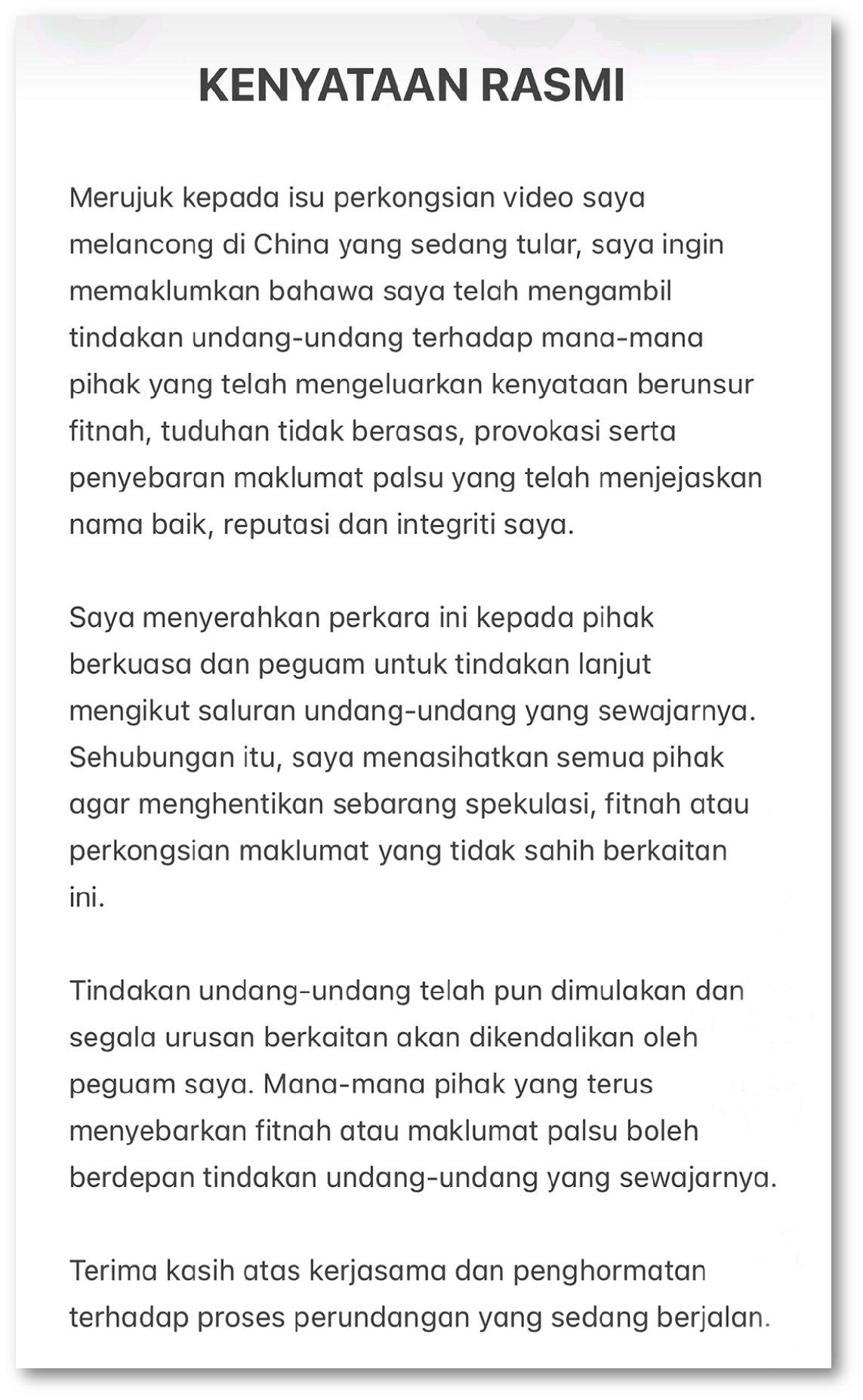
The “official statement”. Screen shot: ekyn.wong/TikTok
As seen in that video, her insult wasn’t just verbal, it was embodied. The word busuk screeched the phonological and semantic weight of rot, but she amplified it with gesture: cupping her nose and mouth, waving a hand as if shooing away flies, but theatrically fanning off the “busuk”. That combination of word and gesture turned the insult into a multimodal performance of disgust. And when she used the word again—while seated next to the driver of the mini-van—to re-enforce the revulsion she felt during the bus queue, the onset was a blunt ‘b’ and a protracted ‘suk’ (that came across as a ‘sok’. The ‘u’ sound did not allow the lips to open up as the ‘o’ did, which allowed the word to come out forcefully)—the ending was a guttural scream of horror at an unbearable pong. Covering the nose and mouth is a universal sign of foulness, a signifier that the viewer is trained to read immediately. By exaggerating it, she and her friends dramatised the assertion that the boarding commuters were unbearably odorous. Waving a hand to dispel the smell was not functional—it didn’t remove odour. It was symbolic, a theatrical gesture that made the insult visibly unambiguous to others. It is easy to see both the verbal and the gestural as coordinated contempt. The word busuk set the tone, but the gestures embodied it, making the disdain legible to both the immediate audience (commuters) and the mediated one (social media viewers).
Additionally, we can’t help but also notice the cowardice in their rabid exercise of putting down a people. During the bus-boarding incident, they screamed entirely in Malay with only two phrases in English. The disparagement was hurled at those who did not understand the language. They cleverly insulated themselves from direct confrontation, enjoying the thrill of insulting others without the risk of being challenged. This is appealing to two audiences: those present who were none the wiser, while performing for those back home who could. But in Malaysia, if they thought their flagrant (not fragrant) outburst could pass as cheeky entertainment for a domestic audience, they were sorely shocked, enough to issue the official statement. She is essentially saying, “I do not owe you an apology; I can offer you a lawsuit.” It’s an attempt to silence the conversation by shifting the battlefield from the social sphere where she was judged and found wanting to the legal enclosure, where she hopes to leverage fear. The most telling part is her request for “penghormatan terhadap proses perundangan” or respect for the legal process. While she and her friends 坐井观天 (zuojing guantian)—sitting at the bottom of their wangi (fragrant) well, looking at the sky—what respect did they offer the people of China? Or the Chinese of Malaysia? Perhaps, in her kota or kampung, the sky is only as large as the opening of the well.
 Style on the Dot