Donald Trump was in Versailles’s famed Hall of Mirrors, but what he caught was the infinity-mirror image of his own ego
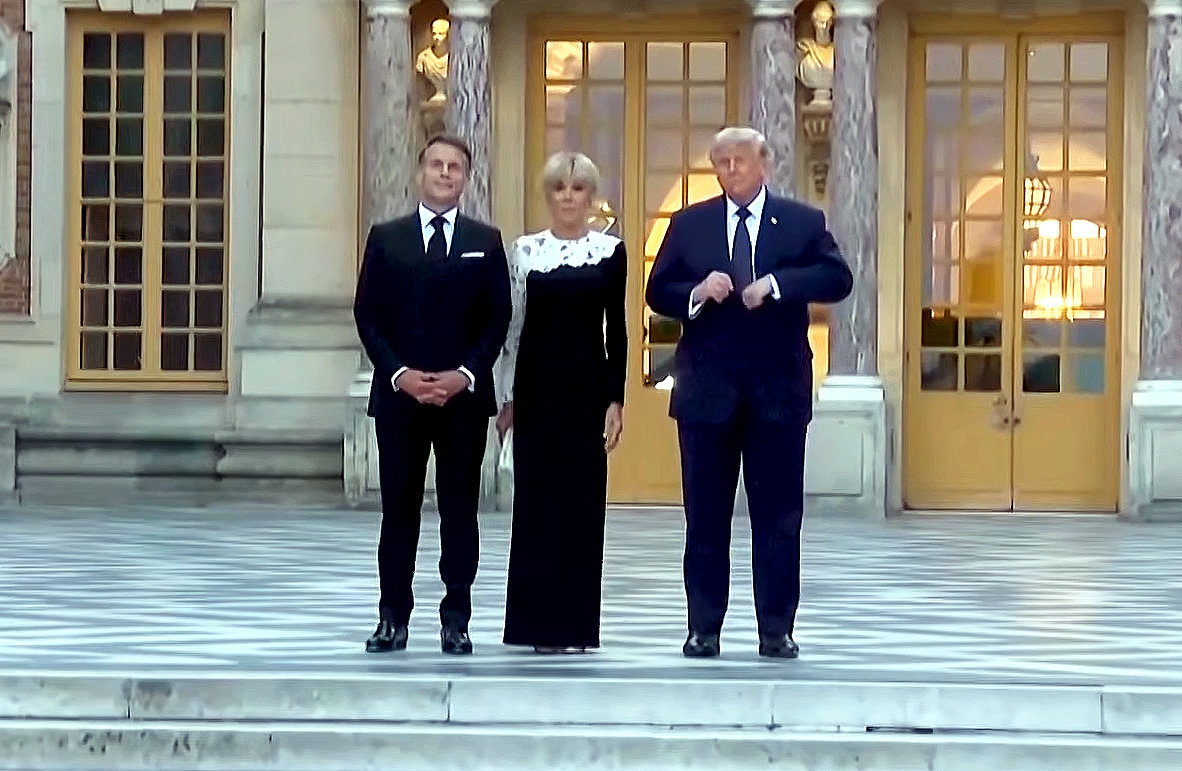
Emmanuel and Brigette Macron with Donald Trump outside the palace of Versailles. Screen shot: apt/YouTube
Donald Trump finally made it to the wellspring of his collective wet dreams: Versailles. At the recent G7, the French president Emmanuel Macron and his wife hosted Mr Trump to a private dinner at the lavish palace as the closing act of the summit’s theatrical engagement. Before they sat down to eat, the American president was given a personal tour of Versailles, including the famous Hall of Mirrors. One can easily imagine the gold-monger saying, “I should have created this. If only I could bring this back to the White House as my big beautiful ballroom.” For someone whose fame is tethered to pure gold-toned or plated and leafed interiors, the experience was likely nothing short of orgiastic. But Mr Trump, however much he surrounds himself with gold to signal power and timelessness, would, we suspect, be forced to acknowledge that his version of gold is merely a replica of a concept he didn’t invent. To stand in the Hall of Mirrors or anywhere in the palace, where the gilding is a byproduct of power, rather than the primary source of it, would be the ultimate aesthetic demotion.
There is a distinct, dry comedy in the idea of someone who prides himself on his ‘gilded’ branding being confronted by the Hall of Mirrors. In Mr Trump’s world of Mar-a-Lago-marvelous, the gold is meant to overwhelm the viewer instantly. At Versailles, the gold eventually recedes into the background, overshadowed by the scale of the architecture and the terrifying reality of absolute monarchy, even at the in-residence Royal Chapel. It’s the difference between a staged photo-op and an institution. We have largely migrated away from that near-hysterical obsession with gold leaf, opting instead for interiors that do not treat every square inch of molding as an opportunity to bellow about their own importance. We have mostly moved away from that frantic, high-decibel aesthetic, which may explain the continued preference for Scandi or Japndi aesthetics, and why Casa Armani continue to appeal to the wealthy. Mr Trump, instead, went rogue Tony Duquette, channelling a version that’s resolutely vulgar. In Trumpland, anyone harboring a penchant for negative space should be sent to a state penitentiary to enjoy the beautiful bareness.
To stand in the Hall of Mirrors or anywhere in the palace, where the gilding is a byproduct of power, rather than the primary source of it, would be the ultimate aesthetic demotion
Reportedly, no photographers were allowed in Versailles this evening, but somehow a few images were captured and released to the media. Mr Trump, in his usual lumpy navy suit but a sombre grey-brown tie, rather than the persistent siren red, looked overwhelmed by the grandeur of the gold. Louis XIV built Versailles because he figured that if you’re going to be an absolute monarch, you might as well live in a place so aggressively opulent that your courtiers forget they’re technically being held hostage in the middle of a swamp. He moved the entire government there in the late 17th century, mostly to ensure that everyone was too distracted by the gilded ceilings to notice who was actually pulling the strings. Back then, the court effectively decamped for the swamp, Mr Trump, conversely, @created a deeper and more sprawling one in Washington than what he initially said he would “drain”. Versailles was intended as a dazzling setting to project the power and majesty of the French monarchy, especially by Louis XIV, who supervised its construction and installed his entire government there in the late 17th century. Mr Trump tried to do the same with the White House, but he has spent his terms in office wearing a costume crown and suddenly he finds himself in the presence of the actual thing.
The president told the media: “Versailles is not gold leaf—Versailles is the real deal. I’m a fan of beautiful places.” It is not known how many other palaces he has visited, but this was, as we comprehend it, Mr Trump’s debut in Versailles—at 80. More irony ahead. Versailles is the archetype of the builder’s ego, yet for someone like Mr Trump, who endlessly and gleefully brands himself as a “builder”, an eight decade absence of a Versailles pilgrimage is rather odd. Mr Trump is not interested in history as a discipline (can he tell Louis XIV and XVI apart?) or inheritance; he’s on enthusiastic about monuments as future proof of his own myth. But when we understand that he’s less interested in the lineage of monumental architecture than in the spectacle of his own projects, perhaps we may see him as “a fan of beautiful palaces”. But Versailles is a humility trap; it demands you accept you’re merely a footnote in someone else’s history. That doesn’t work when your brand is being the biggest thing in the room. Mr Trump isn’t building for the ages—he’s building for the buffet line. It’s not Versailles; it’s just Vegas with better (political) branding.
But Versailles is a humility trap; it demands you accept you’re merely a footnote in someone else’s history
While he called Versailles “a palace”, the French calls it a château (Château de Versailles), rather than a palais (as in Palais du Louvre). Sure, the Louvre was a former royal residence (turned museum, a repository of art and history), but Versailles, by contrast, is the château par excellence—a 3-D stage, a vivid diorama for absolutist power, ritual, and the performance of sovereignty. A château encodes intimacy with power, the court as a living organism, while the palais encodes grandeur, permanence, and institutional authority. One is a stage snd the other, seat of the nation. Trump collapsed these distinctions when he calls Versailles “a palace”, which to him, is just shorthand for gold opulence. But in French usage, the difference is a taxonomy of power: Versailles as the theatre of monarchy, the Louvre as the palace of the city and eventually of the nation. His inability to parse that nuance betrays his lack of historical literacy—he sees only spectacle, not the coded registers of authority. This is rather the MAGA style: the indifference to scholarship or semblance of historical literacy. The whole movement thrives on blunt spectacle, slogans, and the fantasy of power rather than the patient work of understanding lineage or context. Versailles would never have the equivalent of The Claw and cage of the UFC.
Even without that engineering monstrosity, Versailles was the only bait strong enough to keep Mr Trump from bolting mid-summit. One must hand it to Emmanuel Macron; he recognised that if you want to keep the world’s most powerful man interested long enough, you don’t offer policy, you proffer a “palace”. Versailles is the ultimate stage of sovereign power, and Donald Trump, with his obsession for spectacle, would have been at pains to resist it. By staging the dinner there, preceded by a personal tour of the Hall of Mirrors, Mr Macron ensured that his presidential guest would linger. The lure of “the real deal” would have been irresistible to an octogenarian who not only thrives on gilded optics, but relishes to bathe in the ornate excess. The chance to view Versailles’s rituals and beauty effectively bound the American president to the Summit’s choreography. Mr Macron knew that Mr Trump would crave the photo op, the vibe, the association, and that desire would keep him anchored until the end. He is the ‘gilded zookeeper’ who knows exactly what shiny objects will attract his guest. Versailles became not just a dinner venue, but a diplomatic instrument of seduction and a golden leash wielded as hospitality. Deliciously devious.

