After a year of cross-continental drama, the Prada chappals now in stores are more cultural posturing than desirable utility
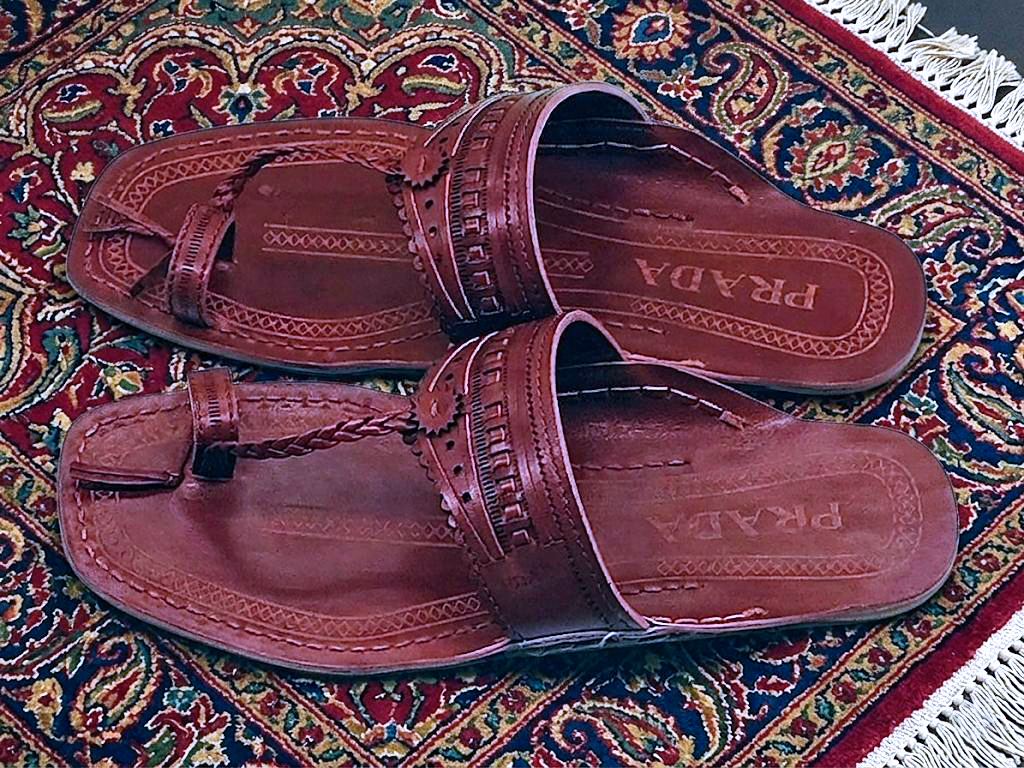
We’ve been wanting to meet Prada’s Kolhapuri chappals, but fate, the busybody, has conspired against us until it ran out of petty obstacles. Near a Prada store recently, we decided to pop in to see if we could meet the Indian slippers face to face. And there a pair was. On the four-shelf display unit, the twosome lie neatly on the lowest, keeping company with other less-covered footwear. The chappals were identifiable from a distance—a familiarity that brings the same smile to our faces as a Bollywood song. Finally launched in April after nearly ten months in the spotlight for not initially crediting the source of its design at its runway debut, Prada’s most talked-about men’s footwear in recent years entered the market here with considerable discretion, anxious perhaps that a louder arrival might invite actual scrutiny.
Not long after Prada announced the global launch of the origins-unambiguous chappals, we did go to a store to see if they arrived. On the Prada website, it was not listed yet. When we asked an SA if the Kolhapuri chappal were in stock, the very young chap looked at us quizzically: “What is that; what are you looking for?” We repeated ourselves, yet he remained somewhat unburdened by the concept of awareness. He wielded a notebook and told us he will “check”. We almost offered to spell chappal for him, but chose restraint—it fits a Prada store. He scrolled down a page with images of footwear, but was unable to locate the object of our curiosity. It was hard to put any pressure on the fellow when the item was not even in the digital inventory system while it was actively being promoted in the media cycle. Those who spend enough time on a digital screen would identify that as a lag.
The chappals were identifiable from a distance—a familiarity that brings the same smile to our faces as a Bollywood song
We took the chappals in our hands. Not only did it look exactly like those easily found in Kolhapur and elsewhere in India, it felt like them too. The details were familiar, right down to the toe ring, which admirably did the heavy lifting for the chappal’s ethnic identity. Apart from the oversized Prada logo, debossed on the footbed, there was nothing Prada about the slippers. This was surprising to us because we thought that, since Indian artisans were sent to the brand’s atelier in Italy to train, the chappals would be Prada-fied, but they were not. When we ran our fingers along the edge of the strap and the toe ring, it felt hard enough to be registered instantly by the skin of the foot. Under the sole of the chappals, there was the clear emboss of “Made in India”. Its neighbour, a pair of thonged slippers, did not enjoy a stated providence. The SA who had silently trailed us offered no introduction to the footwear that we clearly showed interest, perhaps a fervour she found suspicious.
Both experiences spoke nothing about what we thought was Prada’s commitment to the narrative they sold to the world: cultural engagement. It seemed to us that adding a nuanced, GI-tagged, Indian-made collaboration to their inventory forces a cognitive dissonance that, regrettably, the average retail training program wasn’t built to handle. A trainer would certainly call it “missed opportunity”. It is also unclear why Prada produced a replica, choosing to revive rather than to re-imagine, especially when they had the South and Southeast Asian markets in mind. We suspect no Indian will clamour to drop a four-figure ransom for the chappals. It is, therefore, probable that they are meant for wealthy Europeans and clueless Americans looking for exotic novelty, rather than the community that holds the living memory of the craft itself. Prada likely appreciates that their customers view origin less crucially than the aesthetic of discovery. If the narrative is complicated, keeping quiet is definitely more prudent.
Prada ‘Made in India x Inspired by Kolhapuri Chappal leather sandals’, SGD1,330, are avaiable at Prada stores and online. Photo: Jim Sim

