Hong Kong school principal Lee Cheuk-hing traded his career for truly colourful vocabulary. And his professional close isn’t pretty
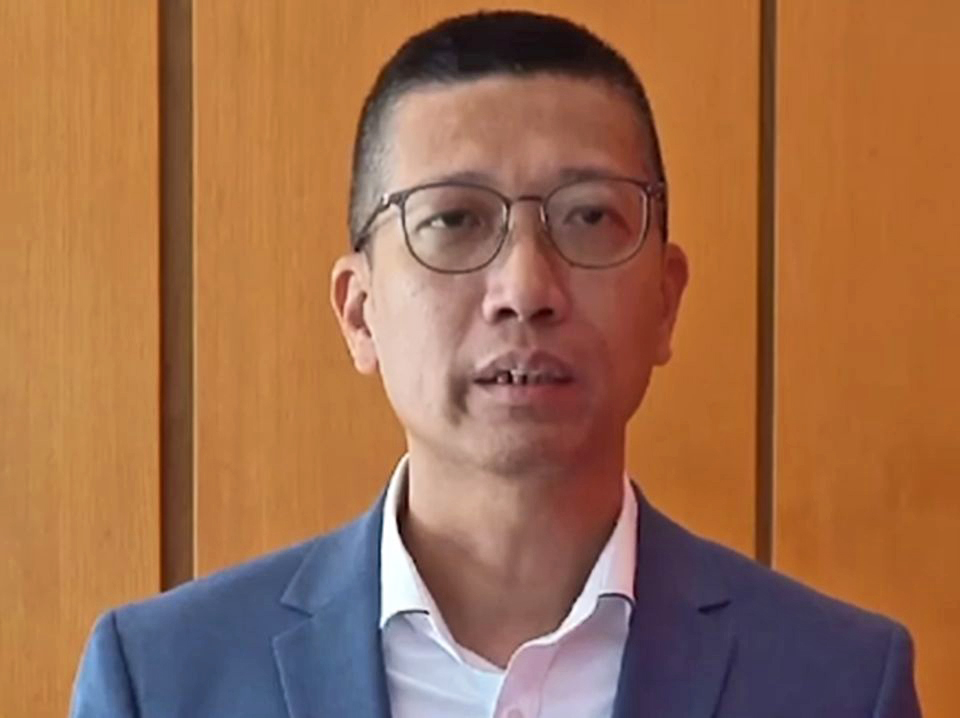
Dr Lee Cheuk-hing in the apology video. Screen shot: rthk/Instagram
Note: the following contains vulgar text in Cantonese. Proceed with extreme caution
Nothing puts decades of national educational benchmark in perspective quite like a twenty-six-second handphone video. This one went viral faster than you can say 校長 (hok cheung) or school principal. And that is exactly who Lee Cheuk-hing was—at least at the time he was captured barking the one-time street vernacular of Hong Kong’s vibrant 庙街 (miu gai) or Temple Street to security personnel. In a display that felt less like a traffic dispute and more like an audition for Pang Ho-cheung’s 2012 film 低俗喜劇 (daisuk heikek), Mr Lee transitioned from the stentorian to the gutter without changing a thing. In that cult film, which earned a strict Category III rating in Hong Kong, it wasn’t gore or violence that defined the narrative theme; rather, it was the profanities used—not as unthinking swearing, but as an exploration of the rhythmic, highly creative cadence of authentic Hong Kong street slang. Mr Lee would have easily fit right onto that set.
In Vulgaria, the profanity is celebrated as a form of gritty, subaltern cultural identity. But in Mr Lee’s case, it was not some lovable, working-class, New Territory character using the natural language of street survival. He was in Singapore, but he did not unleash his vile invective as a solo tourist. He did so as a school principal, in the presence of 35 compatriot-students. In all likelihood, those teenagers would be familiar with his coarse rebuke. But this was not just a vulgar attack, it was vulgar mockery. What transpired had been reported, but not what was said and the actual reaction to that. The security guard had, by then, resorted to shouting; she demanded that the bus Mr Lee was to move “behind”. Instead of reacting to that command, he chose to mock her accent and hit back. His exact words to her were “閪乜嘢閪, 閪你阿媽啊?” Translating that would require a level of professional compromise we are simply not equipped for. Basically, it addresses a woman’s biology, a mother’s, in fact. Specifically, the exit gate.
He was in Singapore, but he did not unleash his vile invective as a solo tourist. He did so as a school principal, in the presence of 34 compatriot-students
The grotesque severity of his words needs to be examined. While many quarters of Hong Kong known for their expressive street language have shifted away from such profane—and ultimately abusive—language, its use is not entirely eradicated. The key word here is 閪 (which will remain unread). It is a uniquely Cantonese word with no Mandarin equivalent. It sits at the apex of what is generally known as the “Five Outstanding Profanities”, cheekily and ironically referred to as “一門五傑 (yat moon mm git)” or five outstanding talents of one school, cleverly referencing the heroic register of the 武林 (molum), the pugilist world. We will not go into the other four, lest this accidentally becomes a practical guide. But 閪 is grossly vulgar because it unambiguously refers to the female genitalia. And is often used with an olfactory adjective denoting bad smell and the noun for mother. Because it is so vile, the word is actually censored in Hong Kong’s broadcast media. 閪 is not just an extremely dirty word—it is a cultural barometer of Hong Kong’s gender politics, class divisions, and censorship battles. Its persistence despite the taboo shows how profanity functions as both raw emotional outlet and social identity marker.
Mr Lee should know all this, but knowledge alone is no guarantee of self-restraint. This is all the more jarring because he is not your average school principal. He holds a Doctorate in Education from the esteemed University of Hong Kong. This is not an isolated incident as some defending him insist. The outburst was not momentarily reactive. From the video, there appeared a deeply ingrained habit of mind. It revealed a baseline contempt for people he deemed beneath him, a complete lack of emotional regulation, and a long-standing pattern of unchallenged authority within his own professional and social domain. In the longer footage of the incident, the moment another person approached (reportedly a higher-ranking supervisor), Mr Lee instantly pivoted, changing his tone to say, in English, “Okay, I’ll listen to you. You’re very polite, I like you.” It showed glaringly that his rage wasn’t uncontrollable; it was highly selective. He knew exactly who he could bully and who he needed to placate. This was not the output of a lazy mouth.
This is not an isolated incident as some defending him insist. The outburst was not momentarily reactive. From the video, there appeared a deeply ingrained habit of mind
Mr Lee works at San Wui Commercial Society Secondary School. In Hong Kong’s three-tier secondary school ranking system, it functions primarily as a Band 3 co-ed 学校 (hok hao). It is a standard, government-subsidised local school that serves the immediate residential community of Tuen Mun (屯門), tucked away in the housing expanse of Leung King Estate (良景邨, literally fine view estate). Much has been discussed in the Hong Kong media about the broader culture of Hong Kong neighborhood school leadership and the specific socio-political positioning of his school. The reality is Tuen Wan is not Central, Hong Kong. Even Temple Street, romanticised by 油麻地 (Yau Ma Tei) gangster films for its coarse vocabulary, is cleaner-sounding today. Yau Ma Tei itself is now a hipster hub, with cool cafés and the aroma of roasted Ethiopian geisha coffee beans and toasty sourdough boules welcoming 小红书 (Xiaohongshu) influencers to “打卡 (daka, or punch card)”. Historically the underbelly, Yau Ma Tei is now the playground for aesthetic specialty brews, pour-overs, and Instagram-friendly nostalgia. But up in Teun Mun, it is another country.
The rules of spatial refinement in Hong Kong are never entirely absolute and not all of Tuen Mun reeks with the stink of foul language. There are anomalies, and one of them 南樂園 (Nam Lok Yuen) is an exceptional study in localised gentrification because it bypassed the traditional public housing density. But in certain localised, highly insular pockets of Hong Kong’s school system—particularly within struggling Band 3 institutions tucked away in public housing estates—that brand of coarse, high-volume aggression isn’t just common, it is the acceptable and unchallenged tongue. 閪 and its various expanded forms are not just occasional outbursts, they are the exclamation mark of daily life. Around the school, it functions as emphasis, as punctuation, as intensifier, as a casual greeting, and yes, as raw aggression. But there is a difference between using profanity among peers and directly targeting female frontline workers. Exporting Hong Kong vulgar street slang into a Singaporean street corner is not just bad geography, it is misplaced macho posturing.
Worse still, Mr Lee was ostensibly the primary guardian on an official, overseas school trip (not an excursion to a nearby park)—a role model by decree, if not by capability. Even if his students routinely marinate in the vulgarities of Tuen Mun’s neighborhoods, or interpreted his actions as “protecting” them, as some saw, the education system operates on a baseline assumption that educators exist to correct the gutter, not to wallow in it. Exactly six days after the incident in Singapore, Lee Cheuk-hing finally breaks his silence. He released a video via Dotdotnews weeping and bowing on cue, and issuing his standard-issue public apology, while simultaneously tendering a strategic resignation letter requesting an effective date of August 31 to secure a graceful exit. But it blew up in his face. The school could not wait. They fired him early today, on the spot.
 Style on the Dot