Behati lets its darts cry, as long as the front row gasps with delight

Tiara Jacquelina in Behati. Photos: behati/Instagram
In apparel design, or even a semblance of it, the boundary between an avant-garde streak and basic technical incompetence is remarkably thin—sometimes measuring no more than a single millimetre. That is what we have seen in Behati from day one. It is not a sudden lapse in judgment; it is a brand tradition. Behati has been delivering this structural optimism since its cheery inception in 2018. We have observed these garments under the dramatic coercion of runway lighting and subjected them to closer, sober inspection on the retail racks. While the microscopic standard of the finishing is visibly absent, a definitive post-mortem on their construction remains elusive. This is largely because there is so little construction to analyse. Behati banks on the oversized, not just the upsized. The pieces are overwhelmingly flat, vast, and capacious—less the product of sharp tailoring and more akin to hardware-store tarpaulins. To evaluate the engineering of these garments would be to search for structural integrity in a bedsheet; they require so little technical manipulation that a pillow case has more structure, and virtue.
Their design philosophy is simple: cover a multitude of sins. And by that, they don’t just mean the wearer’s body, but the garment itself. The brand remains anchored to the baju melayu (Malay shirt), the blueprint that established their entire foundation. Designer Tan Kel Wen (陈楷文) is considered Malaysian fashion’s folk hero for “modernising” traditional ethnic wear. He took traditional men’s tailoring and blew up the proportions so that the garment would elicit the description: gedoboh gila (absurdly oversized). The top half didn’t just accommodate the wearer, but completely excused him. It was—and continues to be—a wearable Hulk. The baju melayu is essentially two planes of fabric, joined to provide an enclosed space for the body to inhabit. Inherently roomy, it does not require enlarging in any reimagining of the garment since the volume is achieved not through tailoring tricks but the void between them. The baju melayu, therefore, does not require internal engineering because its authority comes from its refusal to sculpt. It’s not about forcing the body into a shape, but about creating a dignified envelope around it.
Designer Tan Kel Wen (陈楷文) is considered Malaysian fashion’s folk hero for “modernising” traditional ethnic wear. He took traditional men’s tailoring and blew up the proportions so that the garment would elicit the description: gedoboh gila
Behati’s extreme forms have been the go-to for celebrities who demand conspicuous, mockery-ready bigness for public appearances, especially when they need to ensure that their egos and their newly acquired strap-on bed can all fit into the same camera frame. Like with most of the Behati bajus, they are hard to scrutinise for structural integrity. Until recently. One of the celebrities chose to be different. Nine days ago, Behati shared a set of photos of the actress Tiara Jacquelina—born Jacqueline Eu, now bringing back the classic tale Puteri Gunung Ledang as a musical—dressed in a white blouse and black pants by Behati. Granted the rare privilege of seeing one of their contour-hugging pieces up close, we were surprised (perhaps not) to discover that the only thing holding the garment together was total faith. Immediate diagnostic concern was raised by the front vertical dart—an element that didn’t so much contour the body as cry for help. We saw a vertical seam trying to act as a fitting waist dart. Instead of tapering elegantly toward the apex of the bust to distribute the fabric’s volume, the line completely dies out in a flat no-man’s-land, well above and to the side of the true bust point. A compass pointing stubbornly north while the actual destination sits entirely to the east. It is, quite simply, a dart darting nowhere.
A dart is the most basic intervention in womenswear. Whether a bust dart or a waist dart, it pivots fabric to accommodate curvature, to contour rather than conceal. The blouse that was so eagerly shown off confirmed what we have suspected all along: the oversized baju melayu worked for Behati because it denied tailoring altogether. But once darts appear, the garment is judged by tailoring’s standards. It is no longer shielded by scale. Because that dart failed to meet the anatomical apex, the fabric had nowhere to cup or rest. Even a second dart was unable to control what the first failed to do. The mathematical calculation of the shaping was so completely wrong that the white cotton was forced to pull diagonally across the bust towards the armscye. The intersection, where the sleeve met the bodice under the armpit, was badly cut and poorly set. It was unable to accommodate the fabric when her arms rest at her sides; it completely choked and bundled. It is rare to see geometry so thoroughly insulted by a pair of scissors. A fabric does not lie; when a pattern maker tries to cheat the grain line, it will always stage a public protest.
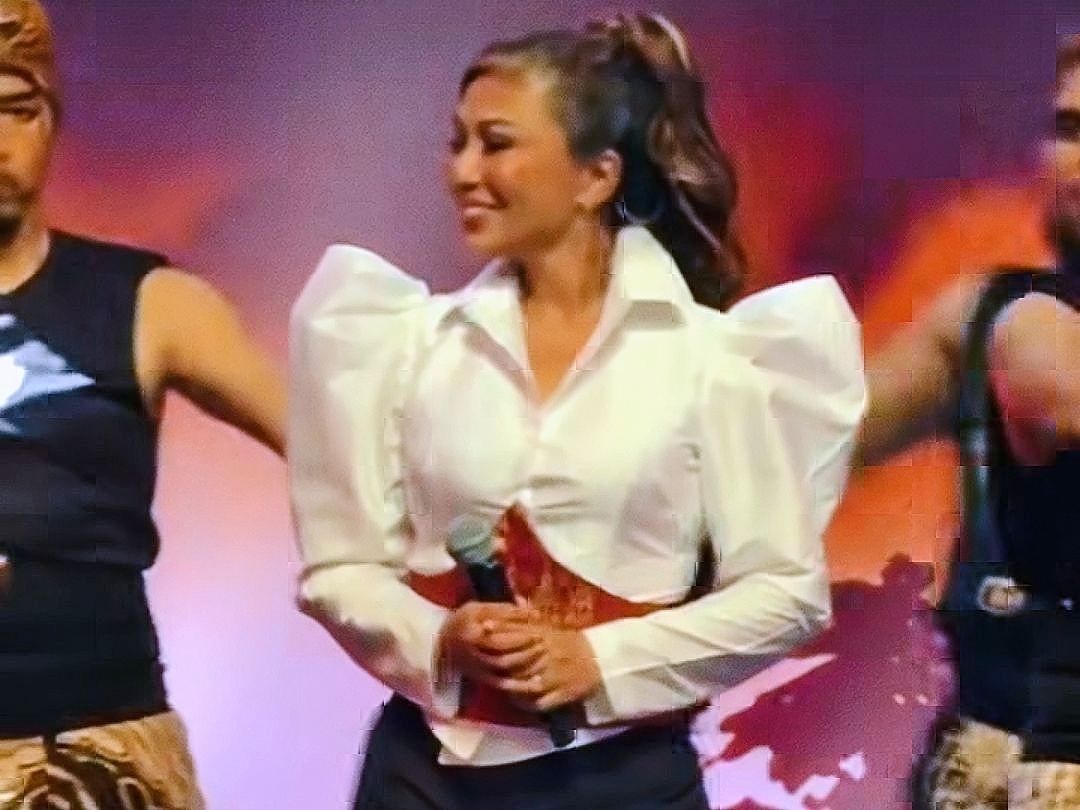
Tiara Jacquelina performing in the Behati shirt. Screen shot: tiarajacquelina/Instagram
And there were the curious sleeves. How wretchedly they sat suggested no internal scaffolding, canvas structuring, or weighted calibration was considered to give those gunung (mountain) peaks a deliberate, sculptural dignity. We were not expecting Viktor & Rolf, nor Plaza Sungei Wang. At the shoulder, they looked entirely hollow, relying purely on the stiffness of the fabric (possibly spray-starched) to stay upright and pointy. They weren’t architectural monuments; they were just inflated telinga (ear) flaps. The addition of the red and gold songket mid-section is a true puzzler. A distraction from the mess above it, the girdle pretending to be a tanjak (a warrior’s headwear) seemed to function as a literal orthopedic brace to force a silhouette that the shirt’s pattern failed to achieve. Because the baju beneath it is drafted so poorly, the hard, unforgiving structure of the songket belt is actively fighting the unguided cotton. We could see the shirt fabric buckling violently directly above the corset line. Instead of a fluid transition of form, the garment looks like a pile-up of two opposing ideas colliding mid-torso in a desperate scramble for structural stability.
The songket mid-section is another of Behati’s persistent use of the shield of “heritage” to camouflage technical incompetence. Now that they have abandoned the safety of the flat plane and entered the arena of three-dimensional engineering, it is easy to see how they have lost the match. Perhaps compatriot Dickson Lim was right: “No matter how original a piece is, if nobody influential wears it, sometimes it gets overlooked.” If anyone understands the tragedy of being completely invisible, it would be Tan Kel Wen, a master of staying in the spotlight, with the exhausting capacity to ensure you never stop watching him do it. But when you design exclusively for the spectacle, trifles like construction, finishing, and wearability are merely creative limitations. It is fashion as a magic trick: spectacular from the front row, but tragic under any form of lighting that isn’t carefully staged. Behati’s clumsy bust dart doesn’t matter in their own framework. The garment isn’t meant to be lived in; it’s meant to be looked at. And if spectacle is the point, the body is, unfortunately, incidental.
Photos: behati/Instagram

