Jared Kushner and Ivanka Trump look to convert a Balkan island into a luxury hold out for the rich, where the only thing more barren than the rock is their personality
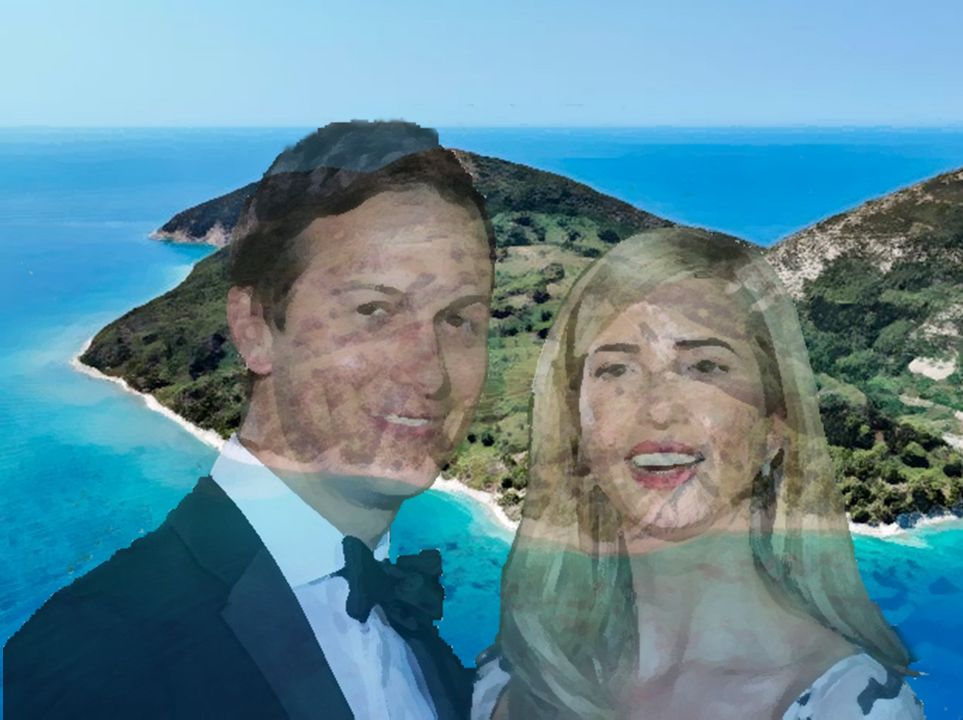
It was classic influencer speak, only the details and scale were different. In an interview on David Senra’s eponymous podcast, Ivanka Trump, who oddly looked bleached out in pink, described the exact moment she felt compelled to develop an uninhabited island in the Adriatic Sea: Sazan in Albania. “We were in a friend’s boat, and we stopped for a swim,” she enthused. “Effectively, that’s how we found it. We swam to the islands. We went on a hike barefoot all the way to the top, and we were just captivated, and it stayed with us ever since.” It was a beautifully cinematic tableau, of course—evoking a sort of The Talented Mr. Ripley glamour, where the ultra-wealthy cross sovereign seas merely to update the backdrop of their sunshine-soaked self-absorption. It was a lifestyle snapshot designed to conjure allure, spontaneity, and destiny. The only flaw in this shoeless expedition was that the Sazan island is not some pristine barefoot‑friendly Eden. It’s a Cold War military base, riddled with bunkers, rusted infrastructure, and yes—unexploded ordnance and leftover ammunition.
There is something Sang Nila Utama about her discovery story. But Sazan is not Singapura at its naming; it is sovereign soil. And among its riparian wildlife, the lion is not one of them. Moreover, one does not simply wander into a hazardous military zone, past private security, naval borders, and international boundaries on a whim. While Sazan allows tourists, it is only for day-trippers, and the entry is highly controlled. The it-was-meant-to-be resignation she sold was thoroughly lubricated by Jared Kushner’s private equity billions long before they ever wet their ankles. By framing the island as destiny—“it stayed with us ever since”—she cast herself as a passive vessel of fate rather than an active agent wielding billions. That absolves her of responsibilities. You see, the island beckoned, she merely answered. It is increasingly evident that geopolitical manoeuvres are dressed in influencer mythologies and USD multi-billion concessions are sold as barefoot destiny.
One does not simply wander into a hazardous military zone, past private security, naval borders, and international boundaries on a whim
Ms Trump’s sloppy revelation quickly provoked a singular, visceral backlash. When people look at the proposals for Sazan Island, they do not see mindful integration with nature that Ms Trump happily touted. Rather, they see the resurrection of a highly specific, deeply alarming geographic archetype: the sovereign-insulated playground of the ultra-wealthy. Little Saint James comes to mind. The current president’s daughter did not play down her project’s chosen seclusion and the extravagant wealth it will draw. Or the backroom political access— her husband casually revealing that the Albanian prime minister boarded that very friend’s boat — and the “strategic” status she and Mr Kushner are afforded, allowing fast-tracked approvals and effectively bypassed public consultation, leading to widespread outrage regarding transparency. It brings to mind one highly contentious figure tenaciously linked to her father. The news is generating protests not only in the U.S., but also in Albania, where citizens took to the streets and literally chanted: “NO EPSTEIN ISLAND HERE.”
Perhaps what is even more disconcerting is that this yet-to-be-named hideaway actively involves Aman Resorts. In an era of truncated public memory, it is worth stating that this is no longer the sanctuary bred by founder Adrian Zecha, but a totally different beast engineered by the Russian-born billionaire Vladislav Doronin, whose tenure has consistently invited corporate warfare, trailing a highly visible history of fierce ownership battles and public friction over the fencing-off of historic European coastlines. He projects the chilly, uncompromising instincts of a tycoon who treats luxury not as a philosophy, but as an exercise in total territorial control. Yet the most optically catastrophic element of this venture remains the sheer geometry of the alliance: a luxury brand controlled by a Russian-born magnate—even when he holds a Swiss passport—partnering directly with the Trump family to privatise a known militarised stronghold. That the first family is linked to Russia or Russian-born magnates is, again, conspicuous. This is not an isolated indiscretion, but a predictable pattern of entanglement that enjoys rearing its striking head, and Sazan fits neatly into that lineage.

Ivanka Trump on the David Senra Show. Screen shot: davidsenra/YouTube
To appreciate the irony of Aman’s pairing with the Trump family to build in the Balkans, we need to rewind to the brand’s birth in Asia. When Adrian Zecha—an Indonesian journalist-turned-hotelier—opened Amanpuri on a secluded Phuket headland on New Year’s Day in 1988, he was executing a quiet, poetic rebellion against Western institutional hospitality. Together with architect Ed Tuttle, Mr Zecha looked at a century-old coconut grove on Pansea Beach and chose deference over destruction. The architect painstakingly designed 40 standalone pavilions to weave around the existing trees, raising them on columns to let the earth breathe. Handcrafted by Thai artisans from indigenous woods, Amanpuri softly exhaled architectural humility. It was a resort with no front desk, no concrete blocks, and no television sets—designed to feel less like a resort and entirely like a private, ultra-exclusive monastic home. Amanpuri did not merely spawn subsequent Aman developments; it cross-pollinated an entire regional movement, inspiring the birth of Banyan Tree and shaping the vernacular of architects such as Thailand’s Lek Bunnag and the late Kerry Hill’s practice, whose enduring legacy is carried on by director Justin Hill at properties such as One&Only Desaru Coast.
It is deeply absurd yet strangely poignant to watch the ultra-luxury Aman resort blueprint—pioneered in Asia—transposed onto a former Soviet-era military fortress on a rugged Mediterranean coast. Aman properties originally coaxed their architecture into kneeling (or at least wai) before the terrain and local community. Instead, it has been forcefully transplanted by those who do not do ‘kneeling’. It is less a cultural exchange and more an aberrant mismatch. Ms Trump said to David Senra that the Sazan project would be “fully integrated into” the landscape, “almost rise from it”. Despite her mythic shoeless pilgrimage, she was totally unaware that, on Sazan, the terrain isn’t a serene teak forest; it’s barbed wire, ordnance, and bunker concrete. In truth, it is not entirely clear what Ivanka Trump really knows. Recycling Aman’s myth of tranquility without realising that on Sazan, the landscape is a minefield of history is like wearing a bespoke silk robe onto a terrain that demands combat boots—and wondering why the hem is shredded. Aman once offered humility before terrain; now, under Vladislav Doronin and Ivanka Trump, it’s about forcing tranquility onto militarised ground. Aman in Sanskrit signifies “peace”, or even “safety”, gifting the brand a residual aura of Asian spiritual calm. But as one little island in the Caribbean has already proven, real serenity may never come to stay.
Illustration: Just So


She described it the way people describe a discovery — an empty canvas, waiting. Entirely unencumbered by the inconvenient fact that the island already exists, with its own history, ecology, and meaning.
LikeLike