Vogue is not the magazine it used to be. That is known. But the the pivot from editorial authority to a digital vanity mirror has been a stealth move. Now, their writers perform totally like influencers
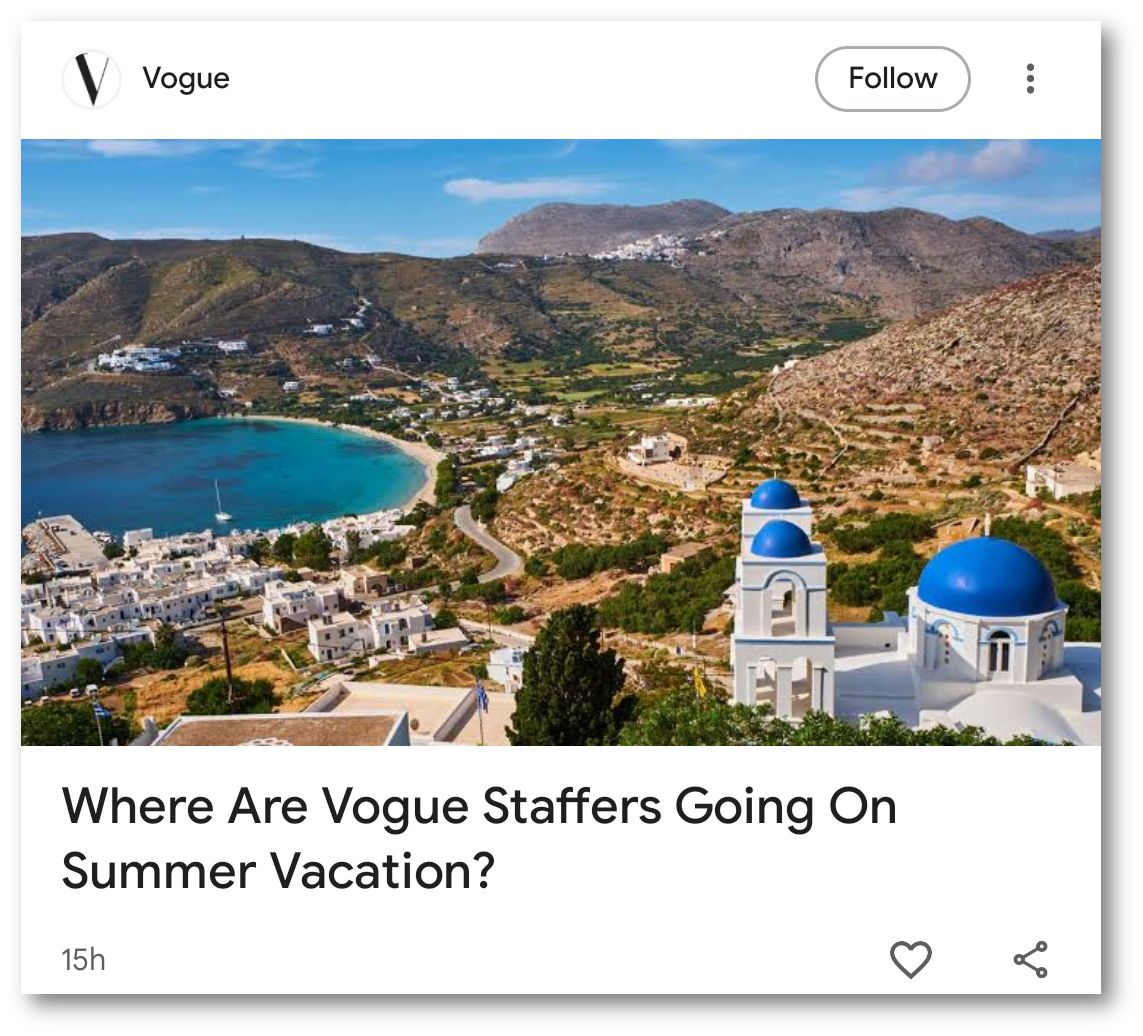
A Google Discovery Card on 2nd July 2026. Screen shot: Google Discovery
We used to buy Vogue monthly—a testament to a more optimistic era. Then, it became once every quarterly. Eventually, we settled for the diminishing-by-weight September issue, until even that ritual withered, leaving us with absolutely nothing to buy—a mercy, given that the magazine now functions primarily as a glossy platform for influencers to project their insecurities upon. This afternoon, a Discover Card appeared in our Google Discovery feed (see above). It was less the image that arrested our attention than the text beneath it—a caption that didn’t so much beckon as bellow a frantic riddle: “Where Are Vogue Staffers Going On Summer Vacation?” One would think that the fate of the free world hung on the answer, rather than the predictable itinerary of a few underfed editors heading to Puglia. It is reassuring to know that in times of global upheaval, the publication still prioritises such critical journalism. We thought it was Teen Vogue.
Why should we care where Vogue staffers go to for their summer vacation? Nobody gives a fuck where a mid-level “parties editor” or the production manager would be acquiring their sunburn, no matter how expensive the swimwear is. It is a bleak milestone in the degradation of content. Where once there was an expectation of insight or, at the very least, a coherent grasp of syntax, there is now only the frantic, breathless cadence of the content creator. They have traded the burden of thought for the currency of the “hook”. Every paragraph in that article that deserved a shoutout was structured like a performative TikTok caption, desperate for engagement, littered with forced relatability, and hollowed out by the desperate need to remain on-brand. It is no longer writing; it is merely digital busking pretending to be prose—a desperate bid for the spotlight by the editorial staff who mistake their own internal monologue for a cultural milestone.
Where once there was an expectation of insight or, at the very least, a coherent grasp of syntax, there is now only the frantic, breathless cadence of the content creator
This exposes the profound delusion of the modern fashion media apparatus: the arrogant assumption that the people who document style are somehow as fascinating as the people who create it. We do not, after all, ask where the petites mains of the Chanel ateliers spend their August. Why, then, must we endure the trite geographical musings of those whose only heavy lifting involves making things look and sound good even when they are not? Vogue has used their staffers for their ostensibly useful recommendations before, but it seems to be getting worse after they put their global chief content officer on the cover of the May issue. Once that happened, the hierarchy collapsed. If the “editrix”—admittedly a very retro word—of editorial aloofness can be staged as a consumable image, then of course a junior reporter can be churned out as lifestyle filler. That shocking cover normalised editors as the very show itself. That legitimised the idea that any staffer could be conveniently repurposed as content. A team member’s banal summer plan is just another rung in the same ladder of self‑commodification. Frankly, we would not even run that piece in a community club newsletter.
To be sure, Vogue has had their own editors express their voices. And these were minds and, crucially, the register mattered. Diana Vreeland had her own Why Don’t You…? rubric. It was whimsical, eccentric, and absolutely tied to her persona, but crucially, it was editorial whimsy as cultural provocation, not lifestyle filler. Built on her celebrity aura, it was a curated fantasy. Each line was a surreal imperative—“Why don’t you wash your child’s hair in champagne?”—designed to jolt readers into a new imaginative space. In later years, there was Andre Leon Talley, evidence that while his was a timbre of flamboyance that frequently bordered on the vacuous, it was anchored in something larger than himself (and we do mean that literally). His flamboyance was tempered by references—to archives, to designers, to cultural shifts. That gave his writing heft, even when the prose was frothy. Mr Talley was indulgent, but he was indulgent in a way that sustained Vogue’s mystique. The difference now is between vacuity as ornament and vacuity as filler. One builds aura; the other drains it.

