The long queues everywhere were gifts that kept on giving and giving, and giving, leading to stores that closed for the day or half of it. It was unadulterated global madness. But Swatch knew exactly what they were doing, and they probably relished it
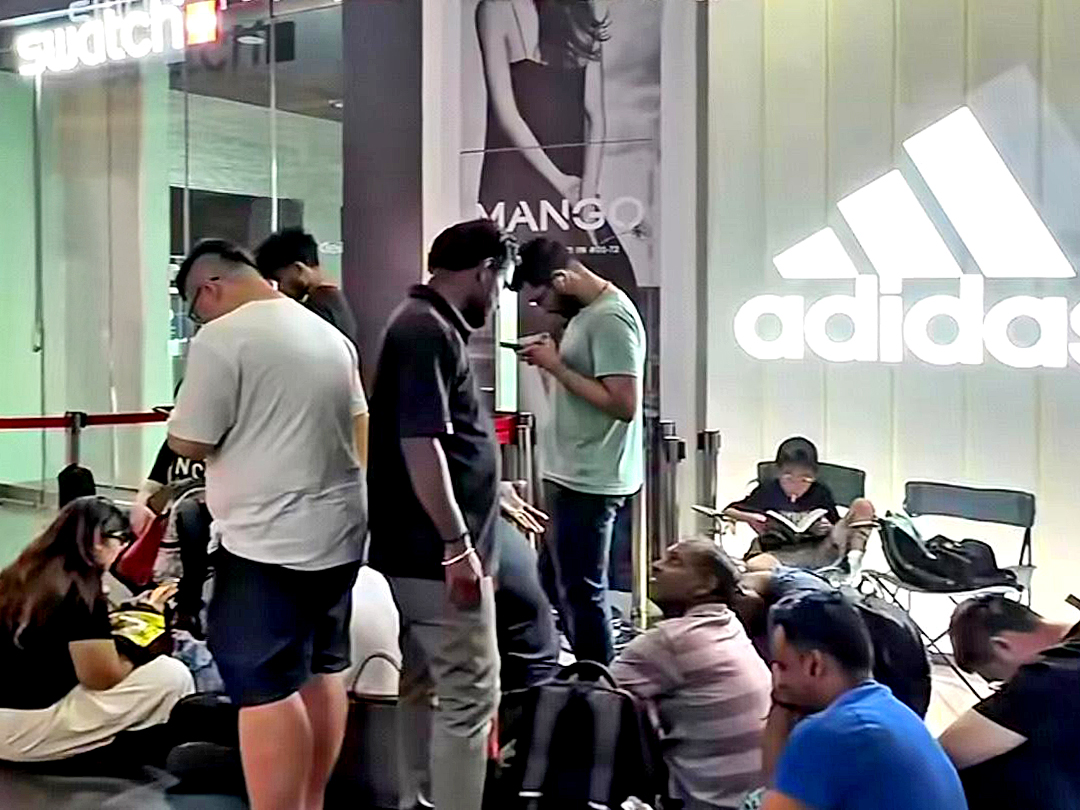
The start of the queue at VivoCity on Saturday morning
On the day itself, it was clear: the ridiculously long queues to get a piece of timekeeping plastic were real. But by the day after, images and reels shared by international news and social media (such as this) finally rendered the full picture, showing the world that the only thing more tragic than the AP X Swatch timepiece was the sheer amount of man-hours wasted waiting in line for it. Those we saw in the images and videos, who queued for hours, looked less like taste-makers and more like victims of a well-choreographed marketing heist. It was not the glamorous affair that Swatch tried to project. The “biggest watch launch of the year” that so many has called it was clearly a staged moment, where exclusivity collides with accessibility. This is a familiar script in a global retail scene driven entirely by hype. Scarcity is compelling theatre and chaos is proof of cultural relevance. For those old enough, it was Happy Meal toy madness all over again.
The launch did not just fail on our shores; it achieved a staggering, borders-defying level of recordable chaos. Even non-Swatch-fans say it was “predictable”. Can a brand keep extracting corporate value from a situation that was actively degrading for everyone else on the ground? Swatch can. Yes, absolutely. Given what we saw in person at ION Orchard yesterday morning and the situation online at MBS and VivoCity (where the store chose to close when the crowd was too large to handle), it was clearly a calculated degradation. The customers—hordes of them—were treated badly. It is not clear how else we can describe being herded into queues and holding pens, and shouted at by security personnel. Whatever question we asked one of the Swatch staffers yesterday at ION Orchard, we were met with “We don’t know”. In any corporate setting, “We don’t know” won’t let you off, scot-free. Accountability requires answers. But for Swatch, it was nothing—just a flawless, ironclad defense mechanism, a conversational dead-end: We don’t want to answer you. After an overnight camp out and roused up by rain, that was not service, it was aggressive incompetence.
The customers—hordes of them—were treated badly. It is not clear how else we can describe being herded into queues and holding pens, and shouted at by security personnel
Some people online defended the staffers, saying they were “stressed”. But the neatly-turned-out Swatch crew had a good night’s sleep in their own beds before they turned up to face the crowd. Assuming they were stressed, no one merely hoping to buy a watch should bear the brunt of retail workers’ anxiety. When genuine inquiries are treated as active annoyances, it isn’t just stress; it is an exercise of petty authority. We are rightly told to show empathy to retail staff, but a retail system that shows absolutely zero empathy to ardent shoppers does not deserve return courtesy. The system does not care that people had sat on bare floors for sixteen hours, or more. The system does not care that transit links were blocked or that the dignity of the shared spaces were being trashed. What was seen throughout the three outlets on our island was clear: staff were put in an impossible position, customers were treated as expendable props, and corporate communication was, at best, lacking.
Expecting understanding from the customers to protect a broken corporate system was not enough. At ION Orchard, in a notice bearing the Swatch logo and crudely secured with zip ties on the tape between stanchions, a sentence in a list of what was called “Queue Rules” (put up only after the barriers were erect following prior confusion of where the line should form) stood out: “The Swatch Group S.E.A. (S) Pte Ltd reserves the right to forfeit or refuse to sell to any customer who engages in unruly behavior, does not follow instructions of Swatch’s staff or FTA Security Personnel, or for any other reasons.” It was an unnecessarily lawyerly message for a public notice, but the brand initiated the mayhem, then tried to criminalize natural bodily/temperamental reactions to it. If someone cut the queue and you stood up in opposition to the insolence, trying to gain crowd support (as was the case at the walkway near Harbour Front MRT station), would that be “engaging in rowdy behavior”? That line effectively flipped the blame back where it belonged—on Swatch, not the crowd. And “for any other reasons” was deliberately left so broad that it reduces accountability to a moving target, allowing them to hit at the slightest perceived slip in civic mindfulness. If chaos is, as we saw it, engineered, calling customers “unruly” is just corporate cowardice.
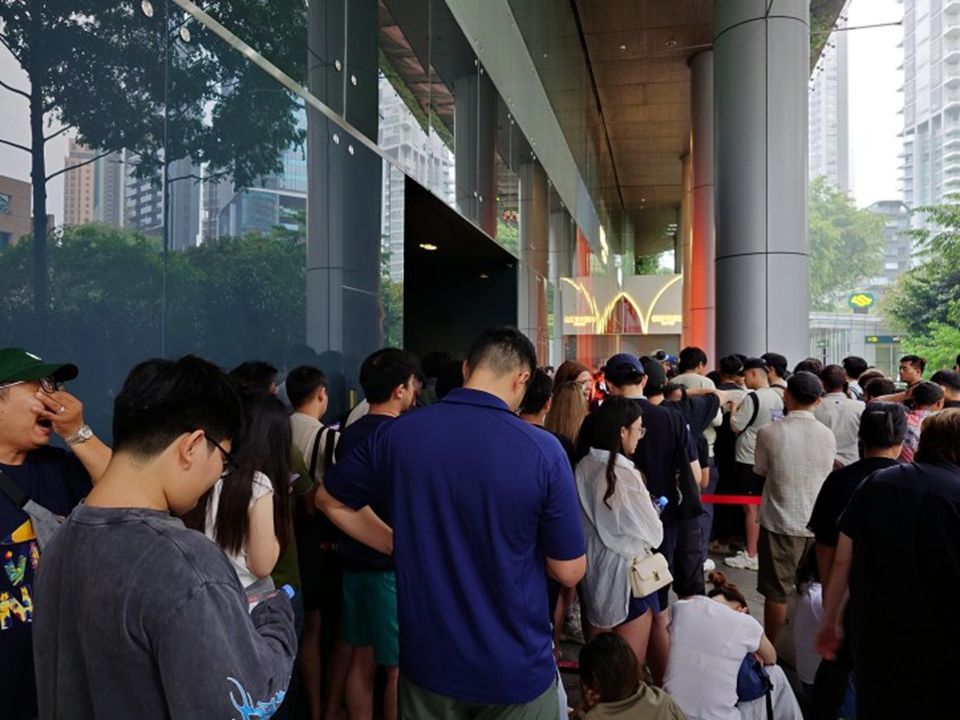
Over at Ion Orchard, the crowd was no less smaller
Three days before the launch, when we visited the store and walked into the calm before the storm, we were expressedly told by the salesman that the Royal Pop “is not a limited one”. We know that to be true because none of the previous pairings—with Omega and Blancpain—were put out hugging scarcity tightly as a production value. As far as we are aware, Swatch did not state that the Royal Pop isn’t a limited-edition products as clearly as a town crier might have. They did, however, know that it would arrive in scant quantities in the stores, so few that the number could not, at any cost, be divulged. It is hard to convince shoppers that as a producer of cheap, plastic, disposable timepieces, based on selling as many as they can, Swatch is not able to produce enough Royal Pop to meet the demand they already knew existed. Moreover, there was no mitigation strategies that could at least play down their logistic shambles. When DSM released some of their extremely limited sneakers runs, such as the Off-White x Nike Dunk Low in 2019, they conducted an online raffle. Winning fans were still able to see the merchandise before purchase (even touching the kicks). Swatch offered no such finesse or courtesy.
When the launch on that wet Saturday morning finally shed its barely-there shellac of curated exclusivity and descended into less than model behavior, particularly at VivoCity, Swatch released a beautiful statement on Instagram at around 6:30 AM: “Due to the overwhelming crowd, we will unfortunately need to close our VivoCity location for the rest of the day.” There is something really ambiguous here: overwhelming crowd or overwhelmed Swatch? The brand’s orchestration has nothing to do with shoppers’ gullibility and desperation. To claim they were overwhelmed—given the provable precedents of the pairings with Omega and Blancpain, where they had the data and the logistical experience—is feigning surprise. In our books, that’s disingenuous. Simply put, what kind of company does not think of crowd size after having done this with the same breathtaking results for the third time? In addition, Swatch wrote in that announcement: “This was a collective decision made with the local authorities to ensure the health and safety of both our staff and customers.” For a notice addressed to Singaporeans, we would not have expected it to be made with the Swiss authorities. And, believe it or not, “health and safety” isn’t a post-release afterthought—it’s a duty before the chaos commences.
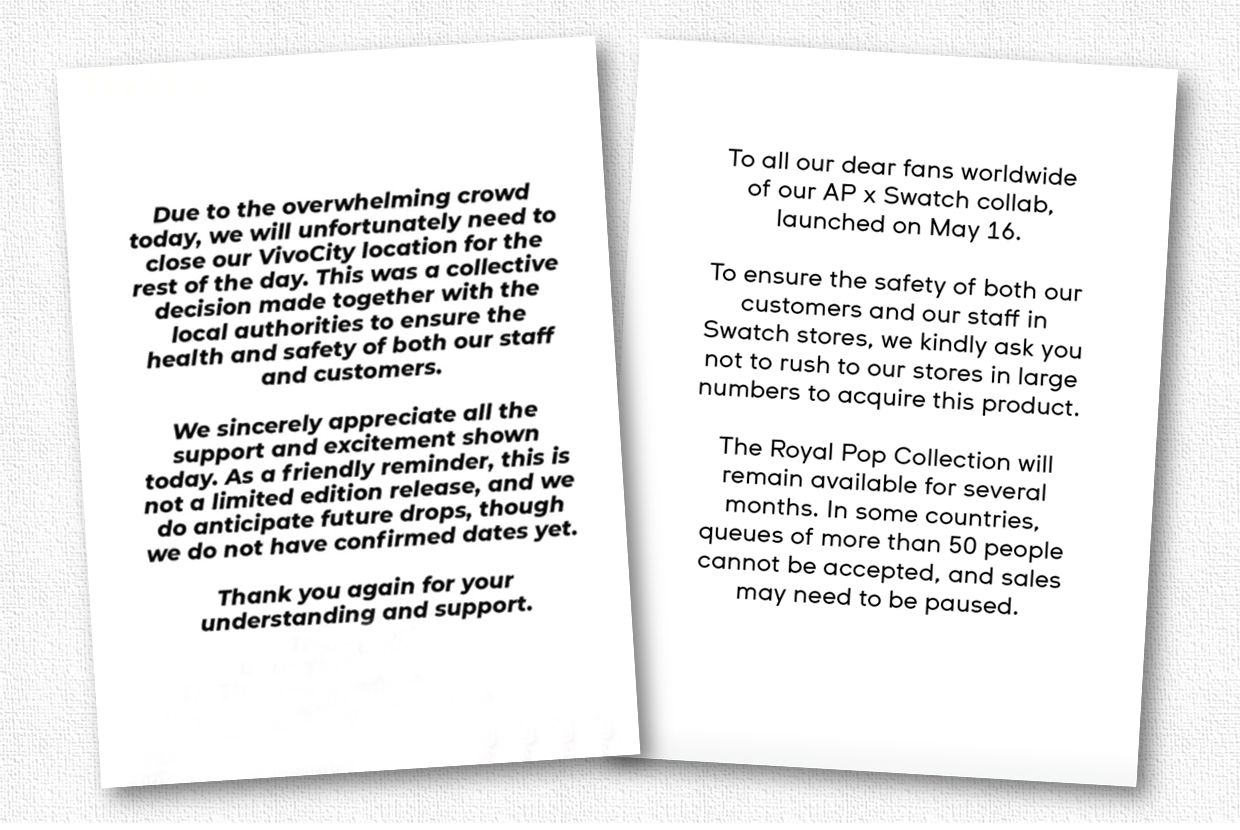
The two messages put out by Swatch after they decided they were able to deal with the ravenous crowd. Screen shots: swatch/Instagram
Of course, the madness witnessed here was not unique to our dot of a nation. We were just a sliver of their magnificent blueprint. Store closures are now reported across the globe due to, yes, the “overwhelming crowd”. Swatch eventually issued a “global” message on Instagram Stories, addressed to “all our dear fans worldwide” in a conveniently avuncular voice: “To ensure the safety [but, this time, not health] of both our customers and our staff in Swatch stores, we kindly ask you not to rush to our stores in large numbers to acquire this product.” You see, people are just 不明就里 (buming jiuli), unaware—you don’t rush to a Swatch store during a launch perceived to be “limited edition”; you skip in twos, hand in hand, and giggle like primary schoolgirls heading for the canteen during recess. Urging fans not to “rush” after spending weeks deploying every single psychological trigger designed to make people sprint is truly only outmatched by a casino manager handing out pamphlets on the dangers of gambling while standing in front of a flashing, siren-wailing slot machine.
Considering the safety of their staff, but not those working in neighboring stores is exquisite selfishness that bubbles up from a rotten core. Swatch boutiques are entirely embedded within premium, shared ecosystems, such as Ion Orchard and MBS. We do not believe they have a single stand-alone store anywhere in the world. Forcing luxury retailers, cafés, and walkways in their vicinity to absorb the physical and acoustic pollution of their engineered chaos is the absolute apex of brand narcissism. We also admire how they could go from so officiously warning against ruffians partaking in “rowdy behaviour” to the shockingly faux-affectionate, “dear fans”. The brand makeup is clear to see: 10% plastic, 90% audacity, and 0% substance. Those IG notices did not inform, rather they perform; they turned failure into admirable spring blooms. Small retailers, such as Stealplug, using engineered logistical mishap as narrative to drive traffic to a sale at their store was despicable. Swatch, similarly pitched, was not only worthy of scorn, they should be starved of the attention they so spectacularly mismanaged.
Photos: Chin Boh Kay

