The French play Lacrima peels away the glamour of fashion by training the spotlight on the plight of the industry’s workers, from Paris to Mumbai, but it really must know what to pare first
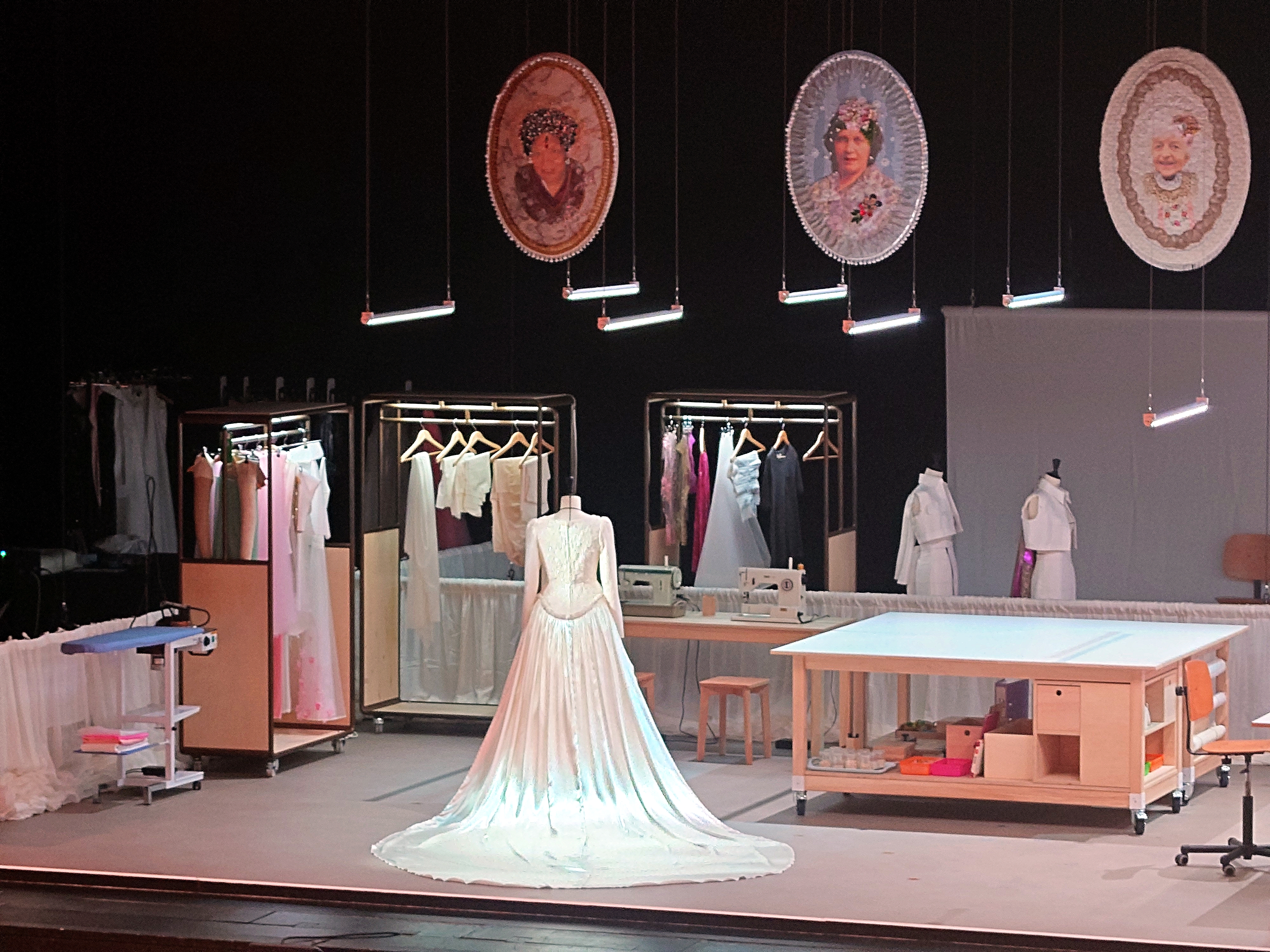
The wedding dress in the middle of an atelier meltdown
As we entered the playhouse proper of the Singtel Waterfront Theatre, an usher told us that the play would be “three hours long”, which we knew, and that there would be “only a three-minute break”, which we didn’t. We replied, “you are not serious.” She said, half-laughing: “I have never been to a play with a three-minute break either.” Has the standard intermission (typically 15 or 20 minutes) suddenly suffered an inglorious death we knew not of? I walked to my seat—which, with the legroom of Soviet-era passenger planes, turned out to be torturous for 180 minutes of a passion play—thinking it would be a forced endurance test. When that abject three minutes finally came at roughly the halfway mark of the performance, we were notified via a projection screen with a concise message that included the duration, and under it, “Do Not Leave This Room”. The play had turned into a hostage situation.
Holding theatre-goers in this manner is sadistic, no? We soon gathered from hearing unasked pre-performance chatter that “Lacrima is about the suffering of people working in fashion. The no-intermission rule is so that you can experience the characters’ pain.” Oh, the absolute drama of the fashion industry. But that was not really it. Rather than sitting at the edge of your tight seat because the true horror awaiting you would be a late shipment of organza, you were served profound, dire, existential human agony at relentless speed. At the end of the play, it received a 13-person standing ovation. We could hear the director’s apologists rejoicing: “By trapping the audience in the room, making their legs ache, and denying them a proper break, they are forced to physically experience a fraction of the confinement, pressure, and entrapment felt by the global garment workers.” Intellectual scams, we now learned, could not have been this splendidly couture-clad.
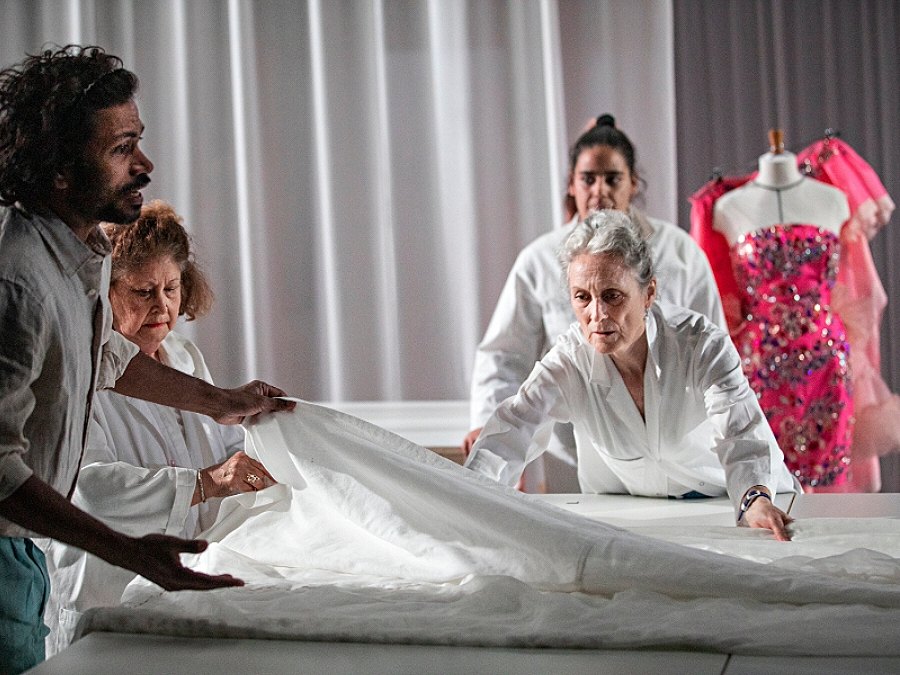
Fussing over fabric. Screen shot: digital programme
Lacrima is set in a couture atelier of the fictitious maison, Béliana, suspiciously modelled after Dior. It was hard not to come to that conclusion when you spotted the oval Dior-ish medallions-as-picture-frames and the matte grey of the walls that could pass off as gris Dior. Bélaiana is owned by an always-in-London designer Alexander Schaaf who speaks with an Indian accent, even when effing everyone off. He has a foul mouth that he uses with the ease of handling faille. You only see him in video calls with his staff. Lacrima was too busy showing how up to speed the fashion business is that the majority of the communication was done via the equivalent of FaceTime (there was even a death by it), projected on the overhead screen. If you thought you were there, like we were, to see the minutiae that characterise a maison, you’d be better off at home watching your little sister play with her My First Sewing Kit. No one on stage held an iron to smooth out even just a seam or sewed a mere inch of fabric with the two sewing machines present that turned out to be more decorative than functional. On the stage, none of the actions involved actual garment-making beyond draping one mannequin, the repeated re-tying of a sash, or dressing the sole tailor’s dummy with the same white gown à la Dior that was perpetually a finished garment rather than a toile.
We had to remind ourselves that this is a fashion story, not a story about fashion. The craft of couture is not in the spotlight—they couldn’t even bring themselves to differentiate between the flou (dressmaking) and the tailleur (tailoring). The gowns and one in particular, commissioned by a French-speaking English princess for her wedding, were not there to wow. Rather, the angry plight of the atelier staff in voluble, histrionic fervour was there for you to take in. There was a feeble attempt at capturing the seriousness of the work the petites mains did, but this was not onstage action; it was shown on the projection screen while unrelated action took place beneath. The narrative is weak “atmospheric prestige”, a heavy-handed visual shorthand meant to inject a sense of gravity, but without doing any of the actual work. A picture form of a soundtrack that no one watching a staged performance pays attention to. When you throw unexplained technical mastery onto a screen, you are hoping the audience will mistake the imagery of labour for its meaning. It was like someone else’s television left on in the background.
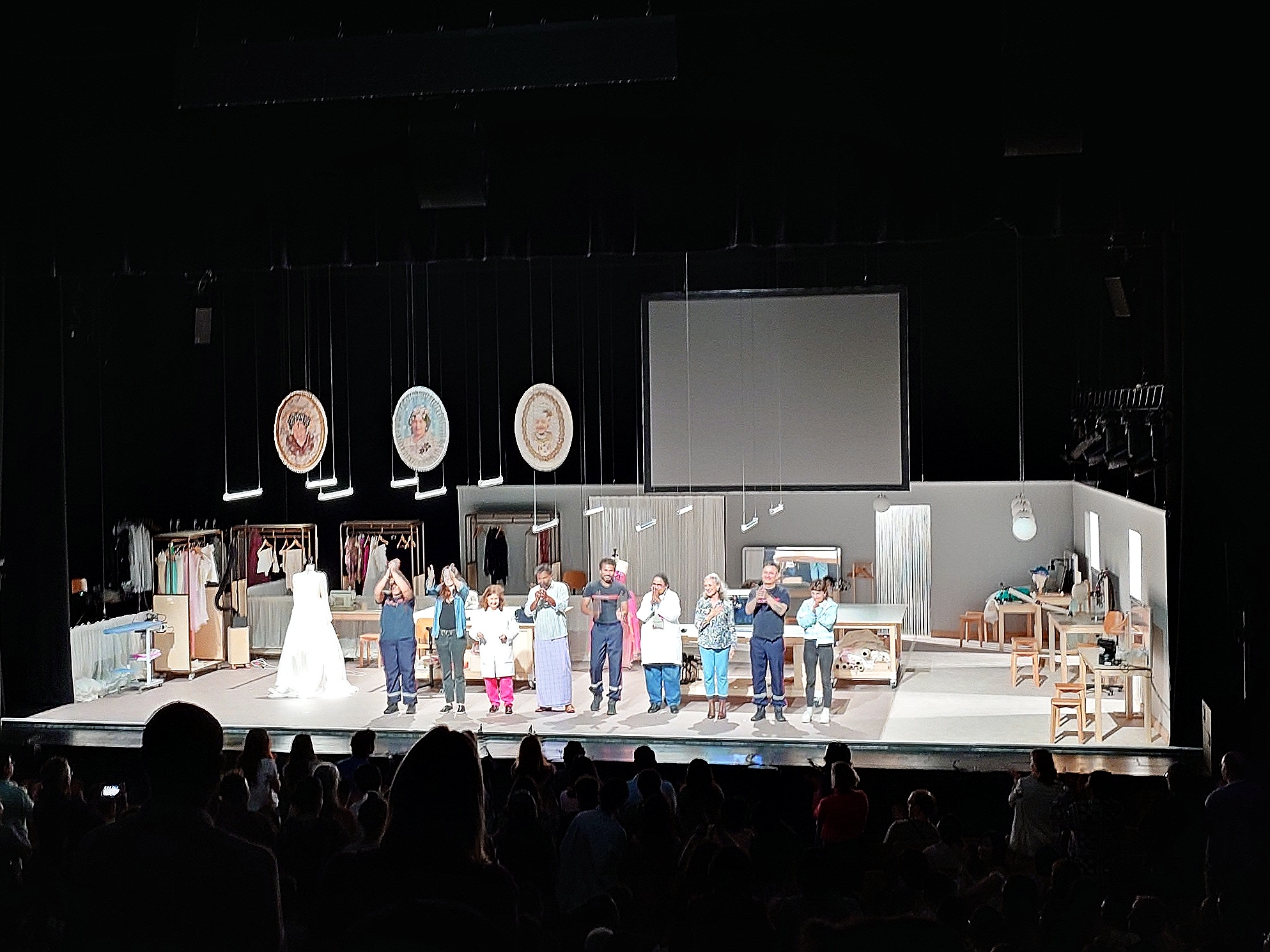
Curtain call. The nine cast member and one dress
But Lacrima is about labour—the normally unseen work in the atelier that curiously came across as drudgery. The space was circumscribed by deep unhappiness. No one appeared contented doing what they were paid to do. Rather, there was constant, loud bickering. This came on top of a tone that was relentlessly bleak. The shouting had nothing to do with the actors themselves. They were directed to bellow. You would have thought they were not remunerated, or sufficiently so. Curiously, the biggest fight was domestic conflict spilled onto the workspace. The première (head seamstress), Marion Nicolas, was revealed, from the start of the play, to have taken her own life. In the unveiling of the circumstances that led to the tragedy, it turned out that she was afflicted with personal issues (husband and daughter!) rather than professional tension. And this was the discomfort-turned-irritation we felt throughout the play, rather than the duration. Opening with Marion’s suicide was a dramaturgical ambush: it forced immediate sympathy, locking the audience into her suffering before any thematic scaffolding was built. From that moment, the play channeled all emotional gravity toward the woman’s pain. Our resistance to the narrative was the refusal to be swallowed by that manipulation. We looked forward to intellectual engagement with labour, exploitation, or gendered dynamics. Instead, we were dragged into a spectacle of suffering, habillé (dressed) as feminist critique.
Playwright and director of Lacrima, Caroline Guiela Nguyen, has become a darling of the global festival circuit. To watch it kowtow with such delight to her is to witness institutional groupthink at its most craven. From Avignon to London, and now to our own shores, international curators have fallen over themselves to shower the play with platitudes, entirely blinded by its high-minded, post-colonial marketing. Lacrima set itself up as a theatre of fashion, but it wasn’t. Neither was it about professional tension, creative burnout, or the ills of manual labour. Sure, it concurrently showed the plight of workers in Alençon and Mumbai, but these diluted the central narrative, making the parallel threads feel like ornamental global suffering, tacked on with loose stitch to inflate scope. This was, regrettably, flashy feminism for show: the women’s suffering was foregrounded, exaggerated, and, for one, terminal, while the men were either useless or granted partial redemption. When we eventually left the theatre, we felt immediate relief, even when it was oppressive outside. Three hours was not a milestone; it was one act of aggression.
Photos: Jim Sim
 Style on the Dot