Tan Kel Wen has taken a temporary reprieve from his duties at Behati to write, sing, and record a pop single. Whether this venture accelerates toward genuine craftsmanship or careens entirely the other way demands scrutiny

MV of Lari. Screen shot: KQAI/YouTube
In Malaysia, everyone and their cousin dream to be singers. And many of them do become one. Actors do, influencers do, beauty moguls do, and now fashion designers, too. Visual over-stimulation is not enough for some who work with cloth; apparently, one’s patience must also be systematically dismantled by aural assault. Negaraku’s (your country’s) purportedly unassailable proponent of “ketupat kutior (dumpling couture)”, Tan Kel Wen, has always desired to sing and he has. But instead of constraining the chanting in a room at the nearest Red Box, he has chosen to record the ordeal and make it available for assessment on Spotify yesterday. It is always touching when someone discovers an infinite well of self-belief, though one might gently suggest that choosing where to project it requires, as old traditions go, a modicum of discernment.
Mr Tan has been teasing his debut single Lari (Run) on Instagram for almost a week now. In a newly created account for his pop-pseudonym KQAI (or by the handle vinkqai), he has been sharing audio snippets of his own creation alongside self-portraits to mark his sudden transition into the realm of pop stardom. There is considerable effort to be recognised because nothing screams authentic musical breakthrough quite like pre-packaged self-mythologising and the urgent need to look at oneself while hearing the product. We lent Mr Tan our ears too, gave him the benefit of the doubt and the hope that there might be a passing acquaintance with pitch, if not evidence of a functioning larynx. Vocal artistry is, naturally, in the ear of the beholder—though one might say the exact same thing for a particularly ambitious bullfrog.

Malaysian pop’s favourite vibe: balik kampung. Photo: kqai/Instagram
Clocking in at a cinematic 4.20 minutes on YouTube and four on Spotify, Lari is a staggering pop opera of a track for a first-time published singer. It is remarkably fearless for a debut release, complete with a gripping, angsty internal monologue in the bridge that functions as a desperate pep-talk to himself. Mr Tan wrote on Instagram: “From the constant pressure to keep up, my single (Lari) stories about the endless chase of life”. He has always had a wonky way with words, both on social media and on his website. Naturally, it would be rude to let them go unappreciated. Let’s put aside the fact that a single cannot feel pressure to keep up. We have not ever listened to one that does. He must have been delighted that the subject of the sentence was missing, leaving the whole clause gasping for air. But what bugged us was turning the noun “stories” into an active, intransitive verb (“stories about”). It is classic online illiteracy—our pet linguistic sloppiness that turns “curate” into a synonym for “buy” and “ideate” into a substitute for “think”.
Written with the same linguistic quirks, the ambitiously bilingual Lari leaves one baffled by how this debut work qualifies as the output of an accomplished lyricist. Mr Tan fancies himself as a troubadour of 卧室流行曲 (woshi liuxingqu) or bedroom pop, such as TikTok sensation Yung Kai (aka Max Zhang), who performed in Singapore at the Capitol Theatre last week. Except that Mr Tan’s music veers towards a harder, almost industrial edge, trading the genre’s lo-fi intimacy—even with the opening bars of harmonica and strumming guitars—for heavy-handed production that sounds less like a late-night, confessional plea and more like a soundcheck gone salah (wrong). From a vaguely kampung folksiness at the start, the track moves with dub delay into a faux sci-fi subterranean sound that is strangely claustrophobic yet vast, interrupted by echo-y blips that could be a digital tweak of a less urgent sound of a monk striking a well-used muyu (木鱼 or Chinese temple block) in an abandoned cave.
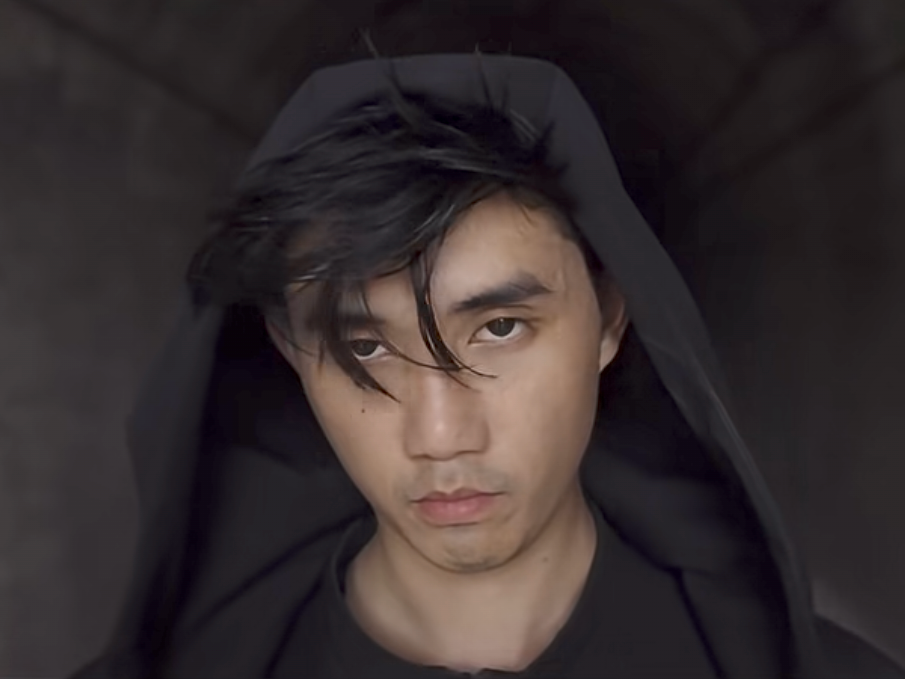
The angst of a dark lord. Screen shot: kqai/Instagram
The self-serious atmosphere is, we assume, to help us appreciate the gravity of the feelings expressed in the single: “the constant pressure”. Instead, it just feels like hard work. When we finally transcribed the song (before the “lyric visualiser” video was shared on YouTube), we could not be sure if what we had before us was a lyric sheet or a certified psychiatric evaluation printed in verse form. Four minutes to process a depressed teenager’s Tumblr draft discovered in 2012, hurriedly cross-pollinated with a corporate wellness seminar and run through an English-to-Malay Google Translate tab was too much to ask for. We bounced from sekolah rendah (primary school) Malay verb repetition (“Lari lari lari/Mana ku/Lupa lupa lupa”) straight into LinkedIn-tier motivational speaking (“Fake it till you make it/Trust the process/Trust the relapse to get there”). There’s no deeper form of introspection than rhyming an existential crisis with an inspirational no-days-off gym poster.
And then a contextual emergency: “Lari lari lari/Ku mana cari/You should not lari/ku tak de kaki”. This is visually curious: “I don’t have legs”—followed immediately by running away? We assume that is an accidental confession about his technical inability to stand behind a cutting table or operate a sewing machine, but deployed here as poetic abstraction. Stupid of us not to see a betrayal of the strong command of both languages so clearly that the code-switching does not feel intentional, clever, or culturally grounded. Was Mr Tan throwing a coin between two bahasas (languages)? There is a word for songwriting (also applicable to poetry, but not in this case) that sacrifices meaning, grammar, or logic just to make the lines rhyme—it’s doggerel. And we have another fine specimen: “Don’t break even it breaks/No more retakes”. Or, the truly audacious “Break the doors in front me/Leave the world behind me”. By the next single, with no use for conjunctions and prepositions, one could ditch the alphabet altogether and switch to a set of hanging angklung (bamboo rattle)—far lighter on those three overworked brain cells.
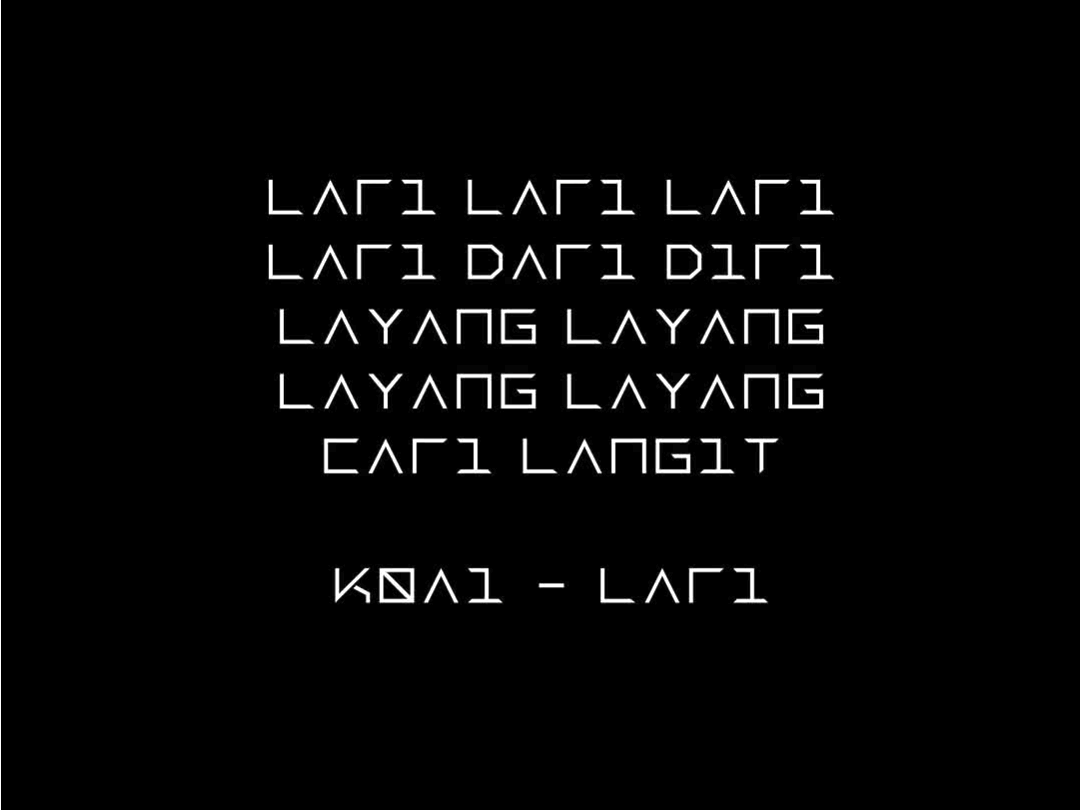
Where lyrics are available, they are in a deliberately hard-to-read font. Here, we have adjusted the contrast to make the text more legible. Photo: kqai/Instagram
Repeating “lari lari lari” some 100 times does not enhance the melodic strength—if any—of the song. Words used in repetition over a monotone are always tricky to execute. The way Mr Tan sings it, the two syllables of lari sound like they’re trapped at the top back of his mouth. Sometimes we hear lalala, sometimes lali lali lai, but most of the time a rushed mumble. Words with tricky tongue transitions—like moving rapidly from an L to a tapped R in lari—naturally trip up the mouth at high speed. Truly a shame that actual craftsmanship did not catch that. It could be a deliberate device to show that repetition over a flat or narrow melodic line—often called a vocal chant or, to be more musical, an ostinato hook—leaves a singer nowhere to hide—he is showing his authentic novice self. But a word like “lari” used dozens of times without harmonic movement, allows flaws in vocal placement to become magnified. Or words to be misread. One Tuk Tuk Bird comes to mind. A competent lyricist writes to a singer’s vocal strengths. When writing for themselves, an artist usually possesses enough self-awareness to know what their own mouth and vocal placement can cleanly deliver. A skilled singer-songwriter writes for the voice they actually have, not the one they wish they had.
What voice does Tan Kel Wen—now KQAI—really have? We have never heard him sing before, so this came as an ear-opener. His speaking voice tends to be on the high side, but when he sings, he drops his voice lower—much lower. In some parts, he even daringly attempts the vocal fry—dropping into the lowest creaky register where the vocal folds slacken and vibrate irregularly—but we did not sense that he was trying to get close. In contemporary pop and R&B, this is typically deployed as a deliberate textural device to create proximity and, especially, vulnerability. When an untrained singer forces vocal fry without breath control, it’s just parallel parking his larynx on a jalan kerikil (gravel road) and calling the scraping sound resonance. It isn’t a style; it is merely a pose. Surprisingly, he raps too—an entire second half, shouting at the top of his voice in the crescendo. It is easy to mistake volume for authority. But shouting is not projection; it is just panic at high volume. In some pop productions, it is easier to drown out weak lyrics in theatrical noise. Turning up the decibels cannot rescue verses that expired long before they left the throat. Which rather begs the question: lari ke mana atau lari dari apa? Running to or running from what?

