This is not a rogue wildlife report. Malaysian pop darling Bell Fu has released a new single—a woodpecker track drilled to distraction. Is it a song or a jingle?
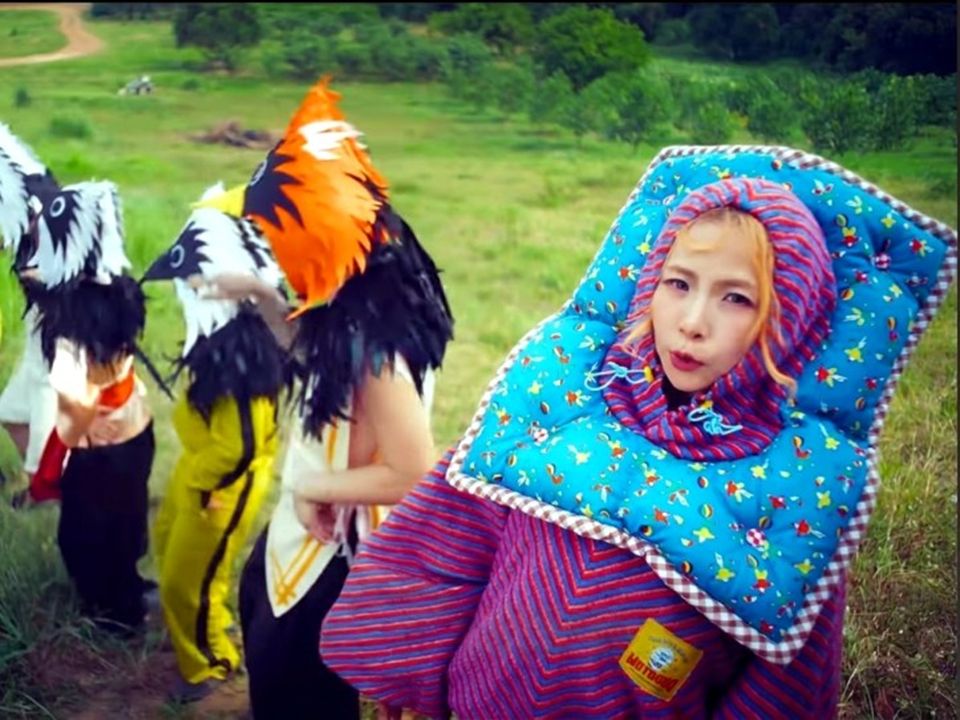
Warning; coarse language present. Reader discretion adviced
Success nowadays appears to require making an absolute fool of oneself. If you happen to be a singer, the humiliation is, thankfully, concise: you need only perform an utterly silly song, and look just as foolish. And sing something fowl. Malaysian pop sweetie Bell Fu (or 傅熙雅, Fu Xiya, or Bell 宇田, Yu Tian—depending on where you look) has released a new single with an accompanying video that has gone—what else—viral. The algorithm hasn’t just noticed her; it’s practically paying her rent. Or at least her Proton. But that may not be surprising when the song title is picked specifically for people who find words difficult. Believe or not, it is Tuk Tuk Bird. A friend had sent us a link to the video with the comment “厉害吧?” Impressive, right? But before we got to the thrill, we weren’t sure if it was going to be about a tuk tuk or a bird. Or a three-wheeler shaped like one.
Tuk Tuk Bird relies entirely on listeners’ love of the adorable. But it is not merely a novelty song; it belongs to a broader genre in Malaysia that is what we believe aggressively un-serious gag-pop jingle for the grandchildren of those who loved ‘Weird Al’ Yankovic’s 1988 hit Eat It. It arrives inside a cultural environment where the budaya is no longer defined by taste, but by deliberate crassness and cringe. Ms Fu sang about seeing a woodpecker from “afar”, but this is not a song about birdwatching; she does not sing about the Common Flameback; she points to “just a tuk tuk bird”. In Chinese and broader East Asian dialects, the word for “bird” (like the Mandarin niao or Hokkien jiao) is the absolute baseline slang for the male anatomy, just as the other feathered beast “chicken” is for the female equivalent. Which is why Namewee‘s (黄明志) 2017 song for the year of the rooster, 那只鸡拜年 (na zhi ji bai nian or That Chicken Paying New Year Calls) was so unambiguously lewd.
This is not a song about birdwatching and her subject is not “just a tuk tuk bird”
We are not suggesting that her use of ‘bird’ is similarly vulgar, but the inference is hardly ambiguous. The entire track flies from a simple, dumb joke to an explicitly layered double entendre. And it is surely no coincidence that Tuk Tuk Bird duplicates the syllabic composition and the rhythmic pattern of the phrase parents use on baby boys: the Hokkien ku-ku chiao (咕咕鸟). By swapping ku-ku for tuk tuk and translating chiao to bird, the song creates perfect acoustic camouflage. Had Namewee not already paved the path, Bell Fu would scarcely have known where to put her feet. Without him spending the last fifteen years normalising the fusion of crude slang (from Negarakuku to 那只鸡拜年 [na zhi ji bai nian or That Chicken Paying New Year Calls]), calculated online controversy, and glossy Mandopop production, Tuk Tuk Bird would not have taken flight. Ms Fu merely looked at the massive blueprint Namewee left behind, placed her feet in his exact footprints, and let the system carry her straight to a viral hit. This is far from the nest of spontaneous artistic evolution Ms Fu tried to convince her listeners to believe.
In the comment section of the Tuk Tuk Bird video that she shared on YouTube, she wrote: “Thank you for supporting my English learning video (sic)”. This refers to the TikTok reels documenting her supposedly arduous English-learning journey. By framing her highly-produced dance-ditty with such a humble phrase, she acts out the final, necessary stage of the modern viral blueprint: narrative continuity. But learning English a la Baby Shark? In case there is any doubt, she adds a pre-emptive shield, singing, “my English is bad”. So she’s not accidentally singing in bad English; she’s performing it. But how bad is it really? There are some deliberate word choices in Tuk Tuk Bird. After spotting the creature from “afar”, she sings that “its mouth is in a hole”. For someone supposedly grappling with elementary English, it is fascinating indeed that she chose that adverb instead of “far away”. Then the bird is seen, and instead of a beak, she notices a “mouth” in, not a cavity, but a “hole”.

But the lyrical choices do not end there. Apart from using the more bodily and anthropomorphic terms, Ms Fu also employs an old, clichéd joke mechanism. Near the end of the track, she chirps, “Turns out, it’s not what I think.” And then turns around and mock-admonishes, “What were you thinking?” She draws attention to a potentially improper interpretation and then theatrically scolds the audience for having it. If, indeed, there is genuinely no secondary reading available, the line would have little reason to exist. This is not a mistaken identification. She does not sing, “Turns out, it’s not what I see.” Suddenly, the song acknowledges that the observer may have been imagining something beyond the literal bird, asking us to consider the contents of our filthy minds. This may not point to sexual intent, but who is she addressing, and thinking what? Is it even about the bird anymore? The lyrics seems to know better. And her reaction is clear 逢场作戏 (fengchang zuoxi)—playing along.
If by now the engineering of the double entendre is not discernible, peck on this: “I see a bird is tukking a tree” (never mind the redundant ‘is’). But we are supposed to believe there is no sexual innuendo there, even when we know what tuk in Cantonese means. That’s classic Namewee. Tuk Tuk Bird operates in a multilingual, multi-dialect Malaysian environment, where sounds are never just sounds; they are the sonic heart of identity. Ask anyone in Kuala Lumpur or Ipoh, and they will be unanimous in what “toke” (啄) denotes in Cantonese: poking, pecking, jabbing. And then she sings about a birdie “tukking” a tree. Subtlety does seem to be the intent. After tuk-tuking her way through more than half the song, she does not merely invent a new verb; she creates an aggressive, physical sound that is evocative of fucking. It is a total stand-in.
And if that is still too subtle, her collaborators, 3P, chorus repeatedly, “back and forward”, demonstrating the action via dance, with no lack of enthusiasm. Is there even a bird anymore? By Bell Fu’s own admission, Tuk Tuk Bird is intentionally goofy, written after a viral clip of her calling a woodpecker a “Tuk Tuk Bird” birthed the avian intrigue. The song purportedly expresses the playful, ridiculous side of her—couch cushion worn as a facial frame—rather than the familiar 文青 (wenqing)—earnest—singer-songwriter image. The woodpecker’s repetitive pecking becomes an inspired metaphor for daily life: work, grind, routine, persistence, repeat. Human perseverance. Except, it is not.
Screen shots: bell_fu/YouTube

