Social media outrage over apparent AI use aside, Dior’s Yuletide cinematic offering is of such staggering banality that not even a screensaver would deign to host it

The world has gone bonkers over Dior’s full-animation, Christmas drama. Naturally, both experts and those not have rushed to inform us, as though revealing a state secret, that the animators actually resorted to AI. Stripping away the predictable indignation over synthetic pixels, we are left with a far simpler query: is the film any good? Does it fill us with holiday warmth? Or, more to the point, does it compel a single soul to rush out and acquire a Dior gown? They brought on French director Sylvain Chomet—an Oscar nominee for The Triplets of Belleville and The Illusionist—to steer the effort, yet top-tier prestige doesn’t always translate to a brand-boosting film. The result is neither a visual feast nor a narrative success, just a costly, manufactured void.
As it appears in the opening credit sequence, the film’s title is Christian Dior’s Night in Color. It did not read as ‘Colour’. We noticed it immediately because for a French luxury house, “color” carries a distinctly and noticeably American linguistic register. Dior is a Parisian house. Christian Dior himself would have written couleur. British English would give us colour. Moreover, the European Union typically uses British English spelling conventions for internal and external documentation. But the Dior title arrives in the language of the contemporary luxury industry’s largest cultural marketplace: good ol’ America. In an era when the American president has expressed the desire to hire the Ultimate Fighting Championship CEO to be the press secretary, perhaps Dior’s linguistic pivot is precisely engineered.

Yet a single printed word is not the only concession to American market orientation. There is also the narration. Dior’s little tale is told by the British actor Robert Pattinson—a long-standing ambassador of the house—speaking in American English. So after “color”, we have “air-tee-liay” and “Air-ver-new Mon-tain”. That is almost funnier than the AI debate. The film is ostensibly a celebration of French couture mythology, but linguistically it keeps leaking into Anglo-American space. This stands out to us because luxury marketing has spent decades convincing consumers that pronunciation matters. People worry about whether they are saying Hermès correctly. Whether it’s Loewe or “Lowee”, as we recently heard a window shopper at Ion Orchard squeal. Luxury is full of tiny rituals of linguistic initiation. Then Dior turns around and gives us a narrator who seems calibrated not for French specificity, but for maximum Anglo-American accessibility. At this point, are we supposed to say “charming”? How is Mr Pattinson different from that shopper at Ion Orchard?
And then comes the star herself, Marlene Dietrich (voiced by the French actress Camille Cottin). Upon laying eyes on the gown she had desired, the avatar of Ms Dietrich exclaims, “Ah, this is chic”! It sounds less like what she would naturally say and more like what a 2020s marketing department imagines a glamorous woman from the past might say. “Chic” is one of the most overburdened words in luxury vocabulary. Historically, it had a certain Parisian lightness and specificity. In luxury marketing, however, it has become a floating token, one we hardly think Ms Dietrich would deploy. In the animated form, she is not responding to Dior, she is performing for an audience. “Chic” here feels less like vocabulary and more like a logo. What’s ironic is Ms Dietrich herself was one of the people who helped create what we now call chic. She wasn’t a tourist encountering sophistication for the first time.
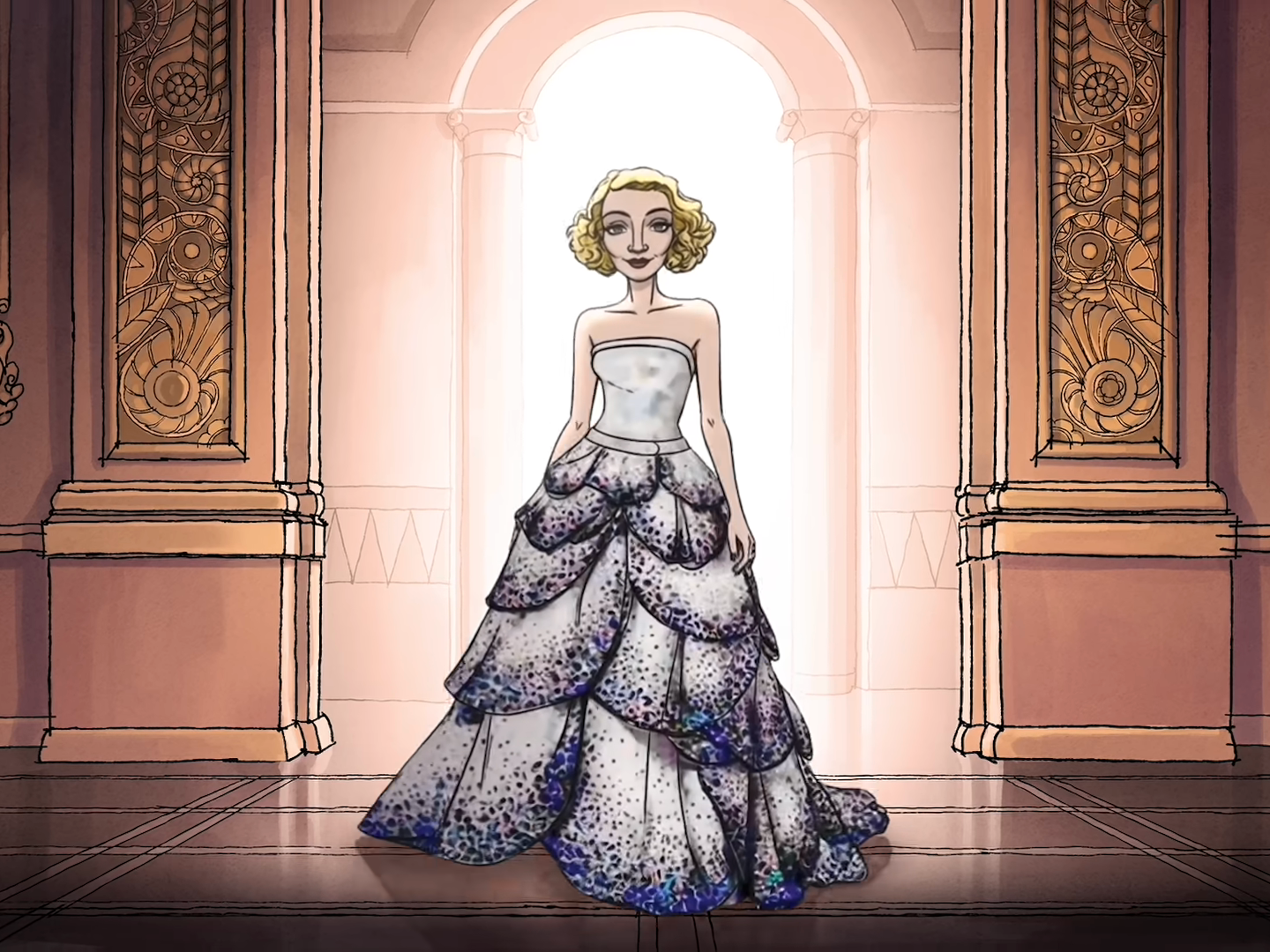
The lines given to Ms Dietrich may or may not be historically accurate, but they contain a perspective. They imply a person with tastes, preferences, and judgments. “Chic”, however, doesn’t express a judgment. It merely invokes a luxury keyword. While online discourse centers on whether the animation was AI-generated, the same skepticism applies to the screenplay. One of the most common characteristics of AI-generated dialogue is not the grammatically wonky. Rather, it is the character that frequently blurbs the thing that a press release would say. Instead of speaking as themselves, they speak as brand ambassadors. The Marlene Dietrich in that animation sounds less like her than like a VVIC. She exists to certify that Dior is chic. But is it necessary? It’s definitely not for her. She already knows what chic is. Nor for Monsieur Dior, who brought the dress to her. It is not even for the scene itself. it is clearly for the viewer. When we heard that line, we did not say Marlene Dietrich won’t say that; we exclaimed aloud: no one, no Dior customer says that.
Perhaps the laughable irony is that the real Christian Dior was successful precisely because he wasn’t American-centric or even universal. He was very specifically French, very specifically of his moment, very specifically rooted in Parisian couture culture. Yes, Hollywood beckoned, but he did not sell his soul. The New Look was not designed to be universally adored. In 1947, many people thought it excessive, impractical, even provocative. It was rooted in a very particular post-war Parisian context. The point was not that everyone already agreed with it. The point was that Dior persuaded the world to come around to his point of view. Hollywood came to him because he represented something Hollywood could not produce for itself. His value lay in his difference. It was the entire product. The real Monsieur Dior didn’t need people to announce that his work was chic. He showed the world something unapologetically French and let the audience catch up. But Christian Dior’s Night in Color showed a man who had to answer a frantic call in the middle of the night, who had no idea what to design, who let his dog lead him to one idea. The film’s telling risks losing the thing that made Christian Dior worth celebrating in the first place: aura.
Screen shots: dior/YouTube

