When two competing mastheads or more hire the same photographer, the failure of imagination belongs to the art department, not the lens
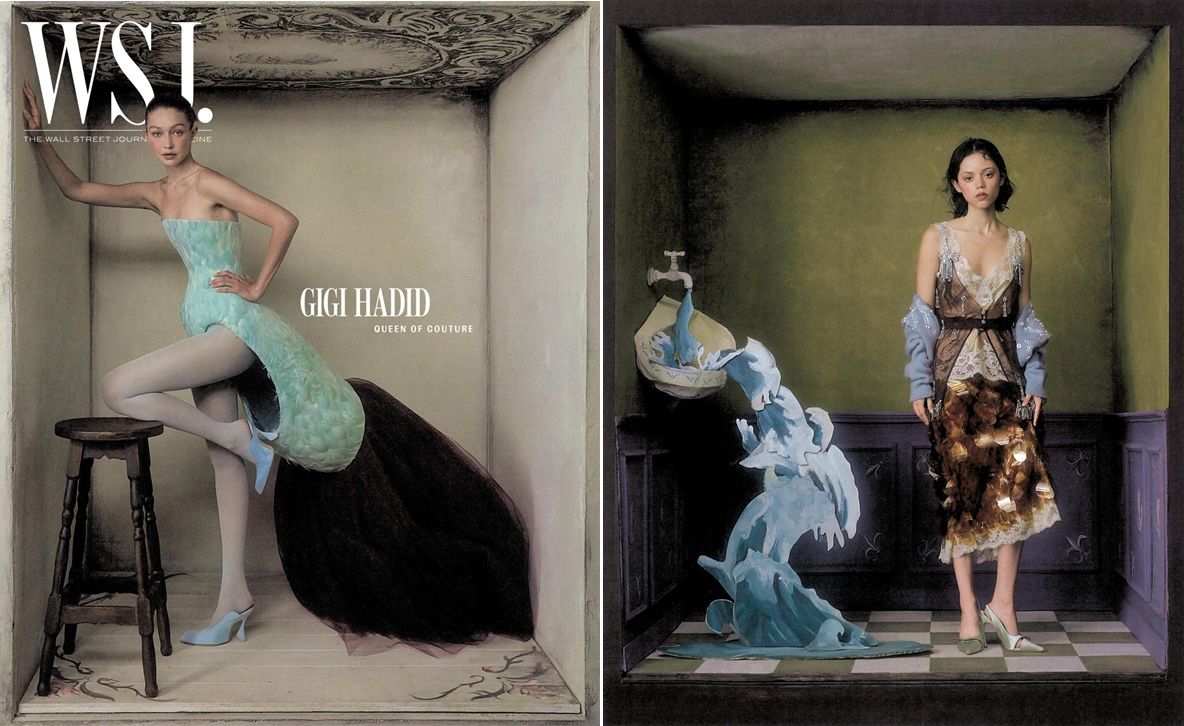
Gigi Hadid on the cover of WSJ. and Jenna Ortega within the pages of Vogue, both images similarly alcoved
Trends do not exist on their own. They are dreamed up by fashion, which is itself curated by magazines. Both exist so that tomorrow, today’s wardrobe will be an embarrassment. And print remains the kingmaker of fashion photography—crowning the auteurs who transform seasonal vanity into visual canon. But the editorial hand does not merely anoint the lensman, it gets to dictate photographic trend itself, even orchestrating every element within the frame—down to the last selected prop or the deliberately cast shadow. Nowhere is this better illustrated than across the covers of the upcoming November issues. What presents itself as painterly spontaneity across these front covers is, in truth, merely high-end editorial shoddiness.
A “trend” might be discerned when three magazines—WSJ., Vogue, Elle—arrived at the newsstands with similar covers and editorial spreads. The casual reader may see a visual fad or a deliberate choice, but fashion folks quickly recognise the images as the work of one individual—the Hungarian fine-art photographer Szilveszter Makó. And most strikingly, WSJ.’s cover looks like a page inside Vogue. How do two disparate editorial lineages arrive at the exact same visual formula? Many observers have noted that, at Vogue, this is the mechanical result of budget cuts, erased exclusivity retainers, and accelerated production cycles. When magazines can no longer afford to tie image-makers to exclusive contracts, every title drinks from the same well, simultaneously. That’s why what we are now seeing at the newsstand—and by extension, the Instagram grid—resembles a single photographer’s portfolio, split across different corporate logos.
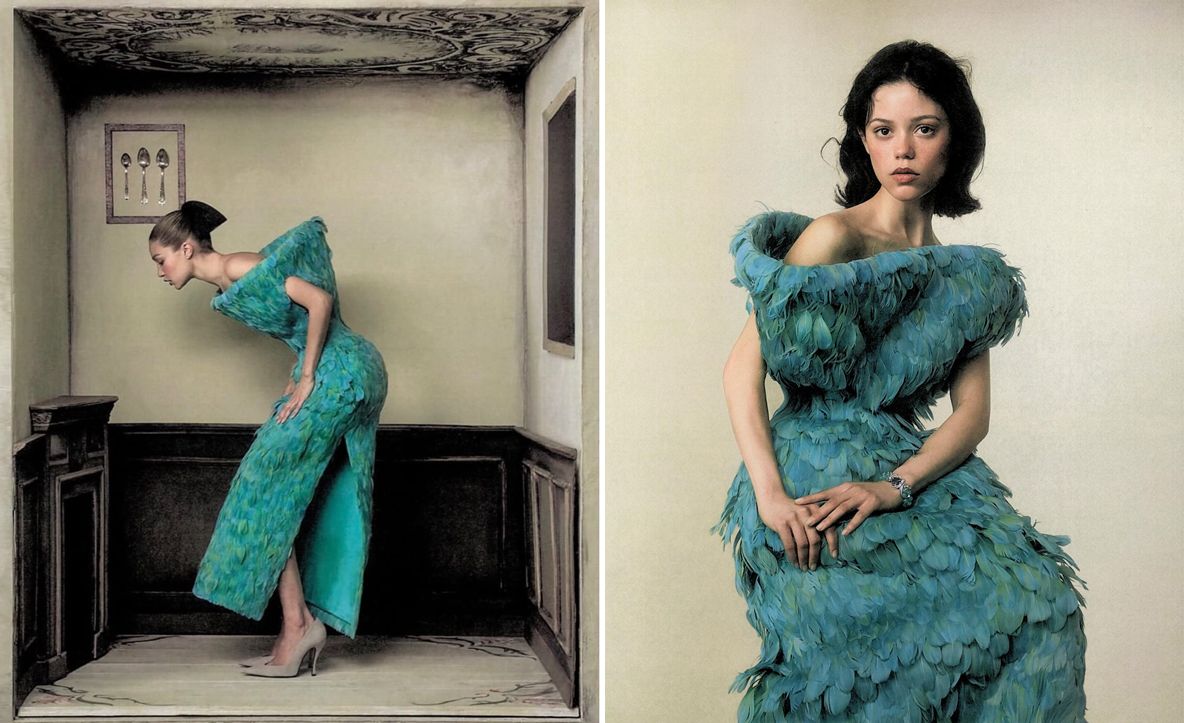
Gigi Hadid in a Balenciaga dress and Jenna Ortega in the same feathered Balenciaga dress
Although SPH Magazines has several magazines (at least five) under its belt, the titles are rarely so carelessly similar even if they are known to use the same photographer, the same stylist, and the same hairdresser for their covers across a single month. Where creative resources are limited—a reality Singapore often needs to confront—visual repetition could become an expected byproduct. Yet here, that assumption does not quite hold. To be sure, bad covers exist and frequently so, but seldom do they actively imitate each other. In New York, by contrast, the publications seem intent on proving the exact opposite. Mr Mako is simply practicing his trade—his distinct, painterly signature that has variously been described as “chiaroscuro”. A photographer is hired for his eye. In a healthy editorial ecosystem, an art director collaborates with a photographer to bend their style towards the publication’s distinct identity, not surrender to the latter’s wholesale.
Much has already been said online on how the Vogue cover of Jenna Ortega is similar to WSJ.’s of Gigi Hadid—both look “boxed in”, and feature the two subjects in the same feathered Balenciaga dress in different parts of their respective issues, so we will happily skip a rehash. The chatter on social media has drifted into familiar, accusatory territory, asking who copied whom—a debate that completely misses the point. Whether fair or not, Vogue suffers from a perception problem. It built its reputation as the publication that sets visual language. If it appears to be following a language that another magazine has already popularised weeks or months earlier, people read it as evidence of editorial sluggishness. The sad truth is, Vogue increasingly finds itself participating in trends rather than authoritatively declaring them. If not, what else is Vogue World? We won’t be surprised if Law Roach shall be asked to style a Vogue cover soon. Perhaps more troubling is that different magazines are now independently arriving at the same visual solution because editorial imagination has narrowed. It is as constricted as a corseted corpse.
Photos: Szilveszter Makó/WSJ. and Vogue respectively

