One is Singapore’s most recognisable label. The other is only Balenciaga
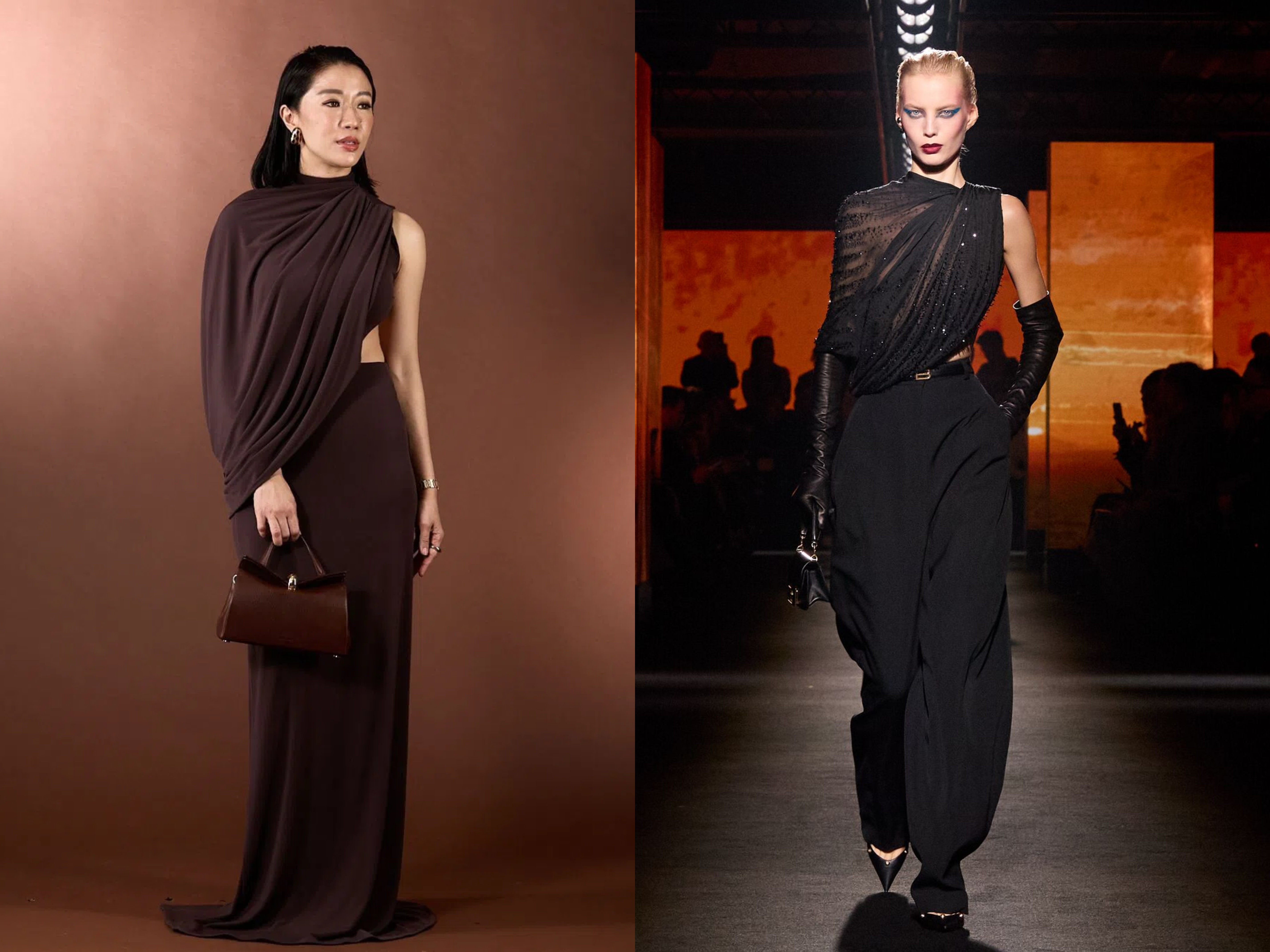
The single-shoulder drape. (Left) Rachel Lim in Love, Bonito. (Right) Balenciaga autumn/winter 2026. Photos: herworld/Instagram and Balenciaga respectively
There is a beautiful science to the drape, especially along the shoulder. It is soft enough to feel romantic, and if it is one-sided, sufficiently asymmetrical to remind the world you have a second shoulder. Balenciaga’s Pierpaolo Piccioli is adept at creating that exact brand of fluid romanticism, proving that even the most rigorous corporate reboot can be softened by a well-placed drape at the neck and the strategic exposure of an glenohumeral joint. And now, apparently the much-loved Singaporean label Love, Bonito, too. At last night’s awards ceremony of the gloriously anticipated Her World ‘Women of the Year’, Love, Bonito’s Rachel Lim stepped out into the dazzling evening in a slender gown that our oldest women’s magazine helpfully informed, “soon-to-be-released”. By Love, Bonito, of course. Unknown to Her World, Balenciaga already has.
For the Balenciaga prêt-à-porter autumn/winter 2027 collection, now available in stores, Mr Piccioli sent out a quartet of gowns, asymmetrically draped across the bodice that were a disposition also seen in his previous, much-lauded output at Valentino. There is immense mastery in the way the fabric fell—an artful insouciance that suggests, for wearers, considerable agonising over precisely how to look like nobody tried. It is a rejection of the well-behaved silhouette, even pure prettiness, a deliberately composed geometry that keeps the eye of the observer keenly engaged. Rachel Lim is an astute dresser. She is aware of the power of such an asymmetry across her shoulders and that showing half an arm is better than both. Fashion folks’ mastery in eveningwear has always been a game of tactical subtraction. Just leave the other arm to mind its own business. After all, one exposed shoulder carries twice the social panache of two.
It is a rejection of the well-behaved silhouette, even pure prettiness, a deliberately composed geometry that keeps the eye of the observer keenly engaged
Wearing Love, Bonito came as no surprise. Ms Lim was likely fishing in a demographic pond she keenly wanted to ensnare that was more than a catch of the day. Yet, when the design easily relied on a recognisable blueprint, it unmasked a paradox. It suggested that while the business structure is self-contained, the imagination was outsourced. True innovation is risky; a dupe is safe. And choosing a silhouette that mimics high-fashion canon is a calculated play for cultural capital. It borrows the avant-garde authority of a marquee European house, leveraging pedigree without a big outlay. A ‘Woman of the Year’ supposedly celebrates leadership, originality, vision, and the capacity to define the future. Yet if the most important public-facing artifact of her creative enterprise resembles the work of another house, the image becomes one of borrowed authority. She is presented as a brand creator, but arrives clothed in the visual language of someone else’s.
Perhaps, ultimately, the message was not “look at what we’ve made” but “what we’ve successfully referenced”. As we dug deeper, we found another dress by the Aussie label Effie Kats that looks almost identical to the one Ms Lim wore. But does that matter anymore? The moment we see her in that dress and think Balenciaga, the semiotic event has already occured. Whether the source turns out to be her own label or Effie Kats, or a third brand is almost secondary. We are not reading the garment as an expression of its actual maker, rather through the visual authority of Balenciaga, specifically Pierpaolo Piccioli. Today, we live in an era where intellectual property is treated as an open-source library for anyone with Procreate on their iPad and a production line in Shenzhen. In high-street fashion, originality is less valuable—or useful—than recognisability. Rachel Lim was not only looking the part, she was algorithmically legible.

