And this year, Roberto Bolle gave it some performance heft, so did humanoid robots from Unitree Robotics. But unlike the models and the dancers, the walking machines were not dressed in Italian finery. They were nude—stark naked
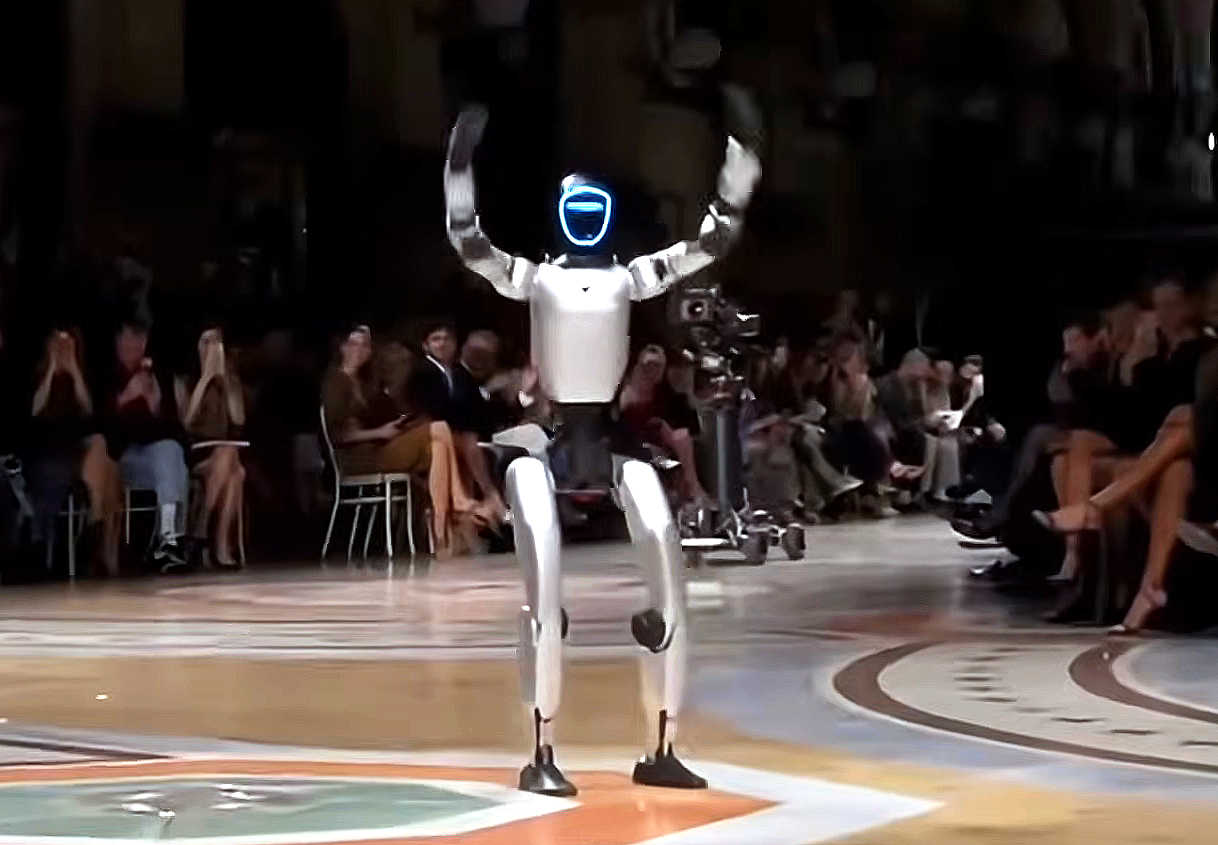
The debut of Unitree’s famed humanoid robot
This year’s Vogue World: Milan apparently “opened” the city’s fashion week, according to some media reports. If Ed Sheeran could manage without an opening act, surely a 68-year-old institution can survive without one and a cartoonish caper at that. After all, the Milanese scene already possesses the authenticity Vogue World is trying to manufacture: heritage, craftsmanship, industrial expertise, global influence, cultural relevance, and spectacle. But the chronological reality was that Prada was the first show of this spring/summer 2027 season. So Vogue World was really only the ceremonial marquee sideshow. The event spent the evening sermonising about Italian craftsmanship et al, but the show was sponsored by two very un-Italian names: Meta and Open AI. And the 十字形 (shijixing or cross-shaped) runway featured humanoid robots from 宇树科技(yushu keji), known throughout the world as Unitree Robotics. But this was clearly not the Lunar New Year Eve spring festival gala 春晚 (chunwan).
The contradiction was sitting in plain sight. They chose marketing language that was drenched in “Made in Italy”, Italian heritage, Italian artisans, Italian innovation, Italian creativity. Indeed, “fatto a mano”—made by hand. Yet, some of the most memorable technological signifiers onstage came not from Milanese ateliers, but from global tech firms and, in the case of the robots, Chinese technology. Even Alessandro Michele did not look amused. While the Unitree robots are admired for their ability to execute high-octane gongfu, backflips, but under the glass roof of the Galleria Vittorio Emanuele II, they were rather placid, presumably not to upstage the real ‘models’, such as Cardi B and Jennifer Lopez. Set to Gigi D’Agostino’s electronic track L’Amour Toujours, the undressed robots marched down the catwalk, waved their arms to implore the audience to clap, and even performed a lasso motion. And just like that, the robots stole the show, again. No 弓步拳 (gongbuquan) or bow stance punch needed
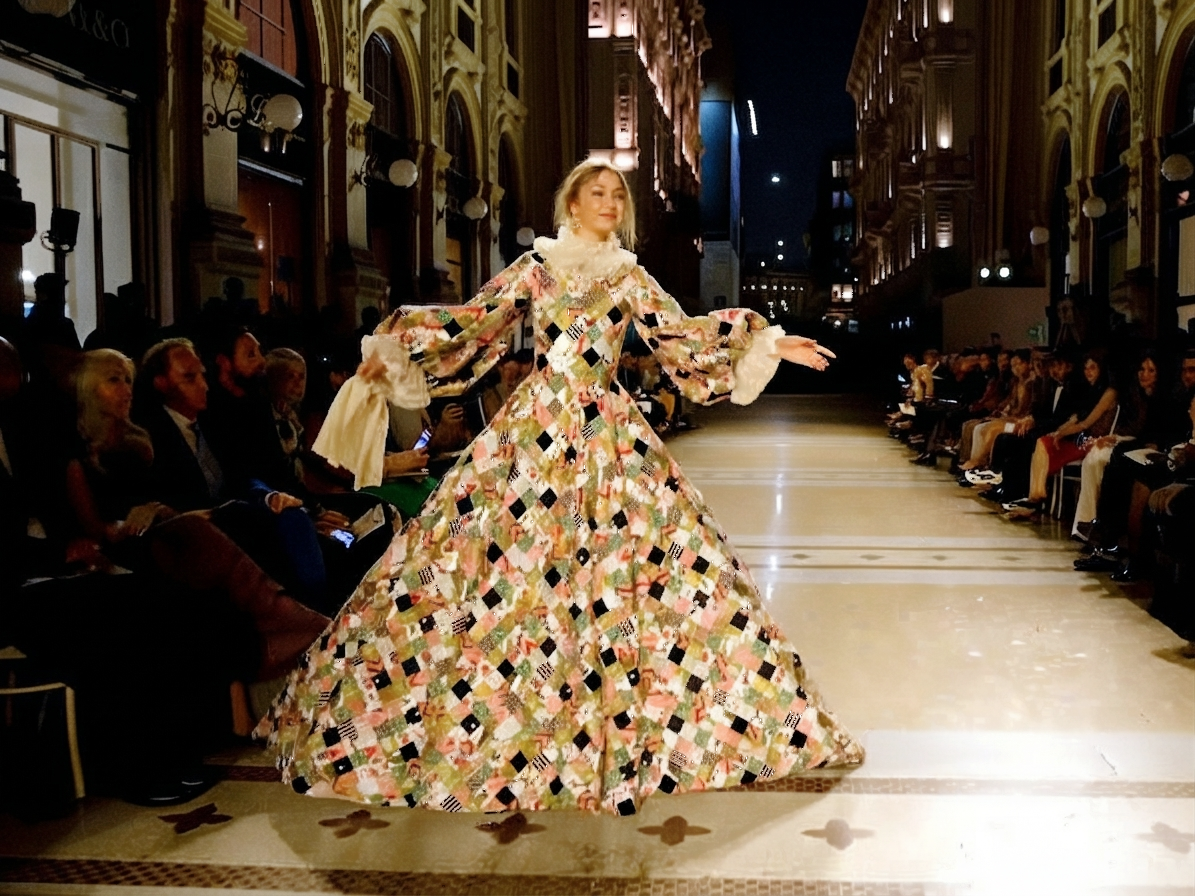
Gigi Hadid in Valentino
Vogue World has always been very much a variety performance, just not quite the royal kind. So, perhaps, treating it as a fashion show is our own mass delusion. The clues have been there from the beginning. But we were hopeful that they would evolve and go beyond the subtext: “Please don’t think this is just rich people wearing clothes. It is actually about culture.” When it debuted in New York in 2022, it mixed fashion, Broadway, music, and celebrity appearances. London, the year after, leaned heavily into theatre and performing arts. Paris followed with a fusion of fashion and Olympic sport. And in Los Angeles last year, the self-explanatory Vogue World: Hollywood. In sum, the event is a civic pageant, a TED Talk, a tourism campaign, a luxury brand summit, a celebrity spectacle, and a moral statement all at once. Yet, it suffers from one problem: variety.
Whether you like chunwan or not, it generally understands a basic rule: If you are going to be a variety show, at least be varied. Modelling-world darling Gigi Hadid started the show, appearing as a quasi-operatic heroine in a grand Valentino gown. This was not just a cliché; this was a cringe-y cliché. If you’re producing a variety show, the first entrance has to tell us what kind of evening we’re in for. Ms Hadid was clowned as the safest possible interpretation of Milan + culture + glamour, to the extent that it was unabashedly algorithmic. The image is legible within half a second. Unfortunately, it remained just as interesting the entire duration of her protracted performance and at minute ten as it was at minute one. What makes it even funnier—or more ridiculous—is that opera itself isn’t predictable. Actual opera can be absurd, erotic, violent, grotesque, tragic, surreal, politically charged, psychologically unnerving, and cheekily comedic. Opera contains witches, courtesans, murderers, as well as betrayals, hallucinations, suicides, revolutions, and divine interventions. But Vogue World’s idea of opera is flatter than the Complete Idiot’s Guides.
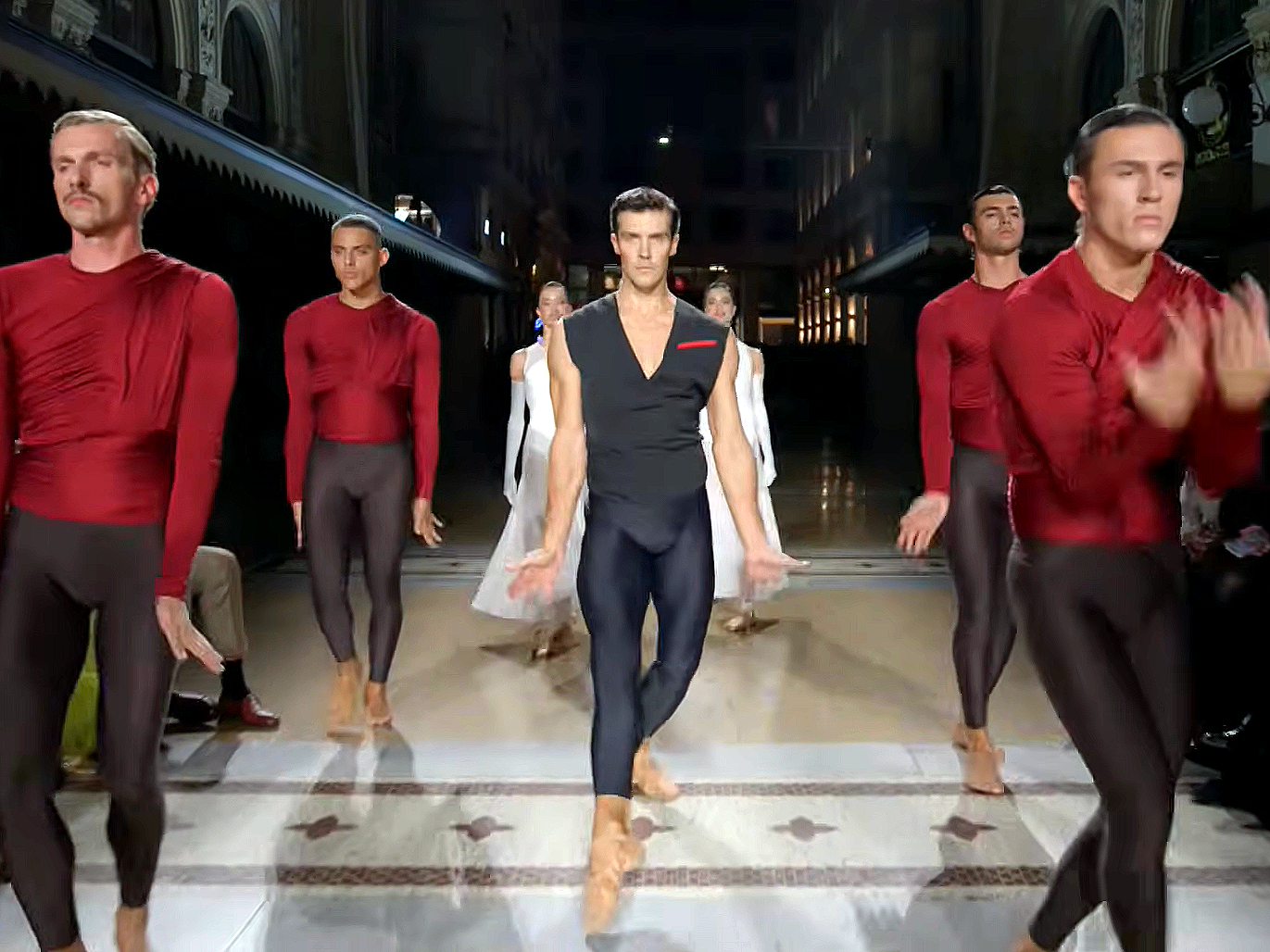
Roberto Bolle’s fashion moment
This was especially embarrassing for Vogue World, considering that La Scala is practically a stone’s throw away. It’s one thing for it to set up shop between the Duomo and Teatro alla Scala and strategically borrow the aura of Milanese high culture. It’s quite another to bring in Roberto Bolle, étoile of La Scala, along with unidentified singers connected to the institution itself to sing—on a balcony, no less. At that moment, the symbolism ceases to be symbolic. Who is legitimising whom? It looked to us that Vogue World was convening the many strands of Italian culture into a grand synthesis. But when Mr Bolle appeared, he seemed to hoof it for foot traffic and livestream scrollers. Vogue World was borrowing credibility from La Scala. Not because Mr Bolle overshadowed the event. Rather, because he belongs to an institution whose authority predates Vogue World by generations, even before Anna Wintour’s. If the show was merely staged as an operatic fantasy, we could dismiss it as theatrical license, but this looked to us more like cultural rental.
At the end of 30-minute splash, it came away as a hyper-inflated, multi-genre vacuum where everything happened and nothing actually mattered. As the show was also a desperate necrophilia of the eBay tie-in, it obliged with vintage fashion that were inevitably “iconic”. Unsurprisingly, Gianni Versace stormed the Galleria, allowing, Donetalla Versace who has lost the house to Prada (that has quietly dismantled it) to bask in the glory that Versace still rules Milan. You could almost hear Ms Wintour tell Ms Versace: “Let’s do this for Gianni.” Cardi B literally strutted in pop-art prints of archival Vogue covers (that first appeared in 1991), Irina Shayk in a 1992 Miss S&M dress, the 1994 safety pin dress that made one Liz Hurley very famous, and a lacey slip-dress on Jessica Miller from 1994. Every look had to scream “fashion”. It was Versace’s idea of a variety show. So, token salute went to Prada’s 2011 banana-patterned Hawaiian shirt and a printed coat and dress from 1996. Blink and you will miss it were early pieces of Consuelo Castiglioni’s delightful Marni and, much to our surprise, the refused-to-be-resuscitated Romeo Gigli.
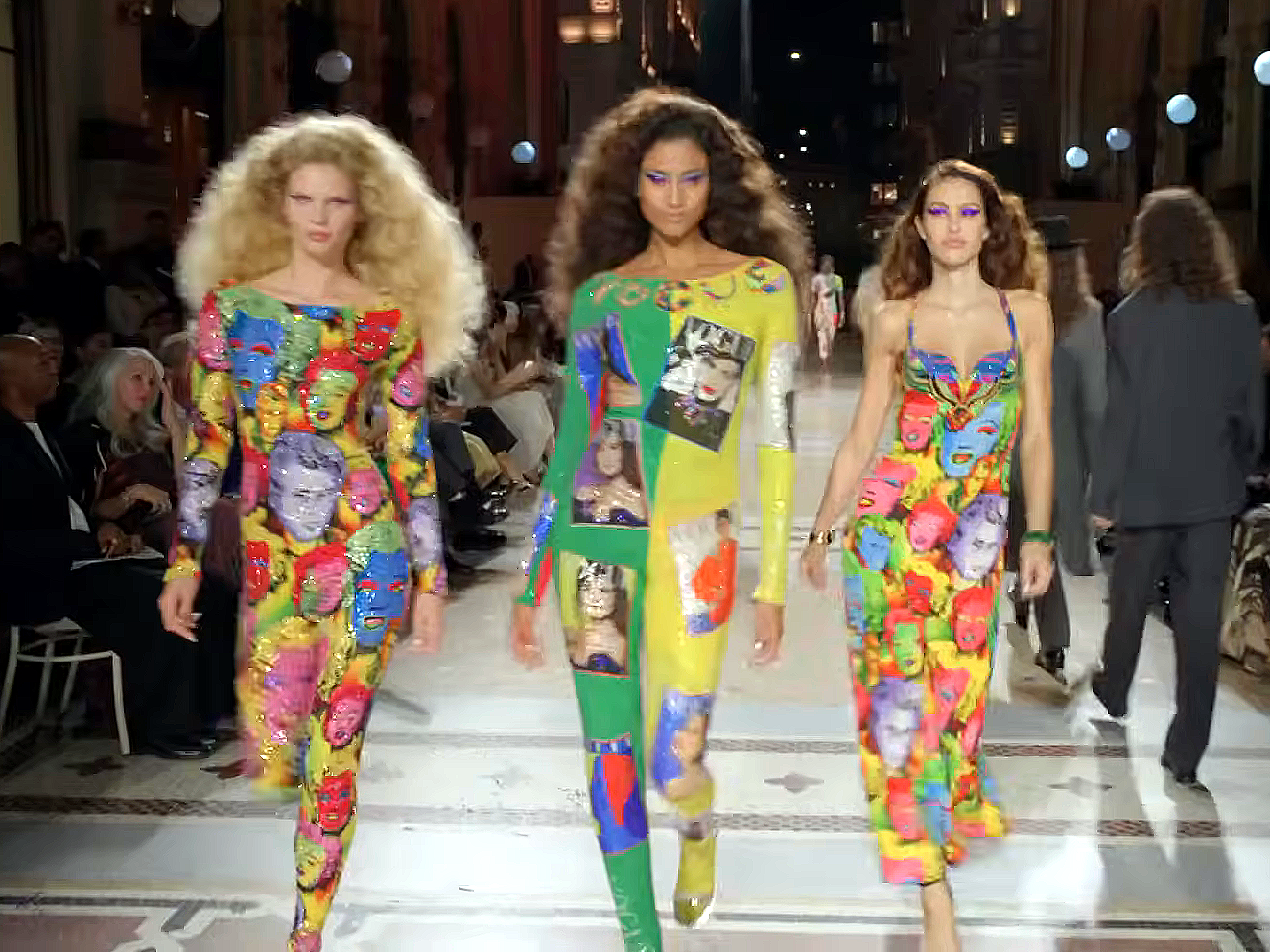
Versace to the fore, with Iman Hammam (centre) leading the pack
Gigli and Marni of yore as fleeting tokens highlight how little room this spectacle actually has for true, idiosyncratic Italian design history when there are key celebrity moments to service. Instead of exploring the strange, eccentric, less-exportable corners of Italian fashion history, they put out footnotes before the show returned to its true priorities. Gigli represented a radically different notion of beauty from the hyper-sexualized glamour that later came to dominate international perceptions of Italian fashion. His work was soft, poetic, introspective, almost anti-spectacular. One former editor told us that it was a “missed opportunity” for Vogue World. He told us: “I remember meeting the late Franca Sozzani in Monte Carlo one spring night in 1994. She was wearing a claret Gigli cocoon coat, and I told her she looked good and she said to me, ‘You know Romeo Gigli?” Likewise, early Marni was weird. Not “fashion-week weird.” Actually weird. Awkward proportions. Strange color relationships. Intellectual eccentricity. A cultivated indifference to conventional glamour. But it is likely not Ms Wintour’s cup of tepid tea.
In fact, Romeo Gigli and Marni weren’t just rushed past as citations; they were actively incompatible with a room designed to worship neon signs, viral celebrities, and naked factory robots. A supermodel dressed like an opera heroine can be understood in half a second. Romeo Gigli cannot be. Nor early Marni. The irony is that the more obscure references were arguably the most authentically Italian elements of the evening. Not in a nationalist sense, but in the sense that they reflected the actual diversity of Milanese fashion thinking. The celebrity moments, by contrast, could have happened almost anywhere, under anyone’s patronage. Great fashion moments leave behind images that become folklore. Alexander McQueen had them. John Galliano, too. If we need Italian references, even individual Prada or Miu Miu shows generate moments that haunt the imagination. But, because Vogue World is a variety show, built entirely for the algorithm, it can never accommodate anything that requires genuine contemplation. It loved Italian fashion history. However, it just loved it most when everything could be converted into cheerful content.
Screen shots: vogue/YouTube

