And a plethora of skirts. Prada’s spring/summer 2027 responds to a world gripped by relentless, record-breaking summer heat
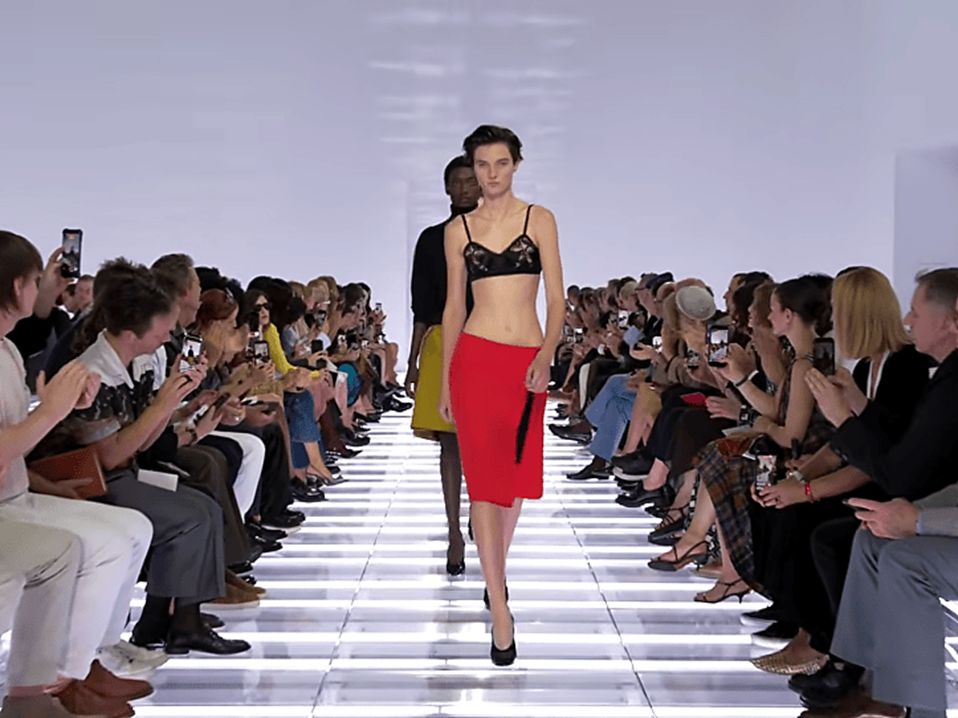
This past summer, Western Europe experienced what has been considered the hottest on record. Data in Italy showed its hottest summer since 1950, with a national average temperature that broke the long-standing record previously held by the summer of 2003. Local media reported a blistering 48.4°C in Orani, Sardinia on July 19. In Milan, due to the ‘urban island effect’, the highest temperature recorded was 38°C, prompting the Italian Ministry of Health to place Milan under its highest “red alert” heat warning during the peak of the season. Because of a general lack of air-conditioning, Italy was suffering from what the media called “extreme indoor heat”. Prada’s spring/summer 2027 collection seems to anticipate that come next June, the weather will be punishing, again. And the best way to beat the heat is to go topless, save the bra.
By contrast, much talked about were the skirts that dominated the entire collection—not a pair of pants or shorts was shown. But it was, at first, those load-bearing geometry of the narrow bands covering the breasts that caught our eye. The brassiere and similarly itsy-bitsies were so prevalent that some specious social media commentator called the collection “Brada”. But there is something appreciable about Miuccia Prada and Raf Simons avoiding tired seasonal fantasies of other houses for clothes (or part of) that combine both breezy practicality and technical flair. Apart from seriously credible bras (even pleated ones) that Triumph would admire, there were attractively-shaped bandeaux that revealed no side or bottom anything. No taped chest. One wavy style came with sleeves—arm bands really—that had a metal D ring attached to the left side, from which a nylon pouch can dangle. Another was basically braces to frame the arm hole (or broad shoulder straps of a sundress without the dress) that was cunningly shaped to conceal. True to form.
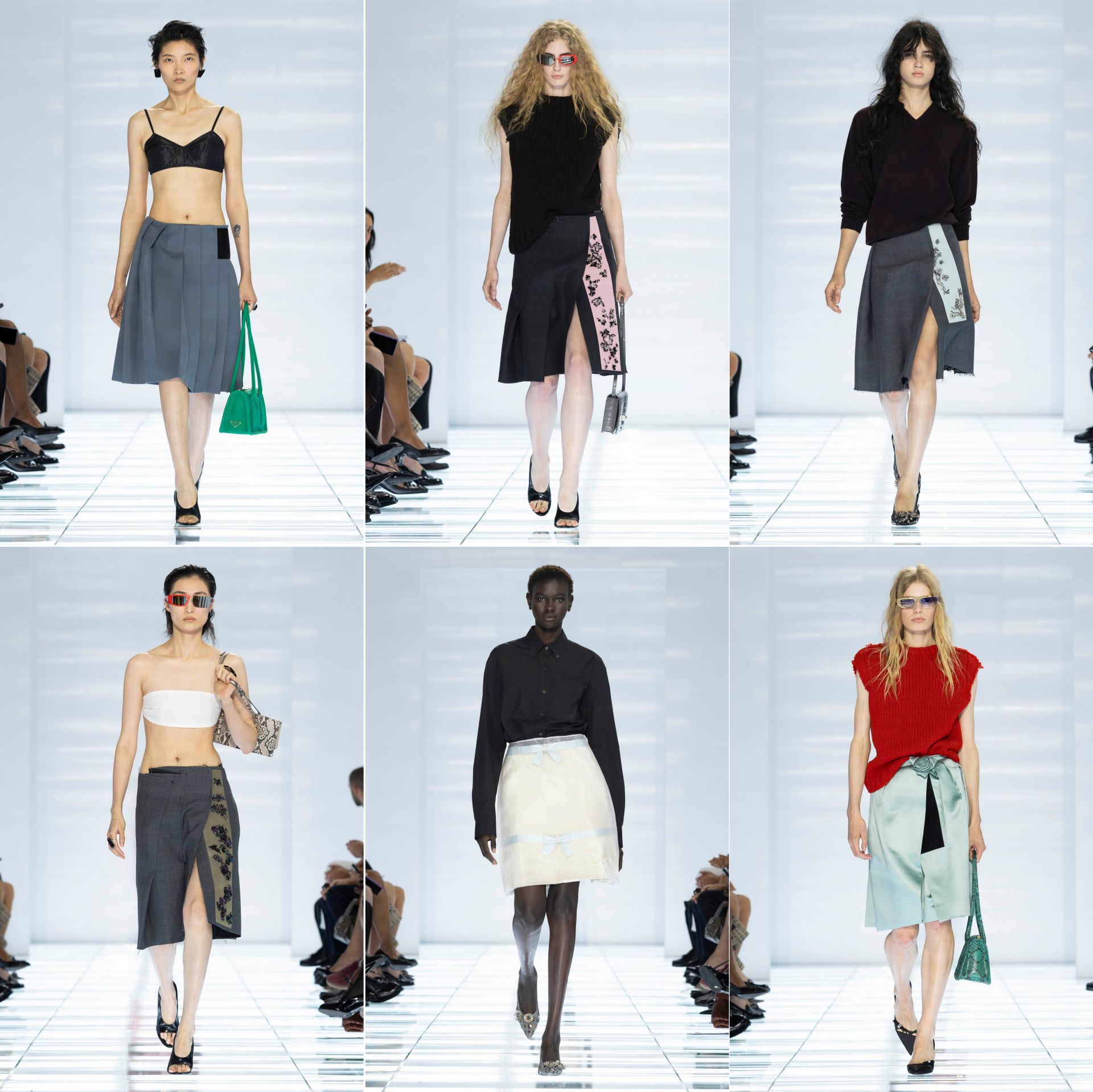
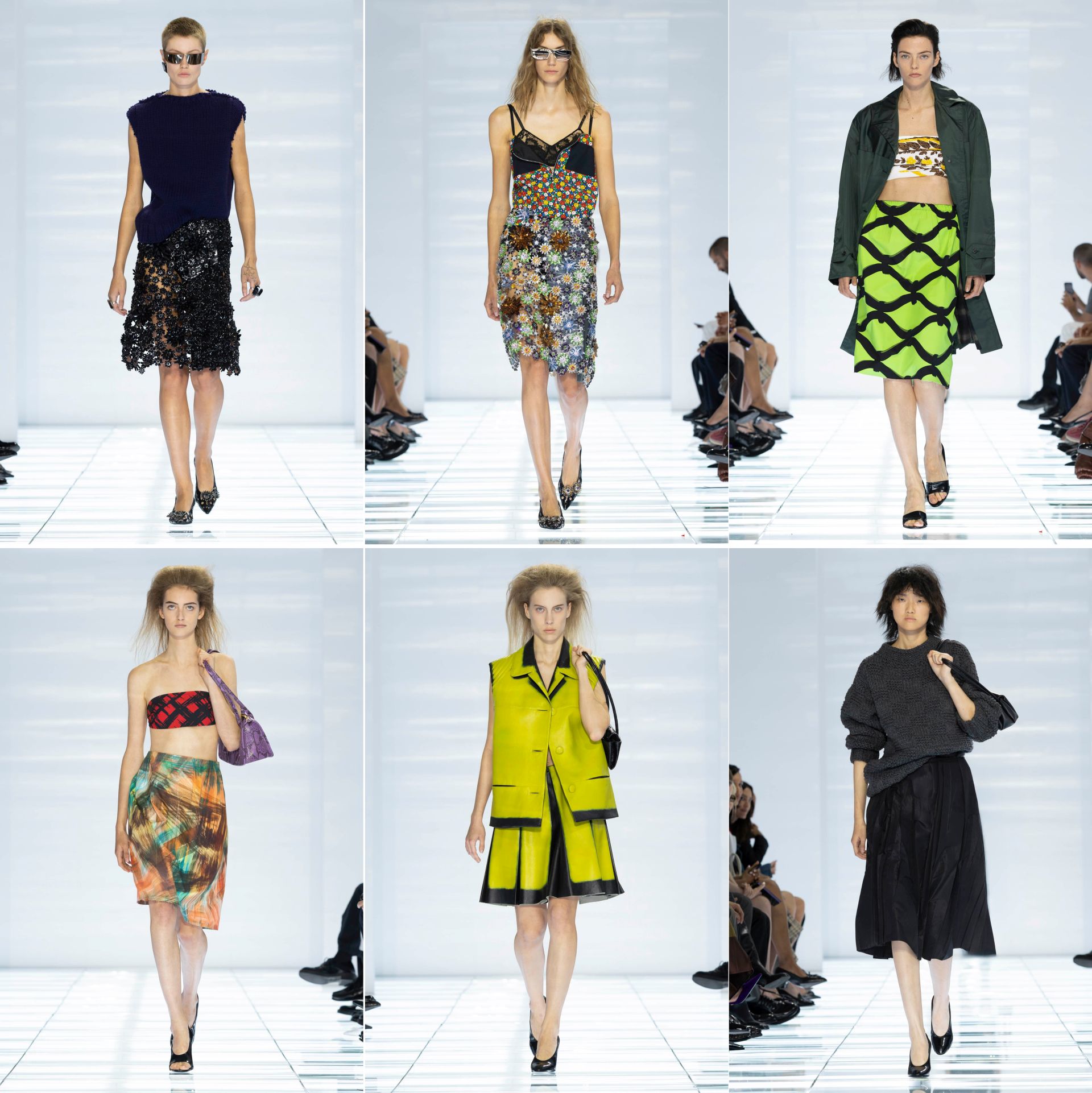
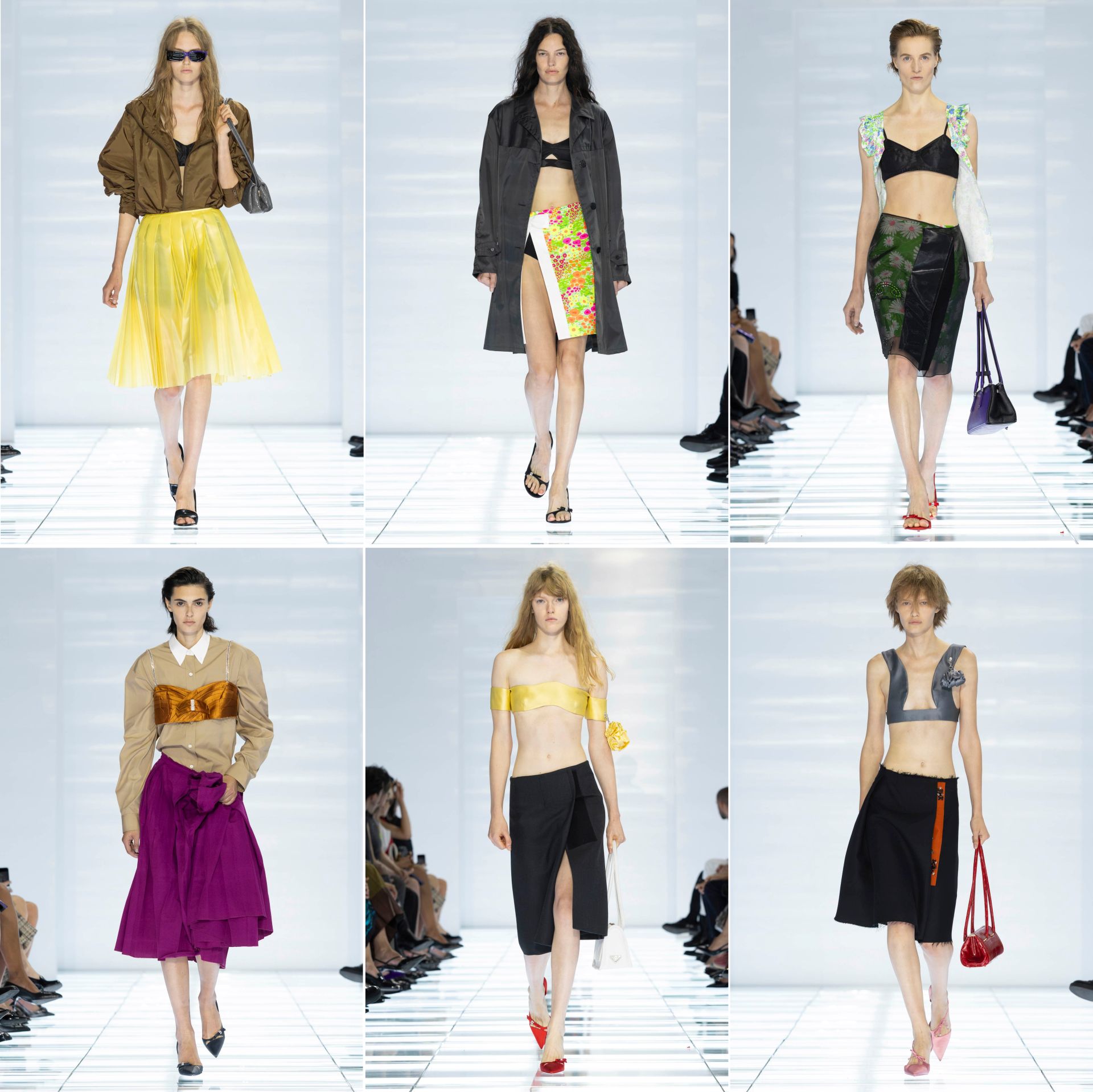
But it was the skirts that stole the show. One Prada fan told us that if she were wealthy enough, she’d buy every skirt—“yes, all 63 of them!” The skirts, to us, were not merely an expansion of Ms Prada’s own obsession—her personal uniform is practically a case study in skirt-centric dressing—but it is also about keeping the waist down cool. Stripping the top to minimal bras and graphic bandeaux eliminates trapped heat around the torso, but it is the knee- and midi-length skirts, particularly when cut with high slits, accordion pleats, or wrap constructions, that allowed for natural air circulation in a way that structured trousers (or the skinny pairs seen elsewhere) simply never can. The skirt, when not worn in the constricted form that Kim Kardashian prefers over her compression wear is inherently equipped with a ventilation system. Equally striking was how the design duo sculpted the skirts and applied their graphic sense of ornamentation. There was the modest flared skirt with the slit to the left that revealed a strip of fabric in contrast colour, on which was embroidered the house’s unique take on flowers
Miuccia Prada has long maintained that a skirt is the equivalent of a T-shirt. But the T-shirt is a gender-neutral garment; the skirt not quite or not yet. We suspect that she meant the world as she wishes to understand it, or perhaps the world within her own class position and aesthetic system. A T-shirt is neutral in a very specific sense. It requires no explanation, carrying relatively little risk of social interpretation. A skirt, however, remains heavily coded. Gender, propriety, sexuality, professionalism, age, religion, conservatism, rebellion, nostalgia, femininity, anti-femininity: all of these can be projected onto a skirt before anyone has even noticed its cut or fabrication. It is often treated as a statement. Hence, the rise of the “statement skirt”. And a good many of the Prada pieces are. But what struck us most is the lack of historical reference in them (except, perhaps the full-skirted of the ’50s): there were no hoop skirts, no panniers, no dirndls. Fashion has spent the better part of the last two decades justifying the skirt through ancestry. Prada’s approach was precisely the absence of that justification. In a way, the lack of historicity made the skirts more confrontational. A crinoline lets the viewer escape into historical fantasy. A plain contemporary skirt offers no such refuge. The audience has to confront its own assumptions directly.
Screen shot (top): prada/YouTube. Photos: Prada

