Ed Sheeran did not call off his troubled American tour. He continued with a performance in Philadelphia all alone, without opening acts nor band support, but one thing is unchanged: he is still a fence-sitter, steady as ever
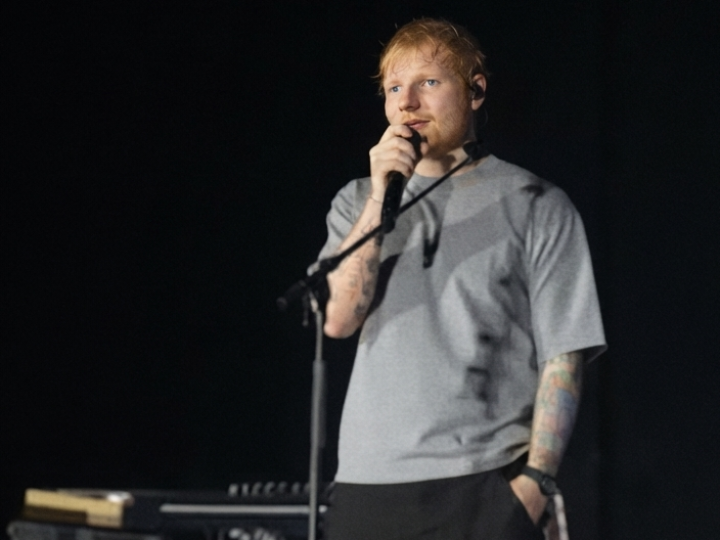
Pop’s eternal “Mr Nice Guy” is back on stage. And he spoke, visibly possessed by the teleprompter. No Instagram statement, just pure voice. But if you thought he’d have a point to make or a heart to touch, you were wildly optimistic. Silence would have saved him from being a punchline, again. But he chose a script and hid behind one so bland and so thoroughly sanitised, it managed to say nothing at all. Ed Sheeran may have started his career on the pavement, but once elevated to a stadium, he exposed a glaring truth: he was never streetwise to begin with. The speech lasted for a grand three minutes, but not once did he mention Macklemore’s name and the specific content of the rousing speech that triggered the crisis in the first place. He sings about love, but he showed none to a fellow artist who called him a brother. Mr Sheeran is known for his “middle-of-the-road” songs, now his messages, too.
With no opening acts, he started sans musical instrument, just a microphone, saying impassively: “Now, I want to address the question of where I stand in the situation in Israel and Palestine, and whether my doing this concert here tonight implies where I stand.” It is remarkable how he desired to “address” where he stood, only to sprint past the destination by saying, “I have tried in my career not to be a political commentator of any kind, because I want my music and shows to be about unity, not division; about humanity, not politics. But this is a humanitarian issue, and I cannot hide how I feel about it anymore.” So he admitted that he concealed the “issue” from sight and speech. The audience had expected a declaration of position, but he immediately pivoted to no desire for “political commentary”. The political rapidly shifted to the humanitarian, like a state dinner abandoned when the drawing room floor gives way to a cellar full of war refugees.
The audience had expected a declaration of position, but he immediately pivoted to no desire for “political commentary”
He continued, as sterile as his grey T-shirt, his tattoo offering a hint of friction. “What happened in Israel during the 7 October attacks was horrific and compounded centuries of Jewish pain. What is happening in Gaza is catastrophic and unjustifiable and disproportionate.” That is truly a magnificent display of dynamic equilibrium. No one can sit on a fence more steadily than Ed Sheeran. Every assertion is matched with a counterbalancing assertion: with the Israeli suffering, there is also Palestinian suffering; with Isreal’s historical pain, there is also Gazan catastrophe; 7 October is disapproved, so it the campaign against Gaza. It is almost a gyroscope (was he standing on a gimble?). The statement constantly corrected its own weight distribution. Once he struck the ideal balance, questions such as “who did what to who?” or “who holds the power over who?” can comfortably recede to a generalised language of tragedy. Perhaps this is indeed a position. There could be a word for it: Equidistance, even between vastly asymmetric realities
“My heart has been broken by the scale of devastation and loss of civilian lives, of children’s lives, and this systemic injustice we’re seeing unfold in the West Bank cannot be overlooked,” he went on. The world is in a strange place when a Grammy-winning singer-songwriter can be out-thought by geopolitically shattering insights of someone who spent twenty seconds explaining why world peace is neat while walking in very high heels. Like moving Miss Universe declarations, Mr Sheeran offered a “broken heart”, some choice words about devastation (not the more specific, such as genocide), and judgment, but without destination. When he said “systemic injustice”, it is profound until you realised he did not tell you “which system”, “who operates it”, and “what can be done”. The language performed moral intensity, but it resisted, rather spectacularly, political specification. It is pageant dialect.
The world is in a strange place when a Grammy-winning singer-songwriter can be out-thought by geopolitically shattering insights of someone who spent twenty seconds explaining why world peace is neat while walking in very high heels
Looking back at Macklemore’s rhetoric, he was persuasively argumentative. He told you who he thought was doing what. You may agree or disagree, but the machinery of the argument was visible. Mr Sheeran’s rhetoric, by contrast, was affective. He told you how devastated he felt and how devastating he believed events to be. But the machinery largely disappears behind ostensible emotion. It was a simulation of depth. That is why someone with vastly less eloquence or weaker command of English can sometimes appear more insightful. Was Mr Sheeran disadvantaged by staring at a blank page, searching for a single honest note that isn’t already claimed by cliché? Insight is not the same thing as verbal sophistication, which is strikingly missing on the stage in Philadelphia. Sometimes insight consists of standing up and making it count. Mr Perfect could easily have taken a stand, but he preferred to inflate his moral currency while standing squarely inside a stadium leased from the very landlord who conspired with others to make sure Macklemore would not be welcomed.
For an international star to tour a hyper-polarised America and shrug off politics as not his job shows that either he is staggeringly naive or conveniently cowardly. And then to make that announcement in a stadium owned by a billionaire who called the bringing of peace to a people ”hate speech” is beyond the ken of even the most average of concert-goers. On that very soil that Ed Sheeran stood, one Rosa Parks did something that altered the course of history. She was fundamentally not a political commentator too, but she took a stand—her actions still bears political significance because they contest rules about space, access, authority, or ownership. As a busker, Mr Sheeran under that too. Busking is often taking a stand: I can perform anywhere even without a venue or a recording contract, or a permit. Even if it’s inconvenient to many people’s commute. That is a political stand, a silent commentary. A busker may simply want to earn money or play music. He could probably be non-partisan. Yet the practice of busking itself carries political implications because it contests who has authority to authorise performance. Singing in a stadium too. It is about power. And claims about power, however aware one is or isn’t, are often political.

