An Earl and a King—when two middle-aged men named Charles start arguing over who said what in the Nineties, hereditary privileges do come with lifetime subscriptions to petty grievances

The defiant face of Charles Spencer during a BBC interview. Screen shot: bbc.com
Books that colour recollections in muddy hues are a dime a dozen. It is becoming a bit of a style of choice among royal memoirists, most recently Prince Harry in his fanciful biography Spare. Increasingly difficult it is then for even the nobility to simply keep a rigid upper lip and quietly sulk in ancestral lands such as a 13,000-acre monument to entrenched feudalism tucked away in Northamptonshire. Instead, we are treated to memory, especially one that serves less like a recall than a moral exhibit. A telephone conversation in an era before messaging dominates is recast as a psychological siege. And it is not a full conversation of lurid details, but just two words, enough to substantiate a three-decade-old resentment. Grudges do not simply expire; they are indexed, bound, and brought out for a timely airing.
Charles Spencer, Princess Diana’s younger brother, has written a book, Swan Song: Diana, My Sister that is beautifully Sun-flavoured. But it is serialised by the Daily Mail, the more “middle market tabloid”. In the second extract, published on 17 September, the Earl detailed one phone call between him and his dead sister’s ex-husband on the night of the 1997 car crash, writing that, unlike other sympathetic callers who were stunned, the then Prince Charles sounded “giddily elated—like a lottery winner”. In what the British media has called “an unprecedented move”, a Palace spokesperson strongly pushed back against the book’s credibility, issuing a statement noting that “the pain of fraternal grief can cloud reason, affect judgment and colour memory in ways others do not recognise”. Chronicling historical grievances is the privilege of those who have never had to—or ever will—bear the weight of an actual crown. “Fraternal grief” is wonderful, polite court-speak for a three-decade sulk.
Chronicling historical grievances is the privilege of those who have never had to—or ever will—bear the weight of an actual crown
The tabloid tenor of “giddily elated” by a former journalist and a writer of historical non-fiction is a choice of revenge rather than revelation. It is not merely descriptive; it is prosecutorial. It’s pieced together to produce a moral verdict before the reader has time to evaluate the evidence. It is almost Dickensian that way: The character enters the scene already bearing the load of his moral role. Many of us do not see King Charles as an exultant kind of fellow, where were are enamoured with him or not. Looking at his public persona across decades, many critics have described him as petulant, self-pitying, vain, resentful, aloof, earnest, or, at times, melodramatic. But “giddy” is not usually the adjective that comes to mind. Of course, public persona is not proof of private behavior. People can surprise and they often do. Yet when a recollection presents a characterisation that feels radically at odds with the broader pattern, we start asking questions rather than immediately accepting it.
There is something frivolous—and visually so—about pairing two words like “giddily elated”. “Giddily” is almost a physical word. People are giddy on a gleefully spinning carousel. Bar-hoppers are giddy with too much to drink. Children are giddy with anticipation the night before Christmas. The word carries motion, buoyancy, even imbalance, borderline vertigo. It practically lifts a person of the floor. “Elated” is similarly aerial, like daffodils. It comes with a sense of elevation, ascent, uplift. Put them side by side and you get a strangely kinetic energy. We don’t see a man talking on a telephone. He is floating above the Palace floorboards. The language is emotionally exaggerated. Charles Spencer chose a pair of words—all six syllables of them—that are almost embarrassingly sprightly, more Wordsworth than Wilde.
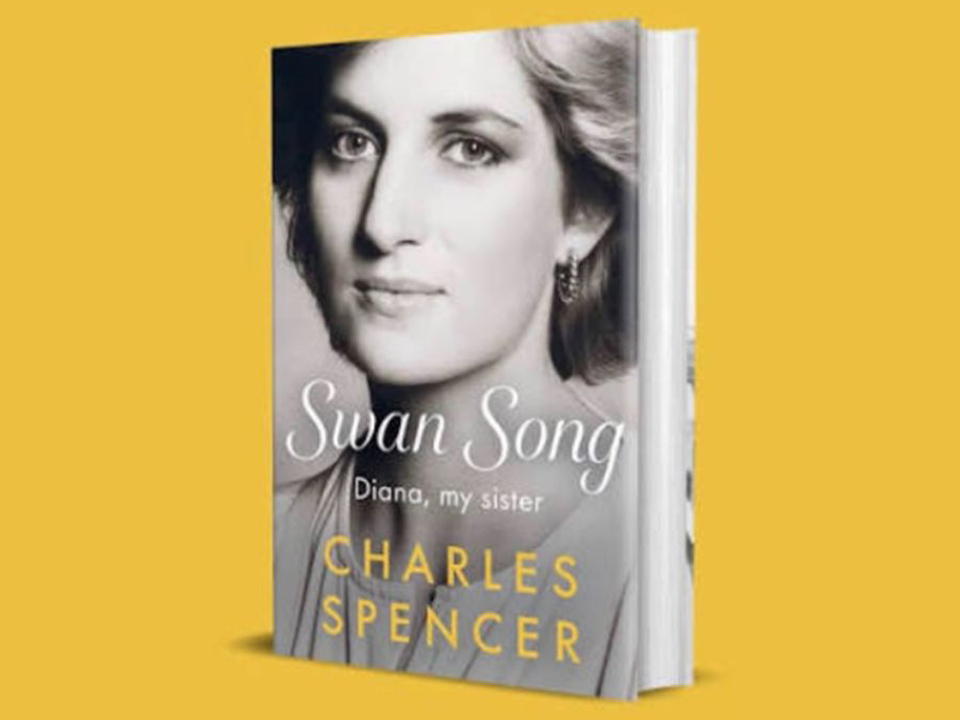
The new book Swan Song. Photo: Penguin
Prince Charles is made to appear to be prancing in his kilt across the room with good news. You cannot miss the theatricality of it because the phrase is macerated in the juice of drama. The reader isn’t hearing the content of a phone call, he is now watching a man in motion. That’s why it resembles tabloid writing, which excels at turning uncertified emotional state into highly specific imagery. Charles Spencer went to Eton College (like his grand nephew Prince George), read modern history at Magdalen College, Oxford, and wrote several volumes of historical non-fiction, as well as a previous memoir—A Very Private School—but having an elite education doesn’t automatically translate to a compelling or authentic perspective on an in-law’s life. The point is not precision, but memorability. Even if we do not eventually read the book, we will remember the details of the Earl’s account: a kilted phantom capering with delight. Not the lottery winner.
It’s from the same play book as his nephew’s for Spare: take a private conversation and twist it like you would with a knife already in the gut. What both texts have in common is a particular narrative technique. You take an interaction considered confidential not as an event but evidence of uncovered moral truth. In Prince Harry’s ghost-written memoir, ordinary family exchanges are turned to profitable malice. It’s similar in the Daily Mail serial. The raw event is simple enough: a phone call after Princess Diana’s death, but the real power of that moment is the assigning of a psychological state to the husband-no-more, one whose response was so devoid of grief it deserves filing away as resentment in its deepest depths. That is the ultimate lesson of the modern royal memoir: true grief seeks peace, while vanity demands a stage. Charles Spencer may have intended to indict the King, but he has instead written a smashing self-exposure. In trading history for a tabloid punchline, he has proven that some vendettas do not age like fine wine—they sour in the dark until someone pops the cork. Revenge porn in full, bloody glory.

