At the H&M London show yesterday, the Peta protestors struck again. But the English kept their heads and all about them did, too
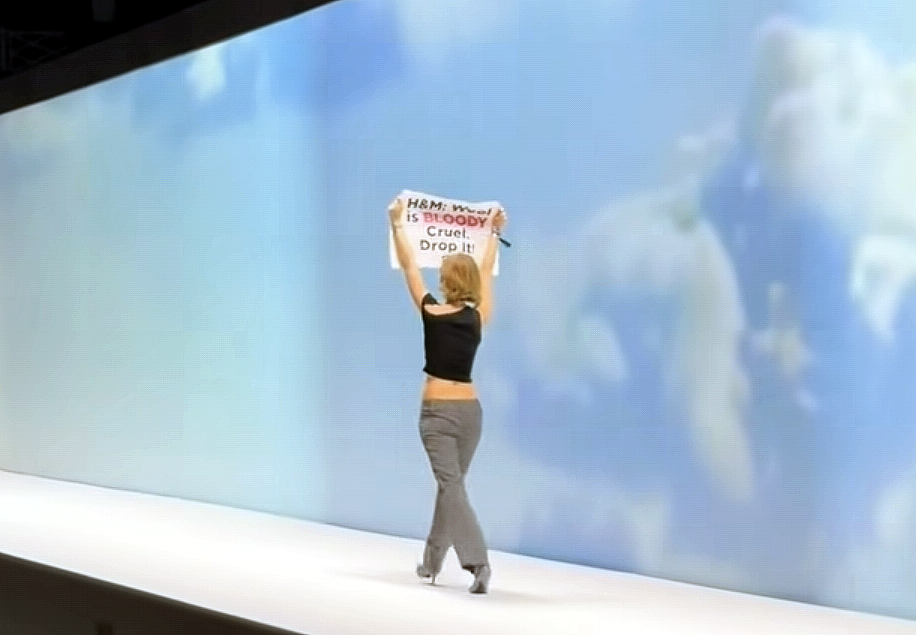
A dedicated protestor waving her flag against a sky of indifference
Another performance of the same tired script. One wonders if they ever grow weary of recycling the exact same choreography. Or, if the sheer predictability of the outrage is the entire point of the exercise. In London yesterday, during the H&M show at the Olympia, pestilent Peta protestors struck again, as they did in New York just at the top of the week. They came, as surreptitiously as before, bounded on to the stage, strutted in their bad clothes, held their limp paper message aloft (identical text about how cruel wool is). We’ve witnessed an identical same setup before—except this time, by some miracle, the peace was kept without anyone needing to violently rearrange anyone’s face held between thighs.
But it wasn’t a miracle. Calm leadership carried the day. We were not at the H&M show, but social media reels showed us vividly that the interruption passed with almost no fuss. A model came on, a protestor tried to cut her path, the model went ahead, and completed her walk as blankly and icily as model do. The protestor continued her unimpressive catwalk. No model was cued to take the stage. The protestor completed his routine before being ushered out by security. The next model emerged and the next protestor dutifully stepped up to break her strut, but the wheels of industry turned on. No one from the security detail leapt on stage to perform a live demo of unarmed combat. Most strikingly, Laura Weir did not streak from her seat and smother a protestor’s face like a frantic mother trying to deny food to a persistently overeating child.
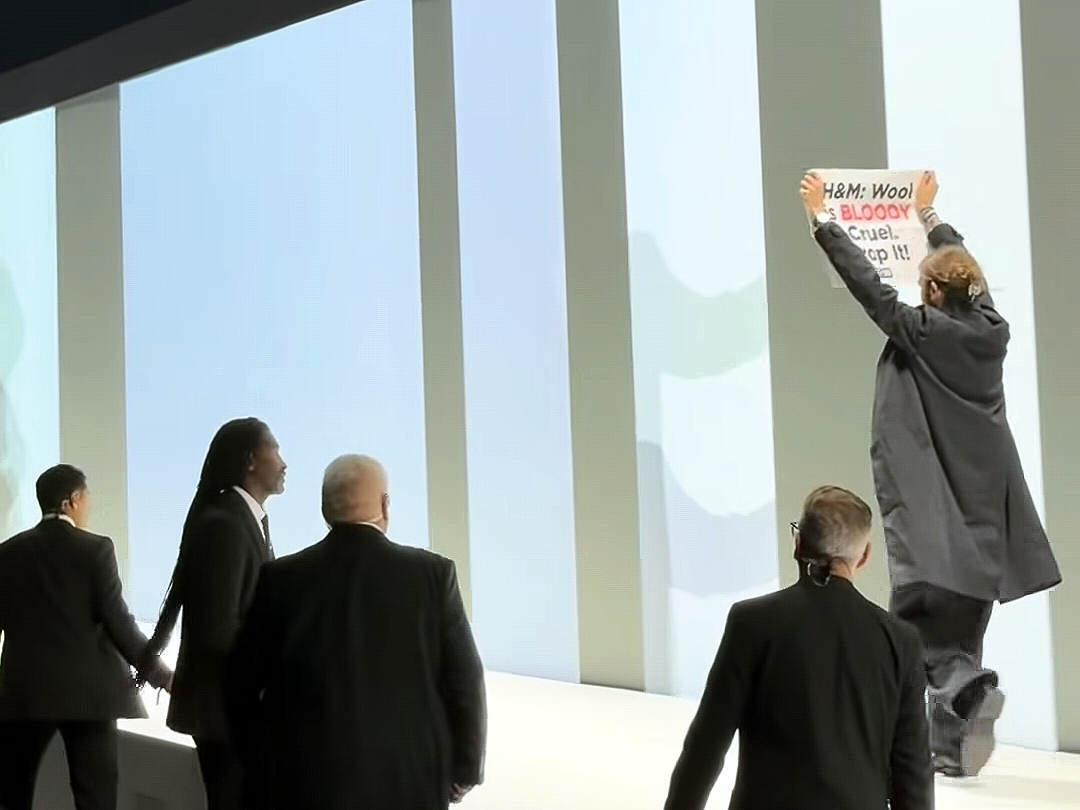
Security officers of the show allowed a protestor to finish her strut
What we did not get to see was how the producer and the floor manager reacted. But it was clear that they refused to rush the queue, telling the models to remain stoically unfazed, and allowing the protestors to complete their own hitherto unimpressive little amateur sequence. It painted an admirable picture of pure, unbothered professionalism. In contrast to what happened in New York early this week, the English fashion elite did not take matters into their own hands. The security detail was visible—there were at least five officers—but no one was frantic. When one of the protestors walked to the end of the runway, a security staffer gestured to him to get off the stage—an invitation he treated with the profound disregard usually reserved for front-row small talk. But she did not pounce on him. Instead, she merely watched him finish his half-baked sashay, clear in her mind that public humiliation on a livestream was a far more severe punishment than a tackle.
Conversely, Steven Kolb’s shockingly physical attack during the COS show gave the Peta activists a martyrdom narrative. And he, a monument to shame, etched in the permanent registry of human disappointment. But many thanks to Mr Kolb, we could clearly see how the H&M incident projected institutional restraint. The audience saw the protest. The protesters got their moment. Security did its job. The show continued. Nobody became the story. Except, non-violence. And that may be the most important thing the episode revealed. Both PETA protests were designed around a moral claim of non-violence toward animals. Yet, ironically, in New York, the images that circulated afterwards were reels of physical struggle. The visual language shifted from “look at what happened to the sheep” to “look at what happened to this sad old man”. From pastoral tragedy to prestige drama, in one swift, front-row leap.
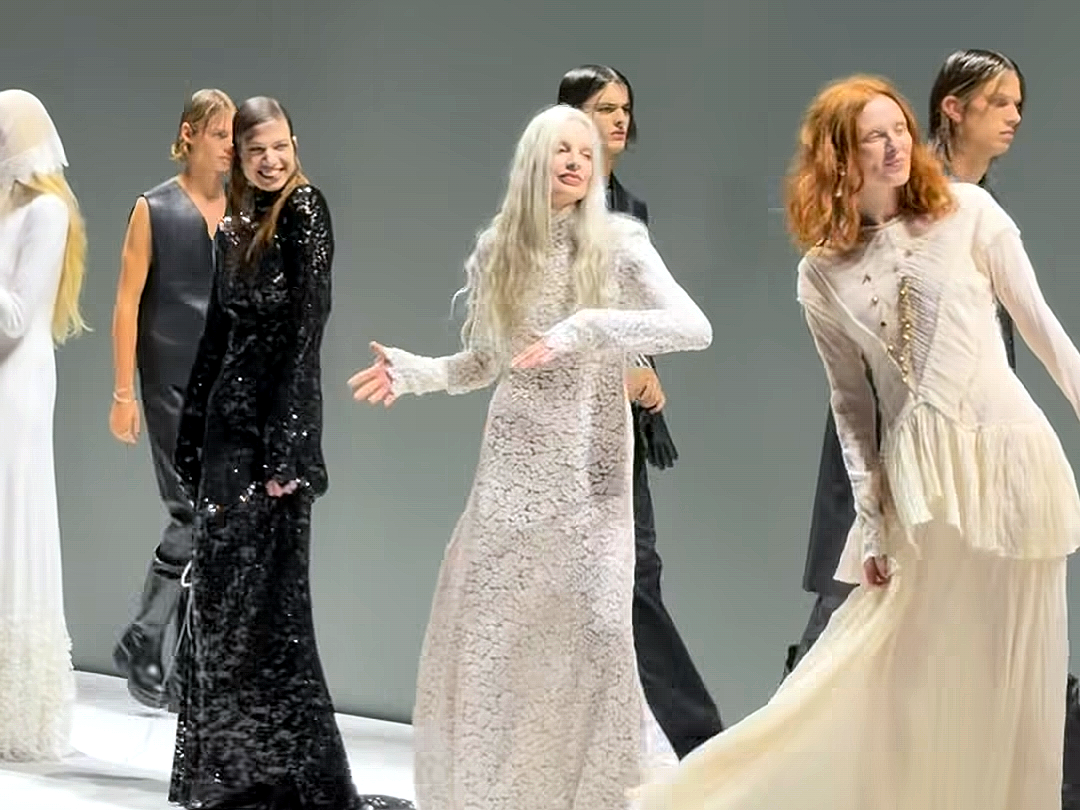
The H&M show went on without a dent. During the finale, models , including Kristen McMenamy (middle), dance merrily
London avoided that trap. The protesters remained non-violent. Security remained non-violent. H&M remained non-violent. As a result, nobody could claim victimhood from the interaction itself. The audience was left to consider the underlying argument that the protestors presented rather than being distracted by a confrontation. What the Peta’s stunt at the H&M show demonstrated was something that many institutions somehow forget. Non-violence is not merely a principle for protesters. It can also be a strategy available to those being protested. By refusing to physically escalate, H&M effectively denied Peta the possibility of a second story. In New York, Peta is now glowing with a police complaint. Notably, the London response remained aesthetically consistent with the fashion world’s self-image. Calm. Controlled. Choreographed. Almost boring. But boring is often underrated. And, the enemy of algorithms.
Google Earth fans will know the Atlantic hasn’t shrunk, but the cultural distance just keeps on stretching. To us, so far away from either side, this is peculiarly British: the instinct to deny a disruptor the status of protagonist. The prefer not to crush the disturbances, but absorb them, then serve tea. Over in America, Steven Kolb’s reaction at COS was simple: “This cannot happen, not on my watch.” The moment the authority went on the runway physically, the authority has accepted the protestor’s framing, however unappealing or disruptive. As we saw in the Macklemore firestorm, even if that’s more a moral than an ethical issue, authority or billionaires do assert aggressively. Everything can be turned to spectacle. Power must be used, no matter the form. But the reason the London episode appears impressive is that it revealed power without needing to display coercion. The way we see it, power looks mightiest not when it wins a fight, but when it never needed to.
Screen shots: tianweizhang/Instagram

