The meteoric rise and cinematic unravelling of regional wellness empire Fitness First saw high-society networking, prime mall sq ft, and a founder’s sheer gravitational pull on a head-on collision with basic economic gravity and the fitness of their finances
True Fitness at Bangkok’s Exchange Tower in the 2010s. File photo: Jagkrit Suwanmethanon for SOTD
At about eight yesterday evening, the serial café entrepreneur Bill Ho shared on Instagram that after closing his new outlet Bill’s 8 Cafe (a call back to his original at Bukit Pasoh), he was planning to work out until he learned that—and we quote verbatim—“my gym is actually—is close. True Fitness is officially just close like that.” He revealed that he had recently signed “a new contract for another two year and I a-ready pay the full a-mound.” That new sign-up was necessary because his “old contract finish at December this year”. Apparently a sales staffer at True Fitness had been “pushing” him to sign an “infinity package” and pay “S$5,000 for lifetime membership”. According to him, the persistence led to “some kind of a bad feeling”—a subtle intuition usually reserved for finding a drowned espresso cockroach at the bottom of the Chemex or realising you’ve accidentally hooked the milk line up to the sewage drain. He eventually settled for something far less than “infinity”—a very finite two-year deal for S$1,731. And ended with our island’s now-trending lament/regret: “I don’t think, right now, I can get back my money a-ready.”
Mr Ho’s relating of getting burned and facing the harsh reality of writing the expense off is a familiar story. It is, unfortunately, the unglamorous truth of the mega gym business model here (and largely the region). We have seen and heard similar total losses from the infamous California Fitness shut down in 2016, when the company announced its total closure just after midnight on Wednesday, 20 July. In fact, the high court order appointing the liquidators was officially handed down a day earlier, but gym staffers and members did not know. The liquidators finalised their legal paperwork immediately and pushed out the announcement the moment it was legally ready, at 12:03 am. Most people were in bed at the time, but it took less than six hours for the news to blow up. While Singapore snoozed, the digital rumour mill required a mere six hours to whip itself into an apocalyptic frenzy. It provoked the sort of existential panic usually reserved for a bank collapse. Mr Ho’s story recounted now had already played out exactly 10 years ago. History apparently lacks the imagination to invent a fresh farce.
Apparently a sales staffer at True Fitness had been “pushing” him to sign an “infinity package” and pay “S$5,000 for lifetime membership”
The absolute permanence of Mr Ho’s financial loss to True First carries a quiet devastation. For his followers, this was not disposable income; it was hard-earned. He amassed a tidy roster of 67,900 witnesses by broadcasting the tedium of business and the chronic failure of his coffee ventures—including, unsurprisingly, the lead-up to the opening of the current shop. The sheer persistence of his misfortune were almost admirable. Mr Ho’s backstory, however, belies the membership of True Fitness in their founding years. To frame True Fitness merely as a digital-era casualty of closed metal shutters and unreturned deposits is to miss the entire architecture of its ambition. Long before serial entrepreneurs were broadcasting their gym-contract disenfranchisement to an amused audience, the brand operated as something closer to a secular temple. When it opened in late 2004 at Ocean Towers, it was a high-gloss monument to Shenton Way mobility, where sweat was commodified, floor plans were treated as cathedrals, and membership contracts were engineered to look like permanent lifestyle acquisitions. If California Fitness was a high-octane, dance-beat-infused snare, True Fitness was a sleek, corporate-chic, and upscale urban workout sanctuary.
At Ocean Towers, the brand did not merely sell access to a treadmill; it sold proximity to an aesthetic. And the chief curator of that illusion was Patrick Wee Ewe Seng. Gyms are sometimes built on personalities. One that comes immediately to mind is the Canadian fitness entrepreneur Eric Levine, the flashy, publicity-hungry modeliser (who married the former model Varaluk “Joy” Vanichku) behind California Wow Experience in Thailand, after founding the original California Fitness in Hong Kong in 1996. California Wow Xperience predictably shuttered in late 2012/early 2013, amid mounting law suits from landlords and even accusations of money laundering, and tens of millions of baht worth of luxury land assets linked to Mr Levine. But at the start of True Fitness in 2004, Patrick Wee belonged to a different social standing than the brash Mr Levine. The son of the former chief justice, the late Wee Chong Jin, his social magnetism and establishment pedigree gave his gym an immediate, almost unassailable sheen of institutional legitimacy.
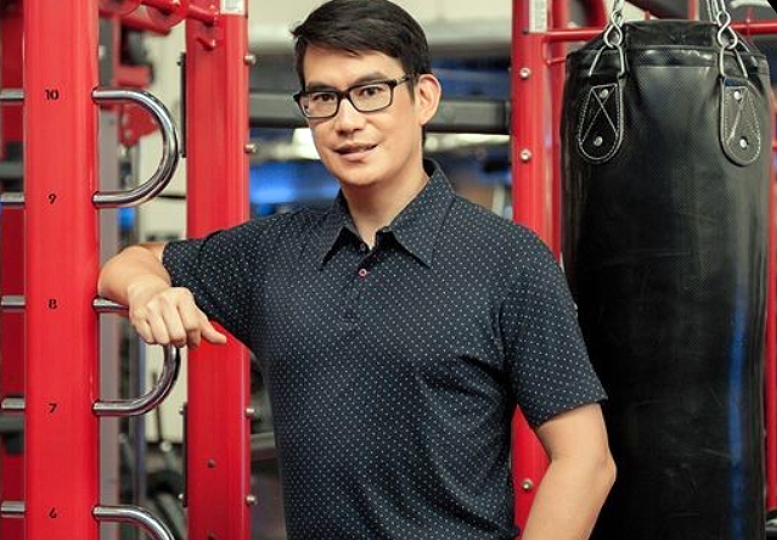
Patrick Wee. Photo: LinkedIn
Patrick Wee was born into privilege. Together with his famous father (who was from Penang and had attended the esteemed Penang Free School that, interestingly, produced many distinguished names in the legal profession), his Eurasian mother Cecilia Mary Henderson (the highly revered president of the Singapore Girl Guides Association) and his siblings Veronica, Laurence, and John, he grew up on their family estate in the atas Nassim Hill, our island’s prestigious residential enclave near Tanglin/Orchard Road. Not much is known about the Wee children or which schools they attended, but Patrick Wee did graduate from the National University of Singapore in 1989 with a law degree. Following his admission to the Singapore Bar in June 1990, he joined the boutique law firm co-founded by his eldest brother Laurence Wee and the Ramayah siblings, Gopal and Vangat, Wee Ramayah & Partners. The company dissolved in 2015 after a strategic merger with another law firm. The youngest Wee son exited full-time legal practice in January 1999 to construct the commercial entities that quickly became the notable, but ultimately doomed True Group.
Long before fitness brands relied on digital influencers or targeted Instagram ads to manufacture actionable desire, True Fitness grew through the oldest and most effective medium available: the social scene. The media of the era called Patrick Wee “flashy”. To be sure, his luxury-brand-filled wardrobe was entirely blameless. He earned the label not by what he wore, which was smart yet skewed conservative, but by the sheer, enviable frequency with which he was seen where everyone else wished they were. And much like Mr Levine, he was invariably accompanied by the era’s most recognisable models—such as Karen Chai, who was frequently seen by Mr Wee’s side shopping, dining, and dancing. A model at the time told us that back then, the social circuit treated him like a gold medal at a national meet, and every eligible woman in town was running an aggressive marathon with a butterfly net just to catch his stride. “He was hot, lah,” she affirmed, “but it was Karen who dapat him.” Ms Chai, who appeared on the cover of Vogue Singapore in May 1995—with the blurb “Absolutely Irresistible Essentias”—would eventually move to Hong Kong, where she was said to have married an Italian fashion executive.
Long before fitness brands relied on digital influencers or targeted Instagram ads to manufacture actionable desire, True Fitness grew through the oldest and most effective medium available: the social scene
While Patrick Wee was manifestly the face of True Fitness and a fetching invitation to be part of an inner circle pivoted on physical enhancement, it was his little-mentioned co-founder Andrew Ong, an NUS mate, who was quietly referred to as the “corporate engine” of the True Group. Mr Ong brought a legalistic, rigorous attention to detail to the company’s operations, those in the know had said. He personally oversaw the logistical, legal, and operational mechanics required to scale the fitness, yoga, and spa brands across five countries. At its peak, he managed a footprint of 30 distinct regional centers spanning Singapore, Malaysia, Thailand, Taiwan, India, and China. In Bangkok, where True Fitness welcomed ex-members of California Wow Xperience disappointed by their club’s palpably worsening state of their facilities, they were seen as Singapore’s polished answer to the Bangkok grand dame’s battle scars. When it opened its massive second branch at the newly refurbished and rebranded Zen at CentralWorld, it unexpectedly leaned into the brash playbook of California Wow Xperience—sidestepping the cautious restraint that its corporate “True” branding typically tried to maintain in their early days.
That expansion into Bangkok’s popular retail megaplex was not a matter of cold corporate logistics. It was brokered, as many at the time saw it, in the shared dialect of an expatriate business class. When figures like Allan Nam (also Namchaisiri)—the hi-so-adjacent Singaporean running Zen at the time—extended an institutional welcome to their compatriots to the Thai capital, the deal felt less like an overseas spread than an extension of the home turf. For a brief moment, it appeared that shared cultural shorthand and multi-floor workout space could outrun basic economic gravity. Just five years after the Zen gym breathed its first life, Bangkok burned. Out of the ashes of the 2010 Red Shirt protests, a blackened crater carved through the heart of CentralWorld—the violent punctuation mark left by hardliners who turned a nation’s fury into fire. The Zen end of the mall, with the Royal Thai Police Headquarters across Rama I Road and the four-faced Buddha diagonally opposite, was the hardest hit. The intense, hours-long, overnight blaze caused a façade wall of Zen Department Store to collapse and the entire 18-storey Zen tower to choke in thick, acrid soot. True Fitness, too..
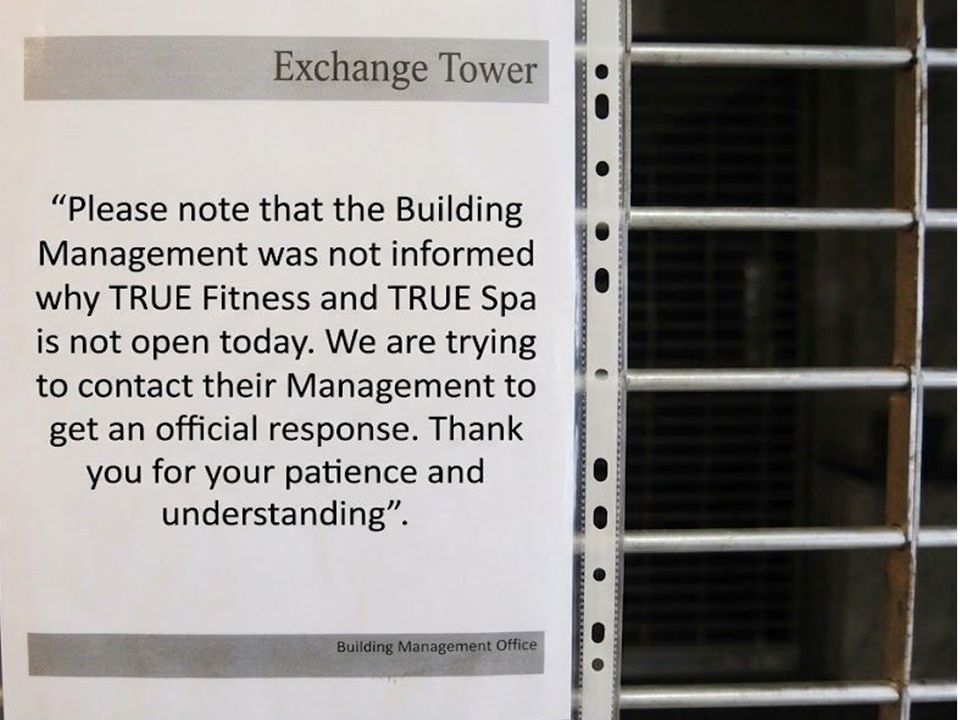
The True Fitness branch at Exchange Tower in Bangkok, permanently closed without prior notice on June 8, 2017. Photo: Jagkrit Suwanmethanon for SOTD
If the smoke that covered every treadmill provided a suitably cinematic omen, the true tragedy of the brand’s regional ambitions was not the sudden act of urban insurrection, but the slow, unromantic slide that followed. The soot in True Fitness was eventually scrubbed from every barbell and the hum of social fitness coaxed back to life. The gym reopened in 2011 after a 150 million baht (or S$7,126,000 today, factoring cumulative inflation) remodelling, after which a brand-new True Yoga and True Spa concept emerged. But, by then, the psychological veneer of untouchable glamour had cracked. What had once looked like an effortless, high-gloss regional real estate sweep began to reveal what some called the “precarious math” propping up its balance sheet. As it was noted after the California Wow Xperience fiasco, a fitness empire built on the illusion of endless cash and upfront memberships is only just riding on borrowed time—and borrowed air. The gleaming temples of wellness did not burn down overnight; they were quietly strangled by thinning margins, restless landlords, and a membership base that suddenly stopped swaying to the beat.
Patrick Wee is no longer tethered to True Fitness. His sweeping descent from veritable man about town began with the spectacular 2017 collapse of True Group’s overseas empire, quickly followed by the only kind of heavy lifting he did: legal paperwork. He was officially terminated as Group CEO in May 2018 after the brand was majority-sold to Chinese investment group, Tongfang Kontafarma Holdings (now Kontafarma China Holdings) for US$36.7 million (or about S$63.34 million, factoring cumulative inflation). The new management actively sued Mr Wee for breach of contractual and director’s/fiduciary duties and, in July 2022, the court ruled in favor of True Group. Mr Wee, it found, had breached his fiduciary duties by continuing to sell long-term memberships while knowing the Thai and Malaysian clubs were days away from shutting down. Despite the failure of California Fitness and, later, Planet Fitness, mega-gyms remain a lure even when they are not quite fitness services, but camouflaged cash-flow schemes. Their members traded their disposable income, social capital, and misplaced vanity, and keep coming back for more, coffee in hand. History will hit replay because humanity clearly missed the tutorial on the first run.

