The arcade too. Only in America can statecraft be reduced to cheap, pixelated cruelty-as-digital-nostalgia

The big beautiful five
By Low Teck Mee
For most of the day, I was quietly minding my own business—until my phone’s news alerts, displaying their usual flawless sense of urgency, decided I required entertainment and served up news on the “White House Arcade”. Yep, real: a digital LevelUp, without the pub grub and Cocktail Towers. The Trump White House just launched an official online arcade featuring five video games tied directly to the administration’s policy agenda. Because, I guess, if there’s one thing the American electorate was missing desperately, it was the ability to power-level through national security strategy from their browser. It is really goated that the administration could have come to the delightful realisation that if citizens won’t digest policy through traditional news outlets, they might at least press ‘A’ to pass a bill.
The titles are not unsurprising and you don’t even have to be a regular gamer to know what they point to: Build the Wall, Rio Run, Flappy Bill, Supply Line, and Trump Savings Tycoon, all designed to crudely gamify immigration enforcement, school lunch policy, and children’s savings accounts, gleefully. When I looked at the interface, it reminded me of what I used to see in my grandfather’s Nokia phone of the ’90s when I used to sit next to him and watch him play Snake and the like while he drank Guinness stout out of the can and I was only allowed Milo in a beaker. But that is the problem I see: the same visual language—the stripped‑down pixel logic of Snake, for instance—that once meant harmless diversion on your grandfather’s phone is now repurposed to dramatize exclusionary policy.
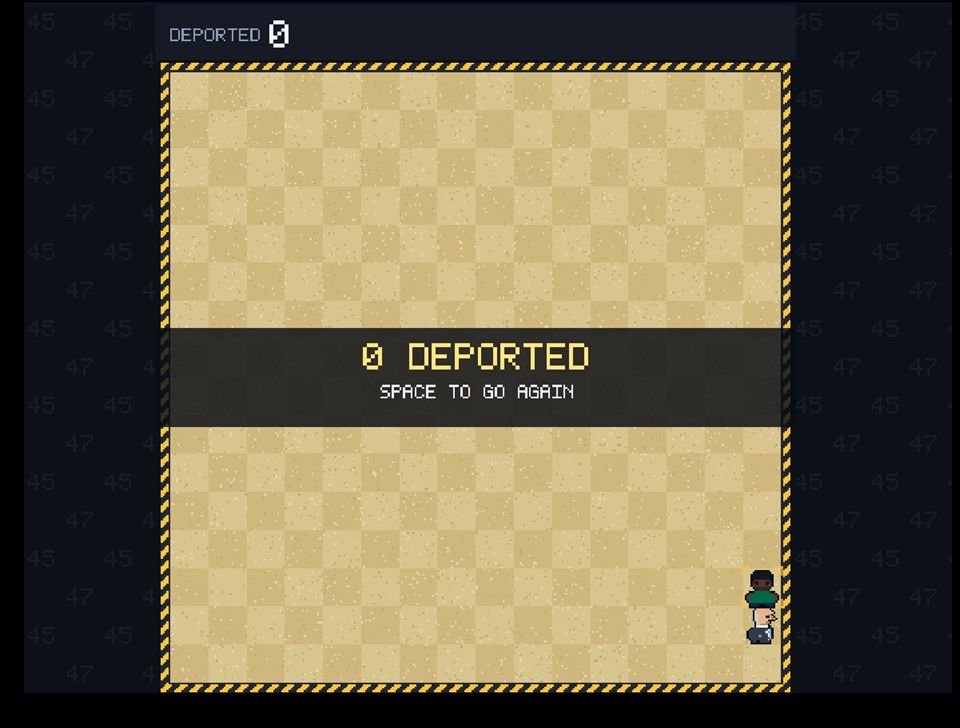
The stunning Rio Run
So I scoped out the “Arcade”. It was more juvenile than I could imagine. The first game I looked at was Rio Run, which clearly echoed the pixel flatness of Snake on those old Nokia bricks. Again, those blocky sprites, repetitive scrolling, and a sense of endless chase. But while Snake was self-consuming (you chased your own tail!), Rio Run is not ouroboros. It is externally hostile—the “enemy” is not the player’s own tail, but migrants along the Rio Grande, rendered as obstacles to be chased or blocked. At the end of the game, you were told how many were “Deported” by you. Looking at this from outside the U.S. (I did not attempt to play), the message is chilling: what was once harmless diversion is now a cartoon of some of our unwelcome status, turned into a game for domestic consumption. It looked to me to essentially be a holding pen for future delinquents supported by presidential policy blunder.
One thing did strike me deeply. The tile map (or background layer) of the game is something very, very familiar. It is akin—even chromatically—to Louis Vuitton’s Damier checkerboard pattern, the brown‑and‑beige grid introduced in 1888, later reissued as Damier Ébène and Damier Azur. Unlike Snake’s gameplay, which is generic, LV’s checkerboard is, as I understand it, a registered design motif in multiple jurisdictions. But it’s one thing to crush Molly Tea in Suzhou; it’s quite another to litigate against the White House in Washington. Besides, Bernard Arnault, as head of LVMH, has historically cultivated cordial ties with Donald Trump, especially during the latter’s presidency when Mr Arnault appeared at White House events and praised U.S. manufacturing initiatives. But I can’t miss the high-class irony: A symbol of seamless international travel now a grid weaponised for border enforcement. I don’t know; I think it’d be hard for LV: Defend their IP and risk being seen as siding with migrants against Donald Trump, or stay silent and let their motif be politicised. Beautiful dilemma.
Screen shots: whitehouse.gov/arcade/

