Two designers, identical moral transgressions, yet entirely divergent fates: Coco Chanel is wildly celebrated, while John Galliano, without a doubt, is condemned to hell
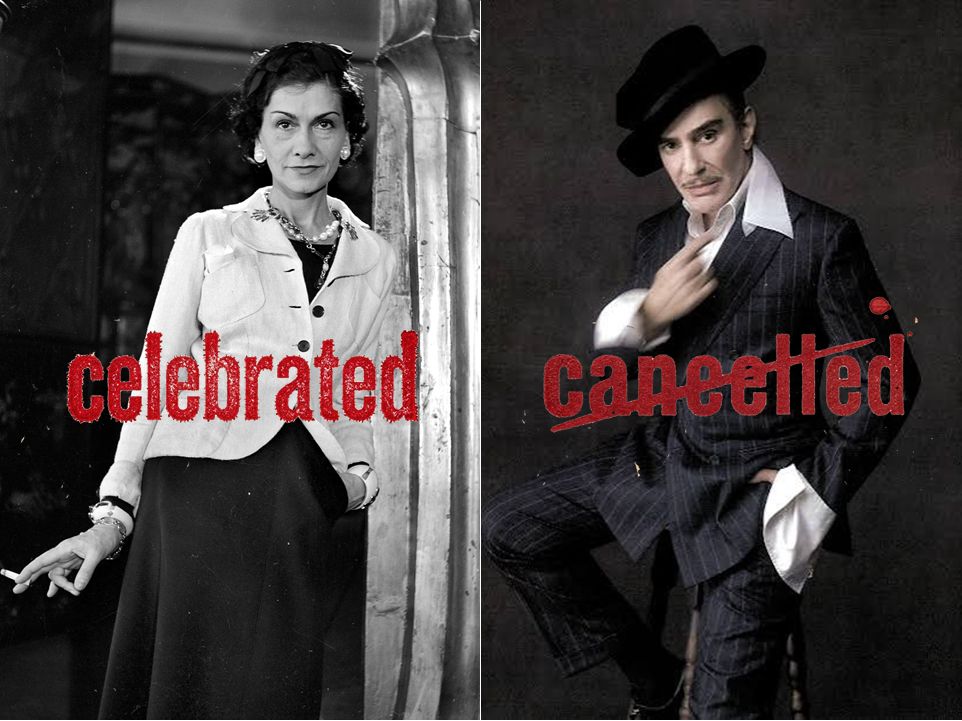
Gabrielle ‘Coco‘ Chanel and John Galliano. Photos: Getty Images and Szilveszter Makó/Instagram respectively
The Met fiasco of the past three days has made one thing very clear: there is a fracture point in contemporary taste culture. What we have been watching is the collapse of consensus around what counts as “heritage” and what counts as “hate”. And, as it turns out, when an institution attempts to package a career rehabilitation as high culture, the donor class can be trusted to crush the entire enterprise the second public outrage threatens their precious brand equity, proving precisely who really runs the museum. And that the philanthropic elite can wield more power than we can imagine—a colossal cheque or a multi-million-dollar van Gogh is always a reminder to the board whose name is on the limestone. For decades, institutions like the Met could canonise figures by insulating their artistry from their politics. But in just three days, we have seen that this insulation no longer holds. Who wants a John Galliano bias-cut gown when they can have a Jasper Johns White Flag?
Mr Johns’s White Flag is about stripping away automatic meaning, forcing the viewer to see the flag as “a thing the mind already knows”, as he famously said, but emptied of its patriotic charge. It was an experiment in detachment: separating the symbol from the object, the art from the politics. But the cancellation of the proposed John Galliano: Horizons exhibition proves that this detachment is no longer possible. We cannot look at a bias‑cut gown as pure form, geometry, or artistry. The gown is inseparable from the scandal, the hate, the optics. Where Mr Johns neutralised—even neutered—the flag into abstraction, Galliano’s work proves that every object, especially now, carries its biography, its scandal, its optics. The gown, however worthy, cannot be seen as cut or drape alone; it must be the moral rap sheet. It clearly demonstrates the impossibility of detachment, as though a badly behaved needle could somehow produce a crooked hem. The back story is truly the only medium.
The gown, however worthy, cannot be seen as cut or drape alone; it must be the moral rap sheet
Let us abandon the tedious anxieties of New York for Paris, where a wartime collaboration is simply remembered as scratched antique finish, allowing Gabrielle (Coco) Chanel to remain the patron saint of laundering history with a tweed jacket and, got most, a quilted bag. More than 65 years after World War II, German military intelligence records, known as the “Abwehr files”, identified Ms Chanel as Agent F‑7124, codename “Westminster”, a reference to her lover, Duke of Westminster. She was no Mata Hari, but she was a spy. These declassified documents revealed she was recruited into the Abwehr (Nazi intelligence) in 1941, undertook missions, and attempted to exploit Aryanisation laws to seize control of her perfume business from her Jewish partners, Pierre and Paul Wertheimer. She lived at the Ritz Hotel in occupied Paris with Hans Günther von Dincklage, a German officer in the Abwehr. This relationship gave her entrée into Nazi intelligence circles. She used her position to secure the release of her nephew André Palasse from a German prison camp.
To launch Chanel No. 5 in 1924, she needed capital and industrial backing. She struck a deal with the Wertheimer brothers, Jewish businessmen who owned Bourjois cosmetics, now belonging to the American group Coty (ironically, owned by the JAB Holding Company that’s controlled by the Nazi-entangled Reimann family). The Wertheimer siblings financed production, distribution, and marketing of the perfume, while Chanel contributed her name and concept. In desperation, she agreed to a deal that was problematic from the start: She retained only 10%, with another 20% went to her friend Théophile Bader, the founder of Galeries Lafayette, who had brokered the partnership. Chanel later grew bitter, feeling she had been cheated out of her own creation. Her grievances stemmed entirely from raw greed, resentment over a contract she willingly signed, and wounded aristocratic pride. She used Nazi Aryanization laws to dispossess the Wertheimers of their majority stake. It is hard not to call that antisemitism—in action.
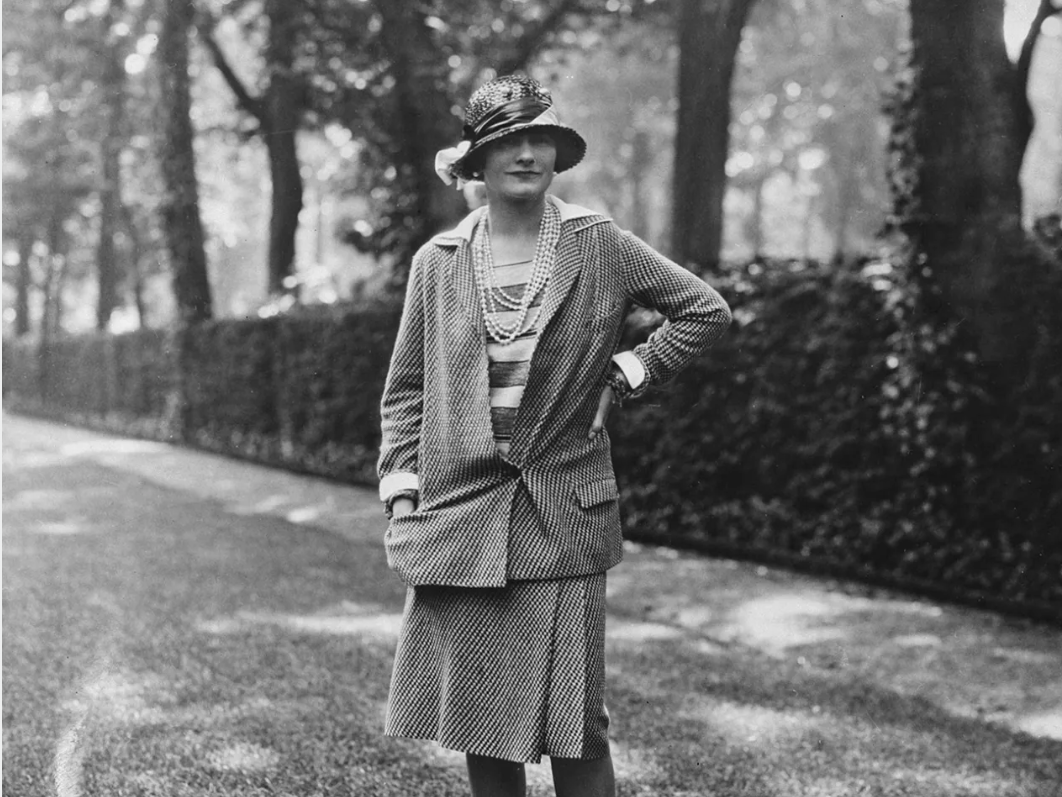
Coco Chanel in 1929 adopted a silhouette that Matthieu Blazy is not reprising. Photo: Getty Images
The irony could not be starker. Chanel No. 5 was made possible by the Wertheimer brothers who transformed the plainly-bottled parfum into a global empire, yet they became the targets of the creator’s wartime treachery. Despite her best efforts, her resentment was wasted. The Wertheimers transferred ownership to a non‑Jewish ally before they fled France, protecting their interest. After the war, she was interrogated, but never prosecuted. Her reputation was, however, tarnished. In 1939, she closed her couture house, retreating from fashion altogether. For fifteen years she lived in exile from her own industry, while the Wertheimers quietly rebuilt their empire. Then, in 1954, Coco Chanel staged her comeback; she reopened her couture house, but the world had changed. Dior dominated Paris, and brand Chanel’s revival was financed not by the founders’s own fortune but by the Wertheimers’—the very family she had once tried to erase. They underwrote her return, secured her survival, and ultimately consolidated control of the entire brand.
By the time of her death in 1971, brand Chanel was no longer owned by her. Coco Chanel was outmaneuvered by the backers she tried to ruin. Today, Alain and Gérard Wertheimer, grandsons of Pierre, own Chanel outright, making it the largest privately held luxury house in the world. The Wertheimers didn’t just inherit the house of Chanel, they actively rewrote its history, turning a scandal‑ridden maison into the most mythologised luxury brand of any era, allowing people to think buying a quilted handbag is a personality trait. Their strategy was as much about design as obliteration and substitution, perhaps more: erasing Coco’s wartime collaboration and actionable antisemitism, while amplifying the timeless aura of No. 5 and the tweed suit. The family through the ages avoided publicity, never foregrounded her politics, and let her image be re‑cast as the eternal couturière. Coco Chanel was, and still is, lauded as “ahead of her time”. But antisemitism is never ahead of anything. A recently published editorial in Architectural Digest called her “a model businesswoman”. The rhetoric isolates her aesthetic innovations—jersey sportswear, the little black dress, the bouclé suits, the quilted handbag, the two-tone pumps, the camellia, No. 5—from her political and moral standing, cleanly.
The Wertheimers didn’t just inherit the house of Chanel, they actively rewrote its history, turning a scandal‑ridden maison into the most mythologised luxury brand of any era
There’s no surviving speech where she says “I hate Jews” or, in John Galliano’s case, “I love Hitler.” What we do have are actions that speak volumes. We do not, therefore, need a transcript of her pillow talk to judge a woman whose career was lubricated by the Third Reich; her actions were not merely worse—they were the calculated, opportunistic betrayals of an unrepentant collaborator whose mythologists prefer to sweep moral bankruptcy under one spiral stairway on a particular Rue Cambon. Denying—even glossing over—Chanel’s antisemitism takes a jaw-dropping level of historical illiteracy. Yet, the brand is now not only trending under the creative direction of Matthieu Blazy, it has become hugely commercial. Mr Blazy has explicitly focused his creative direction on a deep, archival dialogue with Coco Chanel’s early work and personal life, even researching issues of Vogue spanning 1916 to 1939, but he has never mentioned the woman’s complicated, antisemitic past. For the brand today, keeping the focus strictly on the ‘stewardship’, while maintaining the calculated amnesia, is a deliberate business strategy: to protect a multi-billion dollar business and, no doubt, the Wertheimer fortune.
When the French intelligence files on Coco Chanel’s wartime collaboration were declassified in the 1990s, the revelations were damning — but they didn’t trigger the kind of public vitriol John Galliano faced after his drunken antisemitic tirades, and more so after the proposed retrospective at The Met was cancelled. Back then, there were no social tools of the beastly Internet. Mr Galliano’s antisemitic remarks were caught on video in 2011, circulating instantly. There was no buffer of time. Still, long after the world ran out of reasons to care, every microphone-wielding former journalist with a ring light and the internet’s cheapest amphitheater are still furiously lining up to beat a dead horse that isn’t dead. Even his biographer, Dana Thomas—who manages to materialise on every podcast and news segment willing to host her, unfailingly accompanied by the geographic note that she lives in Paris—is only too delighted to inform the room that he is a frightfully and thoroughly unpleasant man, as though such a thunderous revelation required a Parisian postcode to decode. The asymmetry is clear: one is a case of obliteration through deep silence, the other of condemnation through loud repetition. With the burning cottage industry of performative outrage, John Galliano would probably prefer the hush.
Illustration: Just So

