What The New York Times has done this past week in the thick of The Met saga is nothing short of burning down a wing and welcoming readers to the debris tour
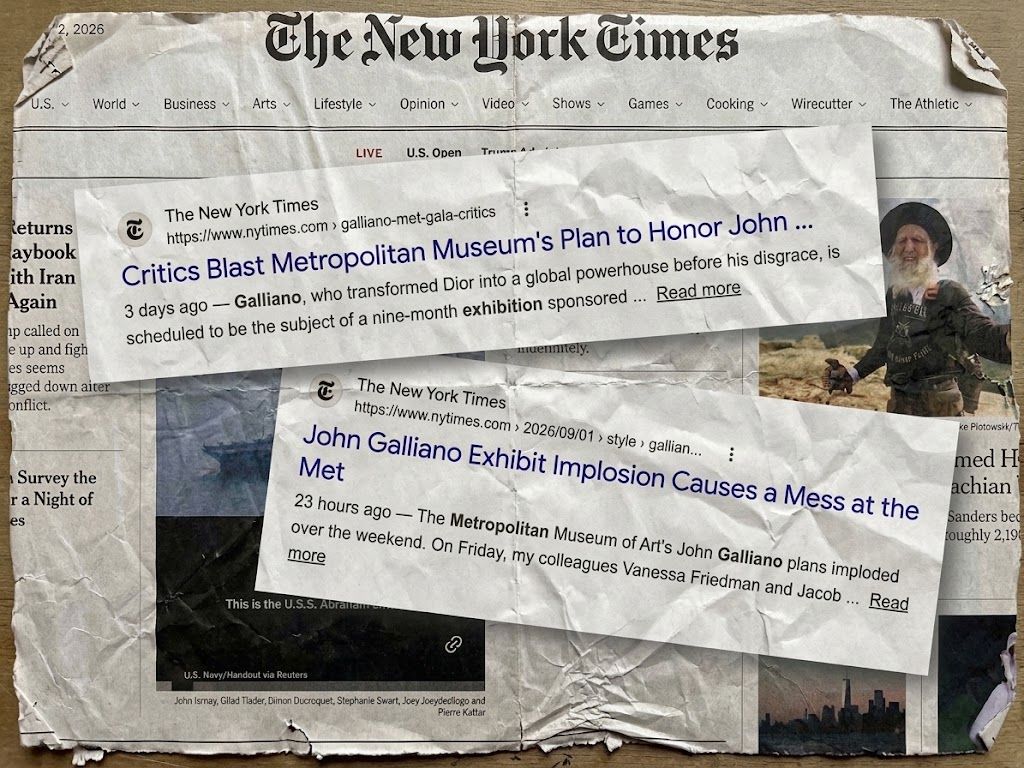
What was once the exclusive resort of the gutter press has now become the universal baseline; even the most venerable broadsheets have abandoned the conceit that dignity pays the rent. We might charitably write off such tactics from our local dailies desperate for views, but watching The New York Times debase its masthead for the algorithmic sewer is a special order of depressing. To chart the descent from serious reportage to this breathless digital screech is not merely to observe a shift in tone; it is to watch a once-proud masthead trade its entire authority for a cheap hook. We have been following the saga at The Met over the past week, largely through The New York Times, but we are struggling to make sense of these two online headlines: first. “Critics Blast Metropolitan Museum’s Plan to Honor John Galliano” and then, then 23 hours ago, “John Galliano Exhibit Implosion Causes a Mess at The Met”. The choice of “blast” and “implosion”—why the martial affectation?
The two pieces were not written by the same staffer, but that does not absolve NYT. Headlines aren’t just individual choices; they’re editorial products shaped by the paper’s house style and its appetite for spectacle. And, as we now see, maximising digital yield. The first headline ran atop a report on The Met’s Jewish benefactors, who are predictably opposed to the planned John Galliano retrospective. Yet the pre-brawl register “Critics Blast” reads as if the opposition were external—journalists, academics, activists. In truth, it was the museum’s financial backbone. The story dispensed with the tedious formality of balancing its narrative, opting instead for the voices of the Jewish community, without a hint of push back. These individuals include: super-donors Alice Tisch and Julie Macklowe, New York City Council Speaker Julie Menin, and gallerist Arne Glimcher. And the editorial is penned by two fellow Jews: Vanessa Friedman and Jacob Bernstein, who, in June, profiled Mrs Macklowe and called her “the pro-tax socialite”. It is hard to miss the insular-family-affair vibe.

Vanessa Friedman. Screen shot: culturedmag/YouTube
Ms Friedman’s and Mr Bernstein’s reporting reads less like heroic journalism and more like a highly coordinated exercise of raw institutional power by a specific, elite New York network. Manhattan’s billionaire philanthropic class, and the city’s political machinery operate as a singular ecosystem. By deploying reporters who share the exact identity, community ties, and cultural priorities of the museum’s wealthiest donors, the newspaper essentially acted as the enforcement arm for a specific group of stakeholders. It wasn’t just covering the news; it was actively organizing a public relations campaign to dictate who can or cannot be celebrated in cultural spaces. By assigning Jewish writers to file the story, a closed loop is created: the reporters, the outraged donors, the local politicians, and the ultimate victims of the original offense all share the same cultural background. For us, it feels like a convenient cover for an intentional, targeted takedown. When a newspaper pairs its top fashion critic with its leading investigator of billionaire networks to dismantle a multi-million-dollar exhibition, it is hard to overlook their shared identity and not conclude that the assignment was deliberate.
Beneath the hallowed halls of journalistic prestige lies a machine with an operation that is deeply disillusioning. For decades, Vanessa Friedman has been marketed as the ultimate global arbiter of fashion journalism—the authoritative voice at the apex of the industry. But this entire episode exposes the reality of her position: she isn’t a detached critic holding power accountable from the outside. She is an insider—a member of the elite crowd she belongs to. When it got organized, she didn’t did not appear to have investigated the situation as an independent journalist. She used her massive platform to act as the megaphone for people she probably already knew, executing what looked like a targeted takedown of an exhibition that the international fashion world was actually quite interested in seeing. We were prepared to fly to New York to inspect the exhibition, despite the Trump administration’s frosty hospitality towards outsiders. But it is now apparent that fashion and forgiveness have always occupied entirely separate galaxies.
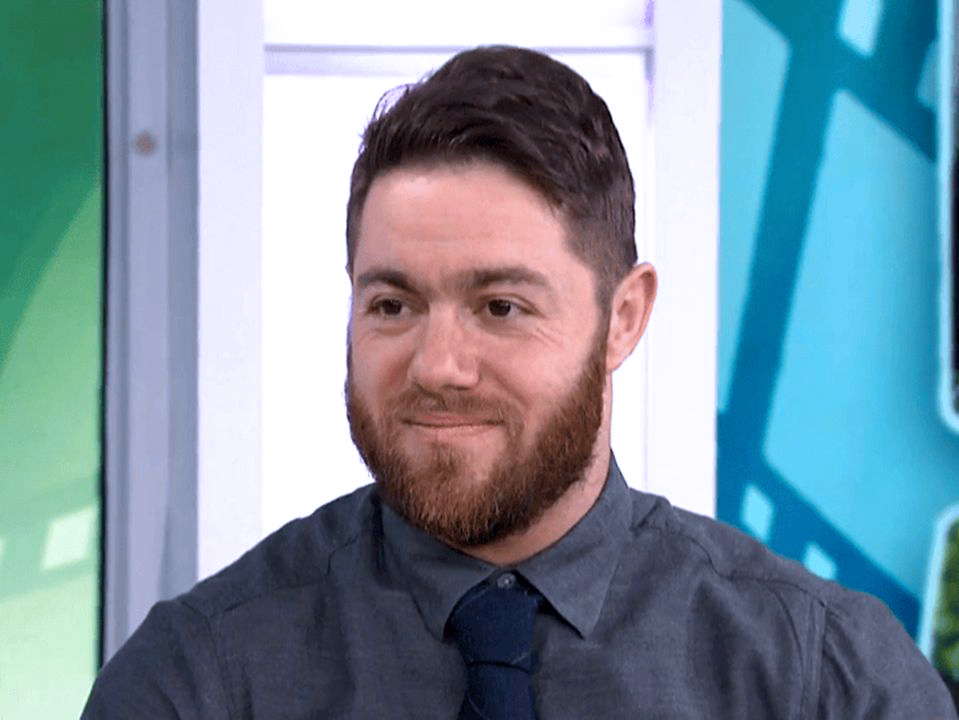
Jacob Bernstein. Screen shot: nbcnews/YouTube
We have been reading Ms Friedman’s reporting for more than a decade since she joined NYT in 2014. While we don’t always agree with what she writes (frequently we do not), we have never felt quite so profoundly betrayed by her coverage of this Galliano fiasco, seeing as she is a top-tier journalist who has somehow chosen to weaponise her position. Cathy Horny, Ms Friedman’s legendary predecessor who served as the chief fashion critic for NYT from 1999 to 2014, would never have co-authored an administrative power-takedown piece like that. Ms Horny was an outsider who did not care about elite approval. She did not act as a conduit for billionaire museum donors. She was so admirably independent that major fashion houses like Armani, Saint Laurent, and Dolce & Gabbana outright banned her from their shows because her reviews were purely and ruthlessly about the garments and the creative output, rather than the corporate optics. She defended Mr Galliano’s work. When he was fired from Dior in 2011 following his now-never-to-be-forgiven antisemitic rants, Ms Horyn didn’t rally Manhattan donors to demand his permanent exile. Instead, she wrote an article titled “A Second Chance for Galliano”, arguing that the fashion world would ultimately have to separate his horrific personal behaviour from his undeniable status as a generational creative genius.
When Ms Friedman and Mr Bernstein, nepo baby of screenwriter Nora Ephron (When Harry Met Sally) and investigative journalist Carl Bernstein, broke the story about the Met’s honoree choice and scheduling failure, they weren’t engaging in fashion or cultural criticism—they were brokering in institutional power. They used the platform of The New York Times to amplify the financial leverage of a wealthy donor network and kill a major cultural exhibition before a single dress could even be put on display. For many outside America, seeing a legendary critic’s desk shift from defending raw, controversial artistic genius to coordinating high-society corporate cancellations is why the modern American media model feels more and more so cynical and exhausting. When institutions such as NYT export their highly specific cultural frameworks, it often looks less like journalism and more like ideological and financial bullying packaged as “universal values”. The writers’ defenders call the “blast” piece “high-stakes journalism”. Reporting that can bring a museum to its knees is certainly high. Regrettably, the journalism part is still up for debate.

Jacob Gallagher. Screen shot: throwingfits/YouTube
In the second headline, what stood out was “exhibit” (the actual article, however, went with the alliterative “The Mess at the Met”). An exhibit is a temporary display case in a regional library or a science centre featuring three loaned items and a laminated placard. A major retrospective or full-scale exhibition—the kind requiring years of conservation, architectural staging, and deep scholarship—is an entirely different beast altogether. We assume the now-cancelled John Galliano: Horizons to be the latter. But what was galling was how they first run the hit job that acts as the detonator, and then, a day later, they stand back in mock horror to report on the blast radius as if it were a natural disaster they had nothing to do with. Brilliant really—the masterstroke of institutional self-preservation: acting as the match and the arsonist, and then showing up to the smouldering ruins the next morning with a press badge and an air of detached bewilderment. And, naturally, just to ice the cake, Jacob Gallagher writes in the piece, lashing the designer with a final swipe: “Galliano may be able to shrug off this monthlong debacle most easily. He still has a Zara collaboration set to debut this month, and he can ebb back to his relatively reclusive life.” The Met throws you out and life goes on. How much more flogging must the sinner take?
And in case you have not had your fill of their rhetoric, Mr Gallagher has other ideas: “There are likely more twists and turns to come. In the mean time, read all of Vanessa and Jacob’s robust reporting…” We do not know what else to call plugging your colleagues’ work other than crass. There is an entire ocean of difference between a quiet hyperlink providing background context, and a desperate, in-line bark telling readers to go consume your colleagues’ content. For us, that exact sentence is the moment the whole charade drops. It highlights the corporate synergy model of modern American journalism. The gall to orchestrate a cultural takedown, mock the institution for the resulting “mess”, and then immediately use the closing paragraph to advertise your colleagues’ previous articles is the ultimate display of modern American media arrogance. How did we sleepwalk straight into this absolute cock-up? Regrettably, this is the cultural slurry America has been exporting in the last ten years. When a museum mistakes its core mandate for risk management, and when a newspaper trades its institutional memory for algorithmic hysteria, the inevitable result is a hollowed-out public square where fashion (by extension, art) is treated as a liability and courage is an extinct vocabulary. The John Galliano saga at The Met will stand as a classic textbook example of this era. It was never about the fashion; it was a demonstration of raw institutional power, wrapped in the language of righteousness, engineered for maximum clicks and subscription revenue. Welcome to 2026, and the rest of it.
Illustration: Just So

