After the Met abruptly canned John Galliano’s retrospective, his enabler-in-chief, Anna Wintour, surfaced just long enough to drop a statement so icy it could preserve meat—tactfully praising his “courage”, as if alienating half of the world, as well as New York’s political and donor powers were acts of selfless martyrdom
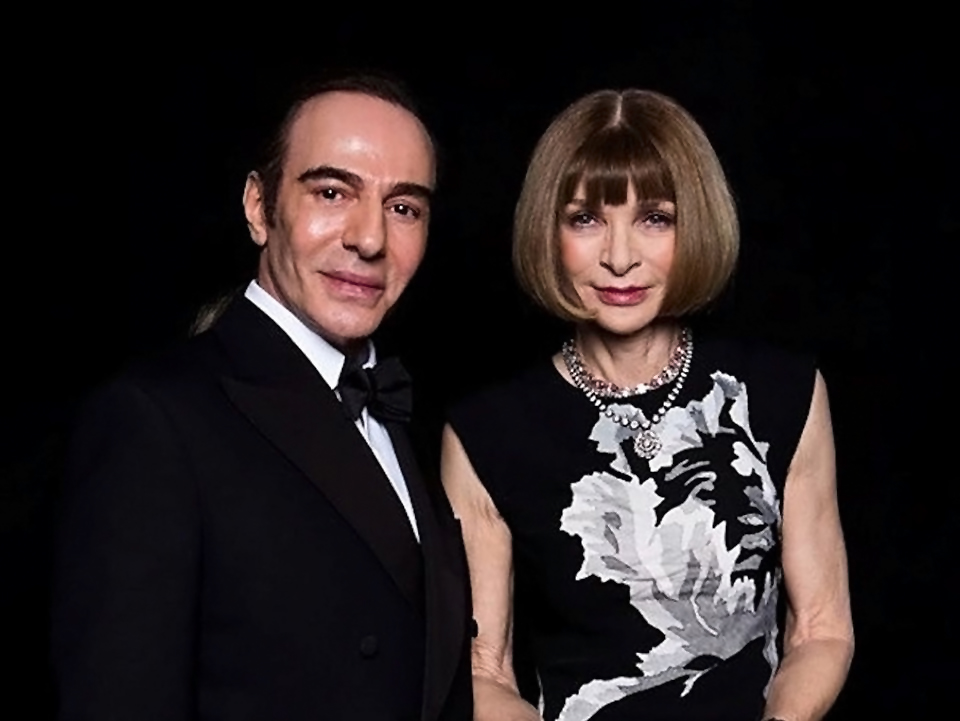
John Galliano and Anna Wintour (wearing Maison Margiela) photographed at the British Fashion Awards in 2014. Photo: British Fashion Council
You might well be anointed the most formidable woman in the industry, yet true power is rather like an overpriced Dior silk train: utterly useless when you actually need to drag it through the dirt. Anna Wintour is the undisputed fashion doyenne, possessed of the divine gift to make or break careers at a whim, yet when controversies rear their vivid heads, her vaunted influence vanishes with the speed of a hastily retracted press release. In a statement released by the Metropolitan Museum after (or around the time) John Galliano revealed on Instagram that he is pulling out of next year’s Met exhibition honouring him, Ms Wintour’s reaction was included, together with that of Max Hollein, director and CEO of The Metropolitan Museum of Art and Andrew Bolton, the curator-in-charge of The Met’s Costume Institute. In that nearly 550-word release, Mr Galliano occupied the huge chunk of real estate to announce his retreat, while his grand patron Ms Wintour tossed him a two-sentence charity bone. If that’s what high-fashion solidarity looks like, he’d have received a warmer embrace from a Siberian winter.
To sound officious, she writes—as a ”Met trustee”—with the intimacy of a restraining order: “John’s decision that the exhibition devoted to his work should not take place at this time is very courageous and a measure of the man he is.” This is striking: exactly the language to use when a long-standing ally becomes a liability. Ms Wintour, who attended the US Open just hours after the cancellation announcement, frames it as Mr Galliano’s autonomous choice. As we understand it, the Costume Institute does not just hand over the reins to a designer; the Met Gala is Anna Wintour’s fiefdom and the designer is the honoree. By attributing agency solely to Mr Galliano, she absolves herself of responsibility for the fiasco, like an arsonist leaving the matchbox in someone else’s palm. Additionally, she spins retreat as heroism, reframing withdrawal as an act of courage rather than a collapse under backlash. And that courage is “…a measure of the man he is.” This is character laundering. Instead of acknowledging the scandal that made him controversial, she redefines his identity around the supposed bravery of stepping aside. There is disgrace here, but don’t cloak it with magnanimity. We do not see courage, only choreography.
The Costume Institute doesn’t just hand over the reins to a designer; the Met Gala is Anna Wintour’s fiefdom
And then the stunning clincher: “I believe this is the right decision, and both he and the Museum have my full support.” So the cancellation has nothing to do with her. Naturally, she is entirely untethered from the fallout—purely an unscratched hanger left undisturbed in the back of the archival rack while the showroom burns. She is now positioned as the wise arbiter, but without needing to admit that it was unwise to champion him in the first place. In distributing responsibility between Mr Galliano and the Met, the presiding princess fancies herself as a benevolent overseer. A clever performance of neutrality after having been the prime mover all along. What’s shocking to us isn’t the statement itself—it’s the brazenness. Ms Wintour engineered Mr Galliano’s honour, even defended him as “more deserving than anyone,” and then, when the backlash forced retreat, she recast herself as a supportive bystander. It’s so transparent—yet it works. The institution remains intact, John Galliano is recast as noble, and Anna Wintour walks away appearing both authoritative and big-hearted, and in couture.
This response illustrates with couture clarity how Ms Wintour is so effectively custom-insulated by layers of heavy-gauge silk and public relations padding that she’s never so much as brushed past a raw edge, let alone direct line of fire. She really does not have a good record at defending decisions poorly made. In 2011, Vogue (then still under her direct editorship) ran a fawning profile of Asma al‑Assad, Syria’s First Lady, portraying her as a chic, modern, and humanitarian “Rose in the Desert”. The regime was just beginning it’s violent crackdown, yet the magazine didn’t just quietly pull the article down from the website hoping everyone would forget the embarrassing miscalculation; they let the seasoned writer of the piece, Joan Juliet Buck, flail in the sandstorm while the backlash mounted. It took over a year of sustained public outrage before Wintour finally issued any form of public disavowal, framing it around how they were merely “hopeful” at the time rather than owning up to the sheer superficiality of chasing a chic, Western-educated dictator’s wife just for the optics of glamour. Perhaps, John Galliano too needed to wait 24 months before the burden he now carries will be shared. It is unfortunate that accountability doesn’t come with an expiration date.

