Orbituary |Yayoi Kusama has left the world, proving that even the Queen of Infinity eventually reaches a full stop—though her footprint on both art and fashion remains entirely un-dot-able
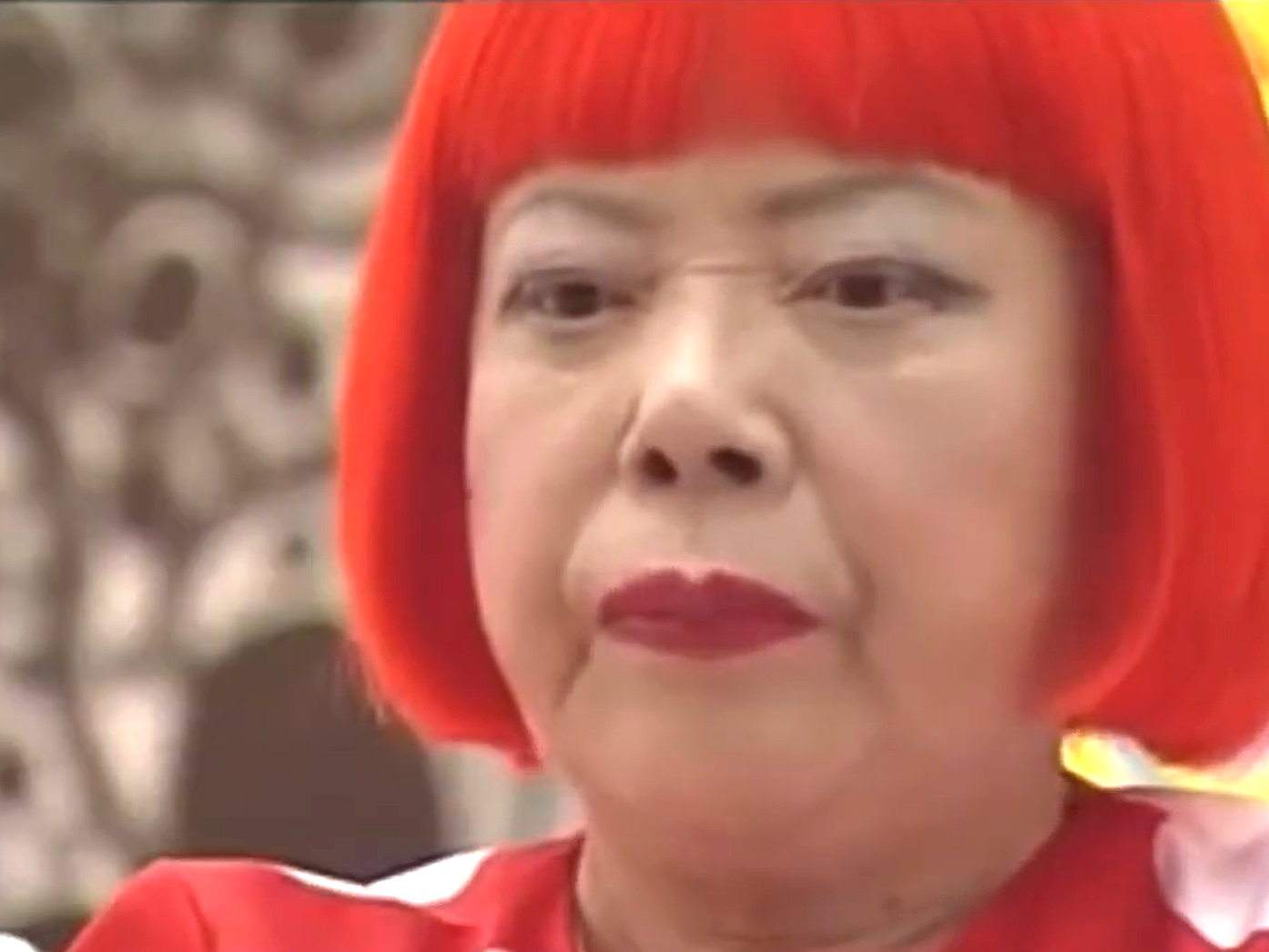
Yayoi Kusama in a BBC interview in 2020. Screen shot: BBC
The art world has lost its favorite focal point. Japanese artist Yayoi Kusama has passed away. Official statements released today by the Yayoi Kusama Studio and her official website confirmed that the legendary avant-garde artist died in Tokyo on 14 August. Ms Kusama leaves in her wake an indelible, enduring legacy that spanned decades. From turning her childhood hallucinations into a groundbreaking vocabulary of infinite polka dots, immersive mirror rooms, and organic, patterned pumpkin sculptures, she redefined contemporary art and became one of the most culturally influential and globally celebrated figures of our time, recognised by her self-designed polka-dotted dresses and shock of red hair. She carried herself with the kind of striking visual weight that made entire entourages reconsider their tailoring. According to her studio, she continued painting and creating until her final days. Ms Kusama was 97.
Her studio announced that she died in “a hospital.” The specific cause of death was not identified and the medical facility was not named in the initial release that was also shared on social media. Ms Kusama spent her later life anchored by a familiar routine: she voluntarily admitted herself to the Seiwa Hospital for the Mentally Ill in Tokyo in 1977, following her return from New York four years earlier, amidst severe burnout and deteriorating mental health. She chose to make the hospital her permanent residence, living there for over four decades until her passing. She realised that the organised and protective clinical space gave her the grounding she needed to pull through. Within her sanctuary, which included a studio she built just across the street, she never stopped painting and sculpting, maintaining a rigorous daily routine to immerse in her art. She commuted by wheelchair to her workspace during daylight hours and returned to the hospital each night.
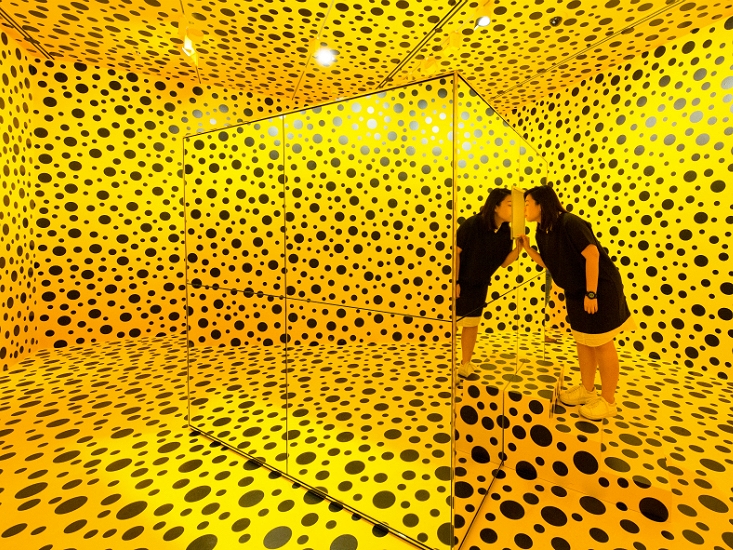
Manic dots at the Yayoi Kusama exhibition at the National Gallery. Photo: National Gallery
According to a Bloomberg Television report, Ms Kusama suffered from “a lifelong condition of panic attacks and hallucinations”, alongside what local media had long reported as obsessive-compulsive neurosis. Yet her mental health challenges never stopped her from pouring her energy into her art. She urged viewers to “see my attitude to my life and longing for love and peace behind those works.” To sustain her craft, the hospital became as indispensable to her as the very anxieties and hallucinations that fueled it. The result is an oeuvre forged at the intersection of acute psychological anguish and meticulous structural control. She remained as dotty as ever, backed by a permanent rotation of exhibitions worldwide, a global empire of merchandise, and paintbrushes that did not fail her. As her studio noted, she “worked until her final breath”—the repetition of the creative act ultimately proving more vital to her than the repetition of the dots themselves.
But the dots and the dottiness of their application—scores of them—were what made her exhibitions must-visits, regardless of where they were staged. In 2017, the National Gallery in Singapore opened Yayoi Kusama: Life is the Heart of a Rainbow, featuring over 120 works spanning seven decades. According to The Straits Times, the exhibition “broke attendance records, drawing more than 235,000 visitors over three months”. It was billed as an art event so enchanting that even people who hated art would love it. Not merely a family-friendly show, it came with play spaces for children, such as The Obliteration Room, which was free to enter (as opposed to the main exhibition that required a paid ticket), where anyone could fix sticker-dots onto what started as a pristine all-white room, anywhere. (The Obliteration Room was reprised last year at the New Art Museum Singapore at Tanjong Pagar Distripark.) We’ve always wondered then, as we saw the kids pasting with sheer delight, what their parents might have thought if they knew that Ms Kusama’s work in her New York years was intensely sexually-charged, including the upholstered profusion of what can be described as penile shapes.
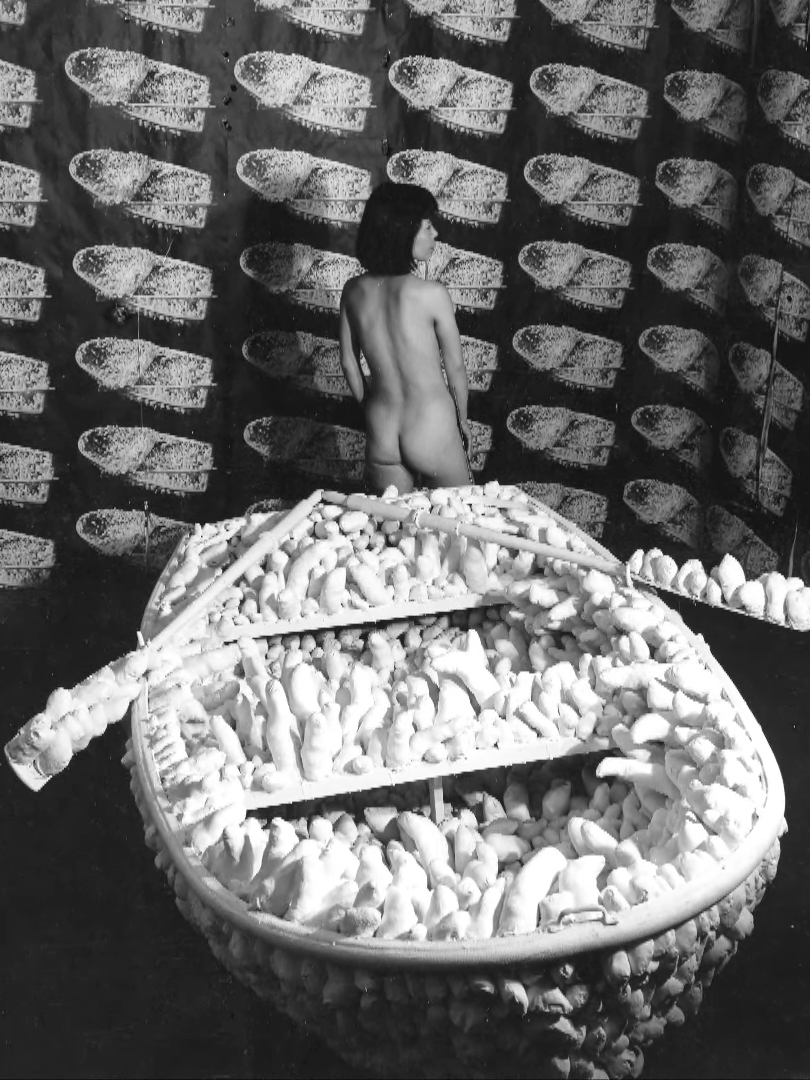
Publicity image of Yayoi Kusama and her installation Aggregation: One Thousand Boats Show. Screen shot: Bloomberg/YouTube
Ms Kusama was never a passive figurehead whose imagery was quietly commandeered behind closed doors. Way before her “cute” pumpkins emerged, she had a long history of provocative experimentation, which included one 1963 installation, Aggregation: One Thousand Boats Show. A rowboat covered entirely in hundreds of soft, white, stuffed phallic forms was placed in a room covered with repeated images of that boat photographed from the top. That filled vessel was reprised in Peter Gabriel’s 1993 music video of Lovetown from the soundtrack of the Tom Hanks film, Philadelphia. The production design of the MV was conceived with Ms Kusama and it featured a man rowing—in a polka-dotted body of water—a boat filled and festooned with phalluses. When asked by the BBC preceding her 2021 solo exhibition at the Tate Modern what the obsession with the “male member” was all about, she said: “I was very afraid of phalluses, I haven’t had sex. As a child, I suffered a lot because my father led a very debauched lifestyle and I came to hate sex.”
The hatred was intense enough that it even climaxed into Phallus Fields (aka Accumulation of Phalli) from one of her most notorious “Accumulation’ environments from the early 1960s. A room completely covered in soft, stuffed fabric phallic forms—floor, furniture, even shoes—until it became a phalanx of protrusions. By multiplying the phallus into absurd excess, Ms Kusama mocked male dominance (at the time, the New York scene was dominated by Claes Oldenburg and Andy Warhol, both of whom she later accused of copying her) and turned desire into parody. In fact, the stuffed fabric dicks soon gave way to the real deal when she started painting dots on nude models as a way of “obliterating” individuality, including Grand Orgy to Awaken the Dead (1969), staged at the Museum of Modern Art’s sculpture garden. Perhaps, by now, Ms Kusama had become more comfortable with sex. Earlier, for the publicity stills of Aggregation: One Thousand Boats Show, she didn’t just bare her soul in her art, she even posed nude with the phallus-stuffed boat, totally comfortable to bare her buttocks to the camera. She became so thoroughly uninhibited that in 1968, she wrote an open letter to President Richard Nixon, telling him that if he ended the Vietnam War, she would sleep with him.
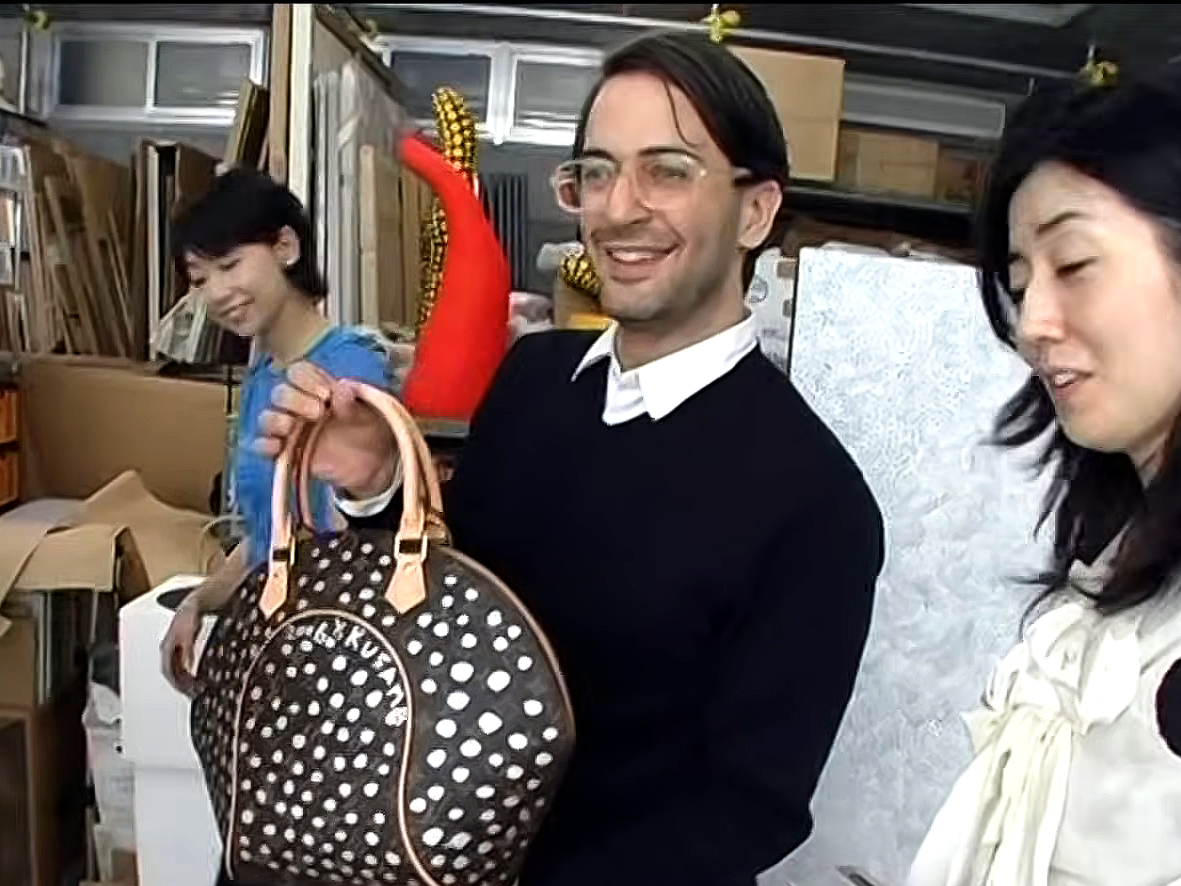
In Tokyo (2006), Marc Jacobs receiving an LV bag dotted by Yayoi Kusama. Screen shot: artistiktv/YouTube
These days, nobody really talks about her early artwork anymore—at least not among younger art fans. Instead, the fledgling crowd mostly knows Ms. Kusama as a limited-edition handbag motif for Louis Vuitton. As the story goes and retold by Loïc Prigent in the 2007 documentary Marc Jacobs & Louis Vuitton, the American designer had met the Japanese artist at her studio in Japan the year before. That was two years after Gwen Stefani’s Harajuku Girls. As a first-meeting gift, Ms Kusama presented Mr Jacobs with a vintage Monogram Ellipse bag on which she had painted dots. The designer responded with “that’s so beautiful—look at that”. The encounter lasted several hours, with Mr Jacobs later recalling how Ms Kusama repetitively held his hand as if unwilling to let go of him, and said—almost beseechingly: “We must create, we must create, it’s important that we create”. And they did with the 2012 collaboration. The result was a commercial triumph proving that if you repeat an avant-garde imperative enough times, a corporate partnership will eventually sponsor the consumer hallucination.
The millennium’s greatest fashion-cultural achievement has been a reflection of a remarkably efficient ecosystem: You take an octogenarian avant-garde treasure whose entire artistic thesis is infinite “self-obliteration”, as she called it, and you use her life’s work to slap a few dots onto a handbag so that one American designer and his finance bros can signal their sophisticated appreciation for modern art between swigs of Gallia. Ms Kusama’s art was always about the blotting out of egos, yet her late career turned her into one of the most recognisable egos in global art. Her installations mutated into social media backdrops rather than contemplative encounters, just as her flat, colourful dots on Louis Vuitton bags became rituals of social signaling—portable Obliteration Rooms carried as flashy badges of cultural capital, even though the very act of flaunting them completely undermines the very thesis of obliteration. In the end, Yayoi Kusama didn’t just change how we look at dots; she made sure fashion spent decades trying to connect them.

