Christopher Nolan’s The Odyssey may be a grandiose spectacle of movie-making, but it is not an easy watch. The costumes, unfortunately, prove to be a persistent distraction that even the imposing visuals couldn’t quite mask. Indeed, what are they wearing?
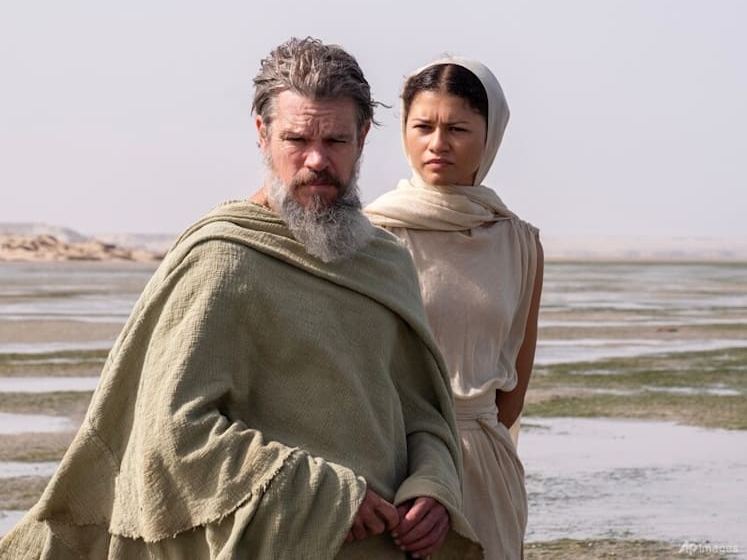
Odysseus (Matt Damon) and Athena (Zendaya)
By Ashley Han
It’s a classic tragedy—to be cursed for reading the book first. Doomed I was, therefore, to spend the entire three-hour runtime of the latest adaptation of The Odyssey mourning the scenes that were cut, judiciously or not. I walked out of the cinema pondering the cosmic injustice that kept me a literary purist in an age of creative liberty. Or worse, the synthetic ‘relatability’ that assumes if we don’t see Hollywood gowns we may not know we are seeing an epic that reimagines the very foreign chiton. I know Hollywood can’t help themselves—they’re too busy rebranding the entire world in their own image to notice that their universal experience is actually just their own bloated reflection. I was perfectly aware of the ruse; I saw the bait, I acknowledged the hook, and, pathetically, I still took a bite. Why wasn’t Athena on my side, as she was at Odysseus’s?
As an epic journey through Bronze Age Greece, many viewers will reasonably expect an immersive Mycenaean world from Christopher Nolan’s The Odyssey. I did. Actually, even when Matt Damon’s character referred to his own time as “the age of bronze”, the Bronze Age is a modern archaeological periodisation, an external, academic label. To enter that era is really to approach a material culture with distinctive architecture, frescoes, clothing, armour, weapons, and social practices. Mr Nolan had quite a buffet before him, and as any bibik will tell you, you don’t have to eat everything on a tok panjang (long table). A fussy eater, he certainly did not. So even when the film asks the audience to enter an ancient world through its epic-scale visuals, the characters’ voices and assumptions do not become part of that world-building. More strikingly and disappointingly, the costumes too.
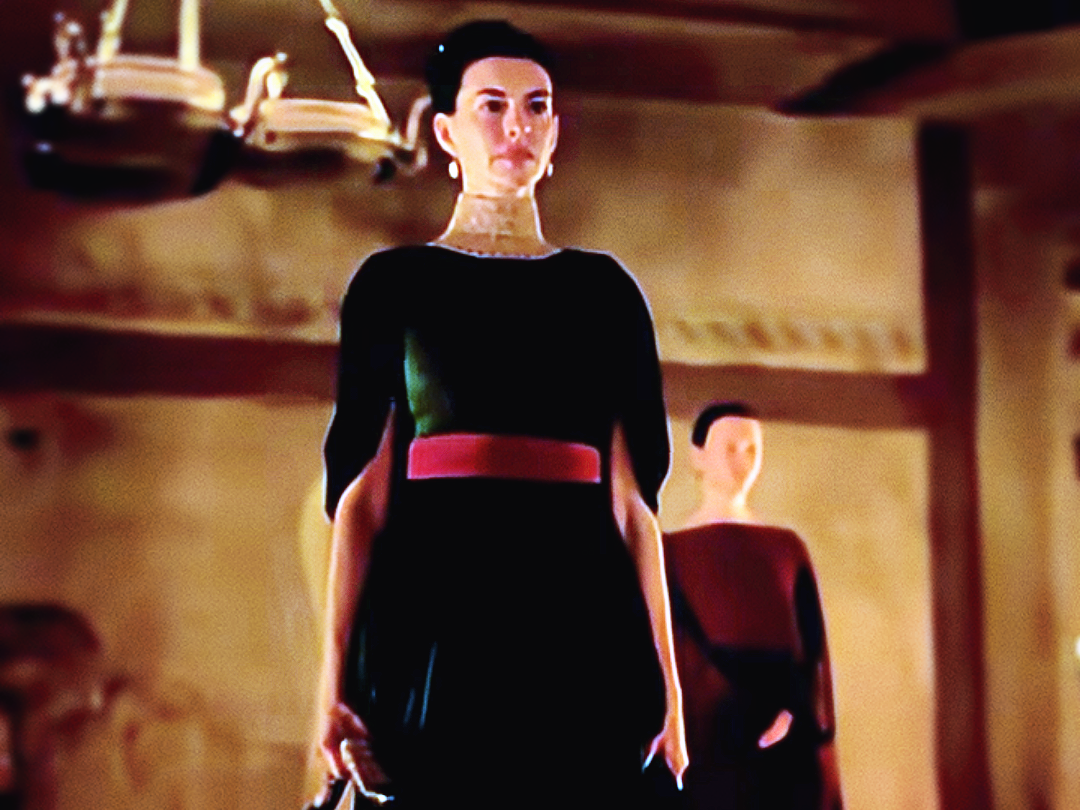
Penelope (Anne Hathaway), queen of Ithaca
Among the major clothing traditions of the ancient Mediterranean, Greek dress has arguably had the longest and most enduring aesthetic influence on Western fashion. Its vocabulary of drapery, proportion, and restraint has been recycled endlessly in clothing . The chiton, peplos, and himation weren’t just garments; they were frameworks for how fabric could articulate the body without tailoring. They are so widely regarded throughout later ages that they continued to influence dress, particularly the neoclassical styles of the Regency era, the “goddess dress” of the late 18th century following the archeological spark of the excavation of Pompeii and Herculaneum, and the 20th century’s pleated gowns of Mario Fortuny and Madam Grès. Its journey from the ancient Mediterranean to Maria Grazia Chiuri’s runways for Dior at the Acropolis in Athens, featuring her beloved goddess gowns. While Ms Chiuri’s work may have its detractors, she did demonstrate that true classical elegance comes from proportion and restraint, allowing the fabric to wrap around the human form, organically.
The thing is, in the Mycenaean era, during which The Odyssey is set, women wore clothes that are quite different from what we can identify as a chiton or a peplos. Dress historians generally describe the dresses of the period as multi‑layered, brightly patterned garments with flounced skirts, fitted bodices, and sometimes exposed breasts (inherited from the Minoan style), as evidenced in frescoes and figurines. If Mr Nolan’s film is not going to attempt Mycenaean authenticity, it could at least have drawn on the visual tradition that audiences recognize as Greek. When Anne Hathaway’s Penelope appears, I did see a regal silhouette, then I half expected Anna Wintour to appear to greet her, as the latter might at the Met Gala. On the queen of Ithaca, the vibrant, multi-layered patterns were nowhere to be found, replaced instead by the jarringly contemporary—necklines and sleeves that point directly to 20th-century pattern-making. The silhouette’s desperate reach for modernity serves only to strip the mythic figure of her stature, reducing a sovereign presence to little more than a lame attempt at historical revisionism.
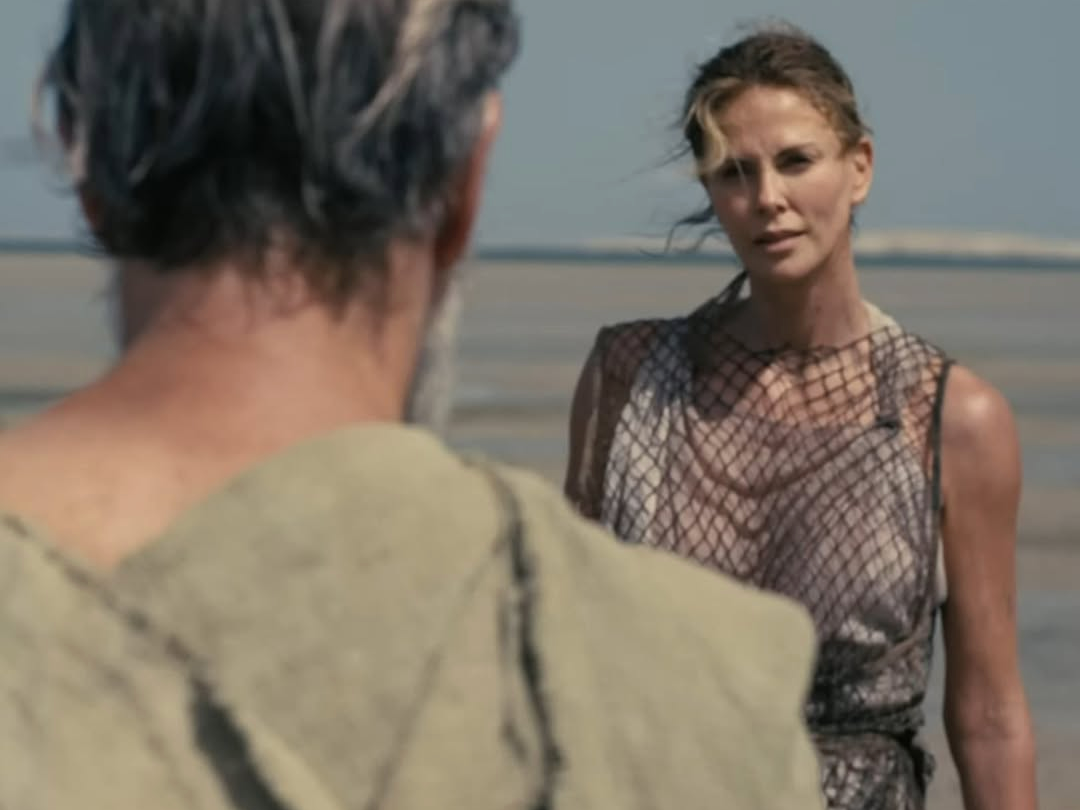
Calypso (Charlize Theron), a seductress who does not seduce
It’s truly a triumph of costume design when a painfully human retelling of Homer’s The Odyssey means that the wardrobe department decides that consistency is merely a quaint relic for the over-imaginative. Apparently, being immortal goddesses—creatures of singular, divine origin—does nothing to prevent them from suffering a sudden, violent identity crisis every time they come into focus. I had a hard time with the goddess of strategic warfare Athena (or at least I thought she is until she is “not really”)—visually, one of the most consistent figures in the Greek pantheon, often depicted wearing a crested helmet and a breastplate that was adorned with serpents and bearing the Gorgon’s head—a tactical, if aesthetically alarming, form of defensive branding. But here, Athena (Zendaya), dressed in wrap of a coarse, seemingly unbleached fabric that passes of as vaguely spiritual, perpetually looks like a Sadhvi—female ascetic of India—and exuding no aura of the divine. Even Helen of Troy—the face that “launched a thousand ships”—is reimagined here as a disco diva, her allure shattered by an unexpected scar on her left cheek of unknown cause.
Then there is the other goddess Calypso (Charlize Theron). In Homer’s The Odyssey, she is described as wearing a long, silvery mantle fastened with a golden belt—garments that emphasize her divine beauty and immortality. Homer even mentioned her hair when he called her the “nymph with the lovely braids” (which makes her a “goddess-nymph”). But in Mr Nolan’s film, she has a weakness for fishing nets, not as casting mesh, but as a top dress, so frequently seen in Patong Beach, Phuket. The sexiness is not explained since she is not seen to seduce Odysseus who is stranded on her island for seven years. A captor looking like a vacationer! I struggled with the visual signal of a nymph against the annoying lack of the storytelling to justify it. In the poem, Calypso has a half-sister, Circe (Samantha Morten), but Mr Nolan does not make the connection. She is also a “goddess nymph” with the admirable ability to turn men into pigs, which she does. But this Circe is less sea nymph than sea hag. I kept thinking of Kathy Bates. The scene is quite a misery. In sum, there’s no consensus on whether the aesthetic objective is transcendent deity or accidental scavenger hunt participant.
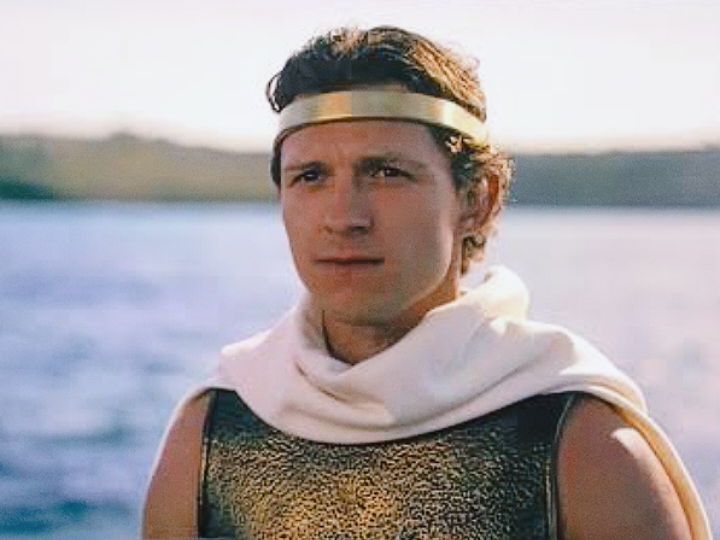
Telemachus (Tom Holland) looking forward to peaceful times
The male contingent fares no better. I think we have exhausted the discourse on their armour and the tedious fakeness of the King of Sparta, Menelaus’s (Jon Bernthal) helmet—yet the sartorial enigma that is Telemachus (Tom Holland) remains inexplicably overlooked. The would be boy-king was not only bereaved of the style advice of a missing father, he could have come straight out of a street-wear catalogue of the present era when skirts for men are as acceptable as it was back in the Mycenaean age. One particular look is nothing short of an aesthetic nuisance: Telemachus repeatedly wearing long-sleeved shirts with round necks and centre-front vertical slits that opened to the chest, paired with a panelled leather mini-skirt. Mycenaean men wore tunics (ki-to), which made Telemachus’s leather skirts especially egregious. The rows of hanging, panelled leather strips (called pteruges) were famously worn by Roman legionaries and generals centuries later to protect their upper thighs. The Greeks did not. If that was not enough, Telemachus, in the final scenes, is given a sculpted gold breast plate, a hooded cape, and a gold band around his forehead, under his hairline. I could not decide what I saw: Princess Diana of Themyscira—also known as Paradise Island—or Richard Simmons playing dress-up on Halloween.
Critics who defend Christopher Nolan’s costume choices say that they are meant to strip away the stiff, “museum-piece” feeling of a classical period piece. But what I saw in the cinema is set in the times of Mycenaean Greece—a classical period. And the Trojan horse is the museum heart of the film. It’s a deliberate narrative and production design choice. The wooden beast’s ‘costume’ overstated the Mycenaean ability to build, on a beach, a beautifully and neatly panelled equine sculpture standing on its hind legs. That raises an interesting question for adaptation: if clothing (or shells of horses) was part of the audience’s unspoken understanding of the story, is it really incidental? To me, no. Material culture—including dress—isn’t just decorative. It is a character in itself; it expresses social hierarchy, gender, wealth, ritual, regional identity, and even morality. Odysseus’ disguise as a beggar, for example, works precisely because clothing immediately signals social status, even when Odysseus (Matt Damon) here looks like a desert hermit. Penelope’s weaving isn’t merely an action; it’s embedded in a world where textile production was central to elite women’s lives. No amount of directorial intent or artistic metaphor matters if the final product constantly broke my immersion, forcing me to ask, Why lidat?
Movie stills: Universal Pictures

