In The Straits Times, another semantic distortion that is uncomfortably close to inciting you to tear your hair out
It seems to be getting increasingly common for the media to work so hard to say so little, and so inaccurately. A national paper of record, for instance, presumably understands the definition of its own mandate. It is regrettable, then, that a feature published last night in the digital edition of our venerable The Straits Times opted to suggest a linguistic conflict where none seemed to exist. In its revisit of the wrongful conviction of domestic worker Parti Liyani, the headline promised a “behind-the-scenes look” at the case, framing the story around Gusti Seruni, the penerjemah (interpreter), who acted as the primary bridge to the accused. It is a striking choice for a story concerning a “historic” case that exposed systemic failures and judicial biases in our legal and law enforcement apparatus. The approach risked obscuring that gravity in favour of a personal profile of Ms Seruni. Her depth was written to begin and end at the surface, offering only a shallow stream of opinions untroubled by the seriousness of insight. Curiously, the article launched with a supposed linguistic drama—a cynical opener designed to confer depth upon content designated to be skimmed, not absorbed.
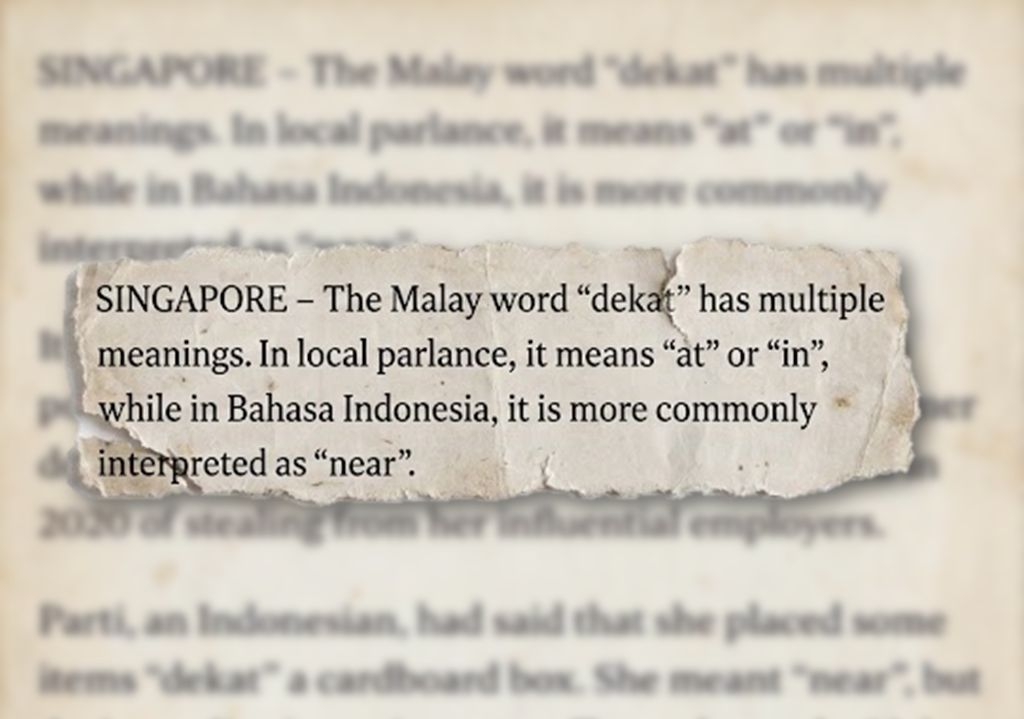
It was an intriguing position: Dropping a peculiar semantic evaluation as the anchor. “The Malay word ‘dekat’ has multiple meanings. In local parlance, it means ‘at’ or ‘in’, while in Bahasa Indonesia, it is more commonly interpreted as ‘near’.” We understand that there is legal parlance, for example, but what “local parlance” is isn’t immediately clear. Assuming the writer referred to colloquialism or (bahasa) Melayu pasar (market Malay), then there is none for dekat. But the word in question is part of standard bahasa baku (standard Malay). Dekat denotes proximity—near or close to, or in the vicinity of—in both bahasas (languages), Malay and Indonesian. We spoke to more than a dozen of our Malays friends, including our neighbours. None were aware of the “multiple meanings” of dekat. Many words diverge between bahasas Melayu and Indonesia, such as dingin and sejuk (for cold), tuala and handuk (for towel), or kereta and mobil (for car), but dekat is not one of them. Lumping dekat into the category of regional lexical splits is a fundamental error. “Local parlance” appeared to be deployed as a vague flourish, meant to add redundant ‘authenticity’ and colour.
We spoke to more than a dozen of our Malays friends, including our neighbours. None were aware of the “multiple meanings” of dekat
According to the article, a “simple difference” (is anything ever?) grew into a “point of contention” in the Parti Liyani case. She testified to placing items “dekat” a cardboard box—using the word for ‘near’, a nuance apparently lost in translation. The report claimed that Ms Seruni, who had served as volunteer interpreter for Ms Liyani’s legal team, said: “during police interviews, an officer who spoke Malay understood it to mean ‘in’ the box.” That sounded like a rumour, dropped into the article by a little bird. Not identifying the interviewer is understandable if there was a gag order, but if “an officer who spoke Malay” could be dangled as linguistic competence, then ordering “nasi lemak satu” technically counts too. The writer managed to consult Ms Seruni, the interpreter, involved in the case, but their curiosity inexplicably died there. To dismiss a critical language breakdown as a mere misinterpretation is strikingly aggressive incuriosity. It left us to wonder if the officer had misheard dekat as, kat, the conflation of dekat that is commonly used in colloquial Malay that means ‘at’ in Singapore and Malaysia, as in kat rumah or at home. Still, kat is not ‘in’. One is proximative, the other locative.
But perhaps the writer did not even personally speak to Ms Seruni, who was strangely also reported to be “not present during the police interviews”. In the fifth paragraph, the writer stated that her subject “spoke to the media at law charity Pro Bono SG’s annual awards ceremony on July 21”. It is, therefore, possible that the entire piece was stitched together from a press‑event appearance rather than from a direct interview. The paper typically tags their one-on-one: “Speaking exclusively to ST…” But this could be a scrum of reporters at an awards ceremony, where Ms Seruni gave sound bites. The writer then repackaged them into a “behind‑the‑scenes” feature. It used the linguistic anecdote as the foundation to the patchwork piece, but it looked to us as the interpreter’s retrospective opinion, not forensic evidence. This is essentially charity PR dressed up as insider access. And it seems to fit into a broader media economy of spectacle at work: much of our mainstream press has slid into press‑event stenography. They serve a secondary PR firm that happens to have a printing press. Instead of deep reporting, many journalists increasingly recycle sound bites from award ceremonies, charity galas, product launches, or D&Ds into features that masquerade as serious, consequential coverage. Here, we have a beautiful recast of a case, which the press repeatedly calls “landmark”, as a prestige profile with a seemingly tantalising hook.
If “an officer who spoke Malay” is a seal of linguistic competence, then ordering “nasi lemak satu” technically counts too
Beyond the tactical shortcuts in reporting, this was effectively about a personality of prestige, as seen in the biographical framing of the subject herself. Ms Seruni, we were told, is married to a “Singaporean art curator” and has her own “jewellery business”. The “art curator” tag was not an impenetrable prestige inflation, but a desperate, stylistic attempt to wrap a flimsy narrative and shove it into the gilded halls of high culture. Apparently, being married isn’t a standalone fact unless accompanied by the husband’s career credentials—never mind that it is unclear if he contributed anything to her pro-bono work or even supported it. The resume-padding tour continued with her private venture. We were treated to two separate plugs about her “jewellery business”, only to come with the clarification that it was not actually registered yet, due to her four-year investment in the Liyani case. The part-time interpreter owns Studio Seruni, an e-store that sells accessories—rather than “jewellery”—pieces embroidered with glass beads and slapped on to a faux leather backing. No gemstone or precious metal is involved. It read to us as social signalling, but why that is necessary in an article ostensibly exposing “behind-the-scenes” reality of a case that was debated in parliament for eight to nine hours in total (a marathon that lasted until nearly midnight) is totally unclear. Give her prestige if they must. But why pivot to a linguistic problem of which they could not explain convincingly is totally mind boggling.
Such linguistic or semantic indifference has, unfortunately, presented itself before. This is not our first silat (a Malay martial art practice) with similar posturing. Just last month, we flagged an article pulling another semantic ambiguity with the traditional batik cap—the stamp used in artisanal textile production. By refusing to italicise ‘cap’, ST stripped the word of its cultural specificity, rendering a technical tool indistinguishable from a generic head covering, traditionally associated with baseball. Similarly, the recent piece opts for a cozy narrative of volunteer heroism and regional lexical splits when there were none, while the massive systemic failures—the collapse of the case, the hours of parliamentary debate—were barely given room to breathe. We see a trend: headline gravitas, body fluff, semantic flattening. It’s not about ignorance because that could imply that they tried and failed. This is worse: it’s about a newsroom style that treats cultural words in a strangely indifferent manner. Call it what it is: not a lack of knowledge, but a total inability to care. Or, as the Malays would say, tahu di angin berkisar, tetapi enggan berlayar. Knowing which way the wind is blowing, yet refusing to set sail.
Illustration: Just So

