They aimed for a climactic showstopper but landed squarely on P.E.-tier embarrassment. Even Chris Martin could not save the day
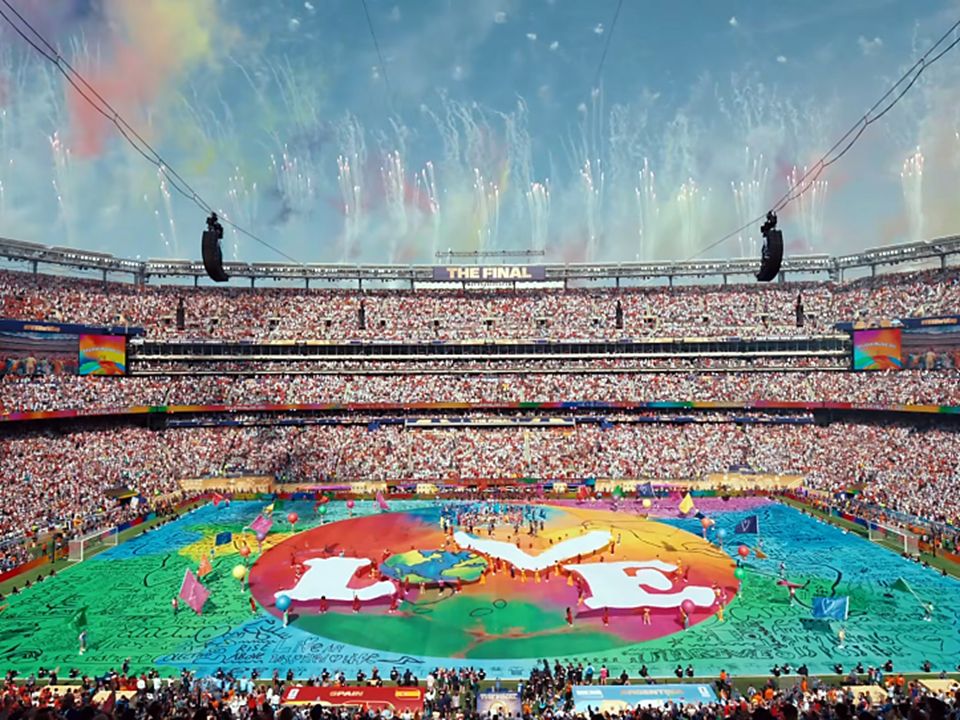
The World Cup’s first ever halftime show at the MetLife Stadium, New Jersey
In 2012, when Madonna performed during the Super Bowl halftime show at Lucas Oil Stadium in Indianapolis, it was one of those performances one remembers for the rest of one’s life. Conversely, for her appearance at this morning’s (our time), we wondered why we bothered staying up. Sure, it was a fantastic win for Spain (and we were close to tears when they scored the winning goal during the extra time), but we’re still scratching our heads, trying to decipher whether we just witnessed a global spectacle, a high-budget identity crisis, or a very expensive cry for help. Fourteen years ago, Madonna’s Super Bowl debut was a massive turning point for Super Bowl production. It saw the first use of full-field projection mapping, allowing the entire football field to be turned into a massive, dynamic video screen. It was the first collaboration with Cirque du Soleil, allowing them to blend theatrical art with pop music on a scale never seen before at the NFL It was the first record-breaking Twitter event, peaking at a staggering 10,245 tweets per second. An perhaps more significantly, the halftime show saw the first sole female headliner in 16 Years: Madonna was the first woman to anchor the halftime show entirely by herself since Diana Ross flew away in a helicopter at Super Bowl XXX in 1996. This time, she had barely a minute on the pitch and no dramatic exit was captured. She was cut off.
At the MetLife stadium in New Jersey, Madonna’s treatment was almost humiliating in its brevity and styling. She was wheeled out in a dune buggy like a relic, given less than a minute, and dressed in a way that screamed fashion cameo rather than football spectacle. More than half of the song she sang—the 2000 dance-pop hit Music (which curious, was backgrounded by what could have been The Trammps Disco Inferno, resulting in a sound that was akin to Danceteria!)—was performed inside what could be the MetLife. In fact, it looked to us to be a totally pre-recorded segment until the point she stepped out onto the pitch, She had already lost 26 seconds of ‘face time’ to the intro of the song and now, in front of the audience, she had only 0.61 seconds to perform for the audience. Flanked by Brazilian football stars Ronaldo and Ronaldinho, Madonna was the Edna Mode of football heroes. Dressed by Saint Laurent, her sports jacket, fluid top, ornamented corset, and running shorts—all in oddly dusty shades of pink—had the theatrical gravitas of a sweat-soaked towel that one might find after stumbling into the nearby changing rooms. How did she go from the un-sporty but eye-popping Givenchy couture, which staged her as a kind of imperial gladiatrix commanding the stadium, to Saint Laurent gym clothes? Fourteen years ago, she was a queen entering an arena. In 2026, she was a sidelined headline taking a tentative peek in front of a tunnel etrance.
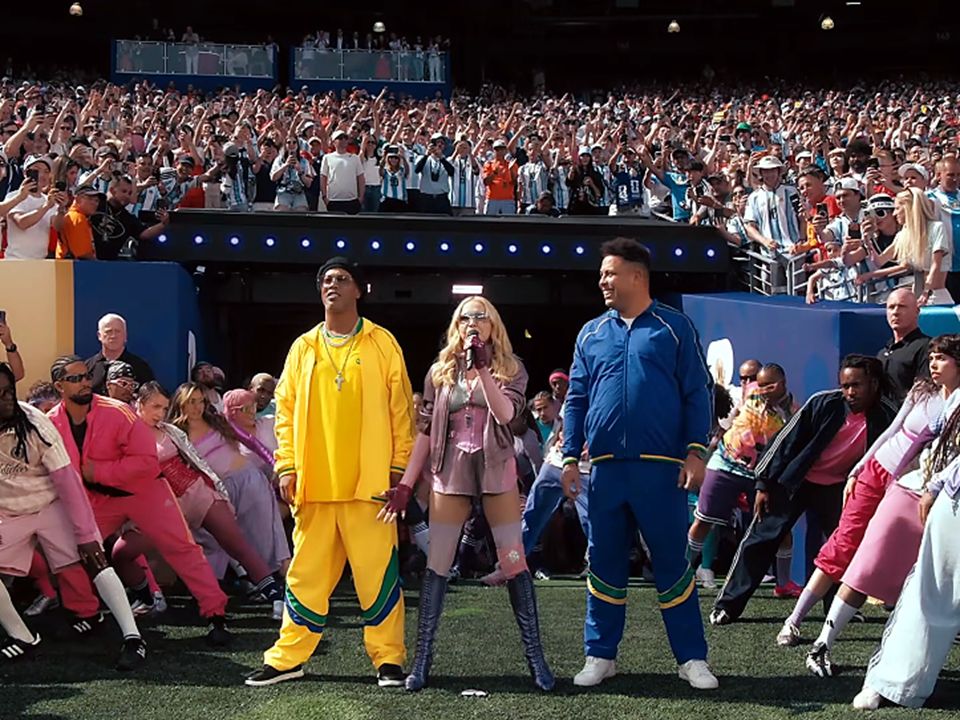
Madonna (centre) flanked by Ronaldo and Ronaldinho
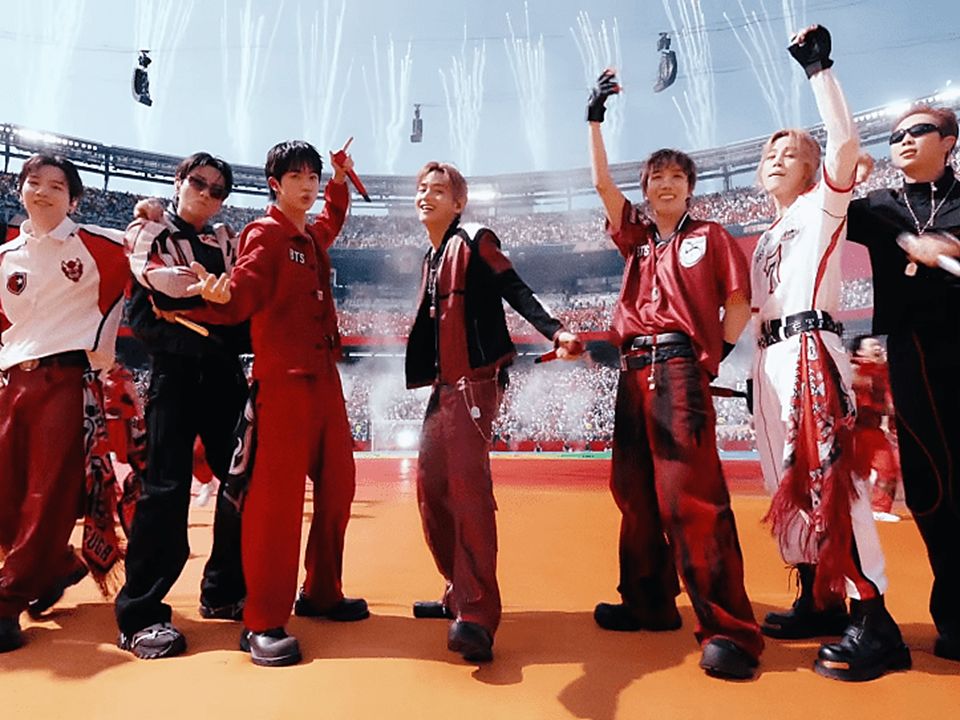
BTS performing to a less than enthusiastic crowd than they were used to
The humiliation didn’t end with Madonna’s vapid performance. It extended to the very ground we were watching. Stadium limitations aside, the pitch was now invisible, covered by what looked like tarp on which some strangely coloured splashes smudged to form a globe, on which “love” would be emblazoned across the flat circle. Online, people uncharitably, yet accurately, dubbed it “a tie-dye” mess. We were told that this was “creative curator” Chris Martin’s handiwork. Perhaps Mr Martin forgot that he was staging a performance in New Jersey, not in San Francisco’s Haight-Ashbury neighbourhood. Apparently, the production team intentionally mirrored the vibrant, multi-coloured aesthetic of Coldplay’s recent tours, such as Music of the Spheres and Moon Music, ignoring the fact that the performance was under a glaring summer sun, not stadium light. Perhaps most unsightly were the photo-wall squiggles of what could be focus-grouped corporate platitudes: “Purpose”, “Grow”, “Future”, and the very un-American “We are all one in the universe”. If they were aiming for the world’s largest motivational poster, they won. Or, perhaps, FIFA was aiming to reach the minimum character count required to trigger a corporate tax write-off for inspirational field enhancements?
Once the camera cut off the eternal Material Girl, the full tarp show unfolded. Conductor Gustavo Dudamel led orchestral musicians from the New York Philharmonic and Venezuela’s Simón Bolívar Symphony Orchestra, playing with grassroots aplomb The White Stripes’ stadium anthem, Seven Nation Army, aided by The Muppets with considerable gusto. The goofy musical interlude gave way to BTS, togged in costume literalism of Red Devils jerseys by the Berlin brand Lueder. But if The Army was present, it was barely a battalion—more of a polite gathering, with very little army to speak of and less of the typical manic concert roar that we have been used to. Football bros are not The Army. It was a choice clearly driven by global demographic reach rather than any genuine synergy with the core football audience. FIFA’s organisers appeared to be working from a spreadsheet of most ‘globally recognizable entities’ rather than curating a performance that felt native or at least familiar to the sport. Like Madonna, BTS’s cultural capital simply doesn’t translate into football’s tribal codes. If Madonna is iconic in pop, especially queer and camp registers, BTS is the juggernaut of a hyper-engaged, female-driven digital fandom. For either singer or group, football bros—the masculinised, nationalist, hetero‑coded fan base—didn’t see them as part of their macho mythos.
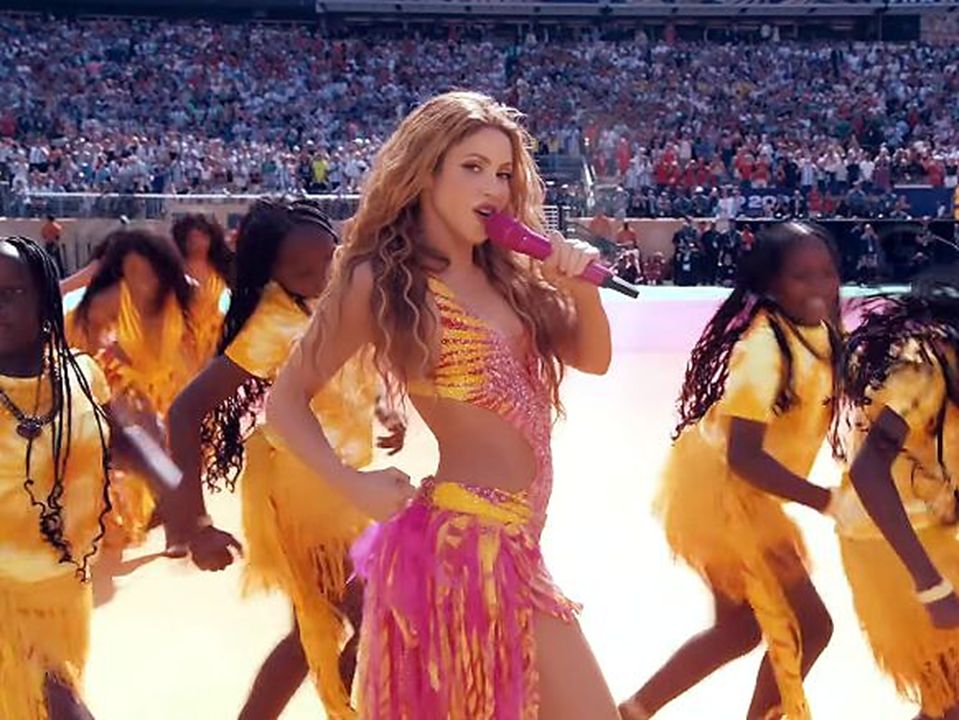
Shakira did what she really excels in: shake
If BTS singing Dynamite blew nothing up, greasy-looking Justin Bieber placidly strumming and singing Everything Hallelujah basically turned “worship music” reimagined for a domestic, pop-star context into a slo-mo hostage situation in a dentist’s waiting room. Yes, it was, regrettably, that excruciating. It would take Shakira’s vigorous hipsway, her able right hip and rump, and the official World Cup 2026 anthem Dai Dai (Italian for “come on” or “let’s go”), a duet with Burna Boy, backed by Uganda’s Ghetto Kids, that brought the stadium energy back up. The Colombian already earned credibility with Waka Waka, the de facto anthem of the World Cup 2010 (the title is African pidgin slang meaning “do it, do it” or “Walk, walk”), sampled from a 1986 hit song called Zangaléwa by the Cameroonian makossa group Golden Sounds. Her performance was wildly appreciated also because Shakira knew how to work her body, and more importantly, her full mane of hair. Her rhythms, choreography, and stadium‑scale energy resonated with football culture in a way Madonna or BTS simply didn’t. Football spectacle is not just about music, it’s about embodied desire. Shakira dressed her part (sexy bra top and flirty skirt), in a way that played directly into the heterosexual gaze of the stadium—athletic, revealing, kinetic—a visual register that football blokes read as both celebratory and erotic.
But that energy was not sustained by the finale that followed. It had all the electrifying charisma of Justin Bieber’s wet singlet. The broadcast quickly cut to soccer legend Pelé’s 1977 “Love, love, and love” speech. Chris Martin of Coldplay then took the stage alongside the PS22 Chorus, Kermit the Frog, Miss Piggy, and the rest of the cast to close out the show with that giant “Love” and fireworks overhead, and the strangely un-rousing song We Dance, sung by kids and supported by more of them. This was not a We are the World moment. This was We are Bored. It was frankly jarring to witness the inaugural World Cup halftime show that managed to underperform the collective artistic output of our NDP (National Day Parade). But if the stadium atmosphere was a disjointed struggle for visual and cultural relevance, the branding was the star of global absurdity. As the show came to a close, we realised that the event has an official name: “FIFA World Cup 2026™ Topps Final Halftime Show”. It is a title with the creative ambition of a finals ticket and the corporate soul of a money-first lawyer. Rather than evoking the name of American trading card company, we can imagine that in Thailand, football fans were wondering, as they shop for fish sauce, if their favourite supermarket found an opportunity for global branding. If only the halftime show had a hint of that beautiful dream.
Screen shots: fifa/YouTube

