They are no ordinary earrings. Zendaya’s lobes are currently holding more controversy than a tabloid headline
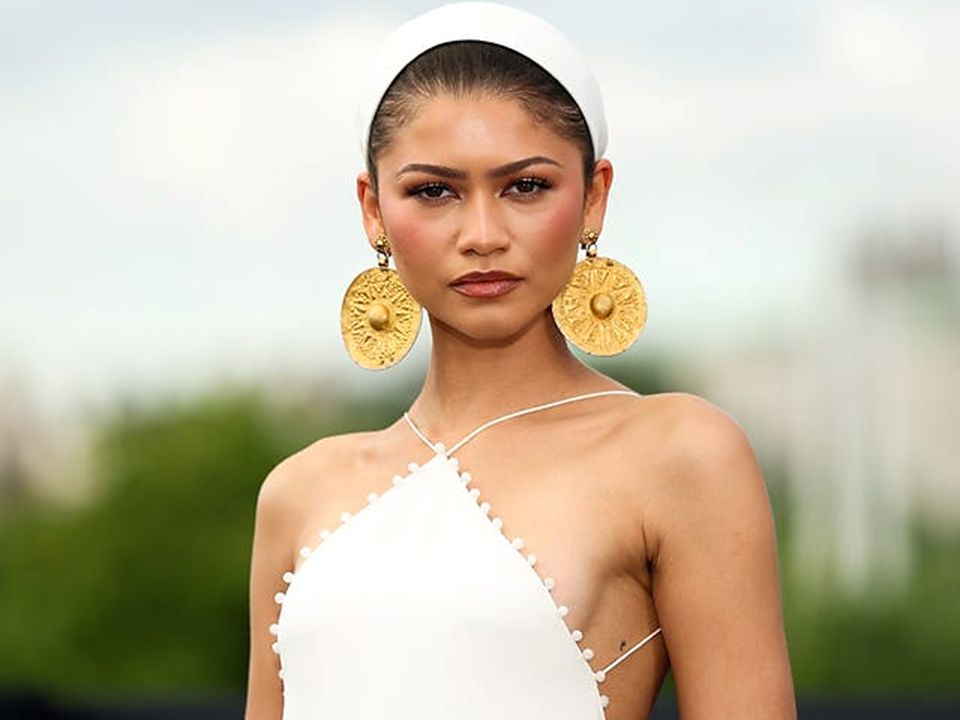
Zendaya with the questionable disc-earrings. Photo: Getty Images
She wore a pair of earrings, but they were circles of intense controversy. Zendaya has been the darling of the fashion world. Anything she wears, the media would say “stuns”, even when they did not. At this level, her fashion sense is apparently bulletproof—until she walks into a firing squad of her own design. At the London premiere of her new movie, the Christopher Nolan epic The Odyssey, Zendaya adorned herself with a pair of very prominent circular gold earrings that were as large as a Pepperidge Farm cookie. It didn’t take long for historians and social media sleuths to discover that those unbranded earrings were, in fact, a piece of Iranian antiquity. With her nice ear height and the gold discs, they formed double exclamation marks that projected visual volume and urgency, signalling a shout that carried visceral weight of defiance and, more importantly, spectacle. These, according to subsequent media reports, were 3,000‑year‑old Iranian gold medallions, which came from what historians called the Ziwiye Hoard, a massive collection of ancient gold, silver, and ivory discovered by local villagers in northwestern Iran in 1947. Because the pieces were plundered and scattered to antiquities dealers rather than being excavated under professional, state-sanctioned archaeological supervision, scholars have long flagged items from the Hoard as highly problematic.
The jewellery was initially described by the media as “statement” earrings. That, to us, implied intentionality. But what was Zendaya’s own statement, in the middle of a war between the United States and Iran, wearing jewelry made from ancient Iranian gold? Her intention is unclear even if damning. Perhaps even more pertinent is why an American actress playing the part of a Greek goddess named after Athens, the heart of ancient Greece, in an American film wearing jewellery of Iranian providence? The earrings flanked her face as a billboard for a history she likely doesn’t understand, or chose to ignore. The twin targets were where the ‘firing squad’ began to take aim. The jewellery is among the many found in 1947 by local villagers in a bronze coffin near Ziwiyeh Castle, Kurdistan Province, Iran, dating back to the Iron Age, between the 700s–800s BC. The pieces of an unknown total number were broken up by the finders and sold illegally; they are now split between the National Museum of Iran, the Metropolitan Museum of Art, and the British Museum. A massive portion of the Hoard ended up in private hands. Because the discovery was completely unmonitored, the illegal market acted speedier than any museum or government could. Now, a pair of them was seen on Zendaya’s grand lobes, as if it was something she bought from Zara.
The earrings flanked her face as a billboard for a history she likely doesn’t understand, or chose to ignore
Zendaya’s earring were originally just flat discs. Inexplicably, they ended in the hands of a Jewish jeweller named Glen Spiro who turned them into danglers for ears, reportedly using “claw settings” that would not damage the pieces. Iranian antiquities in Jewish hands is not a good look. The earrings ended in the private collection of Barron London, a Mayfair-based jewellery dealer and gemologist. They’ve defended the design as “non‑invasive” and claimed it preserved the artifact’s “integrity”. The plot wasn’t just thickening; it was approaching a solid reduction that nobody asked for. What is, indeed, the true significance of a Hollywood film that features an American star, is helmed by an British/American director, and adapts a Greek myth? When this star is dressed in Iranian antiquities refashioned by a British-Jewish designer, premiered in London, and then broadcast globally as a glamorous “statement”, what does it actually represent? All the while, American hostilities in the Middle East persist. It looked to us to be a shallow, aesthetic approximation where ancient looking was considered close enough for a red-carpet photo-op. And the largeness of the saucer-earrings—not typically Greek—ensured that they commanded maximum, unavoidable real estate on a smartphone screen. These days, even jewelry doubles as a beacon for the algorithm.
Zendaya’s styling is curiously about the entire chain of cultural displacement. With her stylist, Law Roach and his bloated self-titled “image architect”, they aimed to create red carpet looks—as well as those for the media tour—to mimick her screen character, in this case Athena, who, in art, is armored, draped, and symbolically loaded. So she has to offer a veneer of what what could pass off as Grecian. For the dress, they went for a halterneck and rear drapes that hinted at a chiton by the French label Jacquemus. Designer Simon Porte Jacquemus is born in Salon‑de‑Provence and raised in Mallemort, a small rural town in Provence. But what was not clear was whether Zendaya and her team were concerned with archaeological fidelity or Mediterranean aura. If the former, and since they were in London, not choosing the Greek-born Mary Katrantzou is very puzzling. Ms Katrantzou’s design language is steeped in Hellenic motifs, architectural prints, and mythological references. We suspect that, ultimately, the priority was not narrative fidelity or cultural coherence, but spectacle efficiency. Zendaya and Mr Roach probably thought it was enough to project French, chic, and goddess‑like, blissfully unaware that the rest of the world is more aware than that. Or what the wrath of angered Athena truly brings.
Ultimately, the priority was not narrative fidelity or cultural coherence, but spectacle efficiency
Law Roach is central to this drama. He was, after all, her “image architect”, an audacious self-appointment. But it now looks like he was the dramaturg of the whole spectacle. He chose Jacquemus for the pseudo‑chiton and Glenn Spiro’s Iranian medallions for the earrings. Those choices weren’t neutral—they constructed the incoherent tableau that critics are now angrily calling “colonial chic”. Iranian antiquities uprooted from their archaeological context, refashioned in London, worn by an American star: it’s a chain of displacement that mirrors colonial pipelines—artifacts stripped of meaning, repurposed for Western spectacle. It’s not just bad taste; it’s a repetition of colonial erasure draped as luxury. Just when the drama reached a rolling boil, something else had to bubble forth: How another dress for the same event found its way to her. Mr Roach managed to trip over himself into a second controversy regarding the exact same The Odyssey premiere in London. It was, quite impressively, failing twice at the same hurdle. Before his appearance in the British capital, Mr Roach was seated front row watching the Schiaparelli couture show. When it was over, he managed to secure one of the gowns, hopped into a private plane, and delivered the dress to Zendaya to wear on the red carpet, skilfully turning logistics into theatre, even boasting on social media that he hand-carried the dress. Does Zendaya deserve the treatment? When a public figure achieves mononymic status, their name functions exactly like the trademark of a luxury house.
The most combustible axis of this spectacle is not how Zendaya looked, but the clear collision she embodied. Against the background of the war in the Middle East, the semiotics could not be more stark: Jewish artisan, Iranian relic, French dress, American star, American accent, Greek myth, British stage, and a conflict started by the Americans. The optics were radioactive and echoed the very power dynamics of war and cultural erasure. Where is fashion in all this? It was perhaps not about the clothes but American hegemony, staged through fashion. Zendaya stood tall in London for a Greek myth retold by an American director, fronted by an American cast, broadcast globally. That’s cultural dominance disguised as entertainment. Add the earrings, heritage became raw material for American spectacle, just as The Odyssey is open source for American story telling. All this unfolds while America bombs Iran, with Israeli support. The film and the stars turn American culture into the global default by cannibalising everyone else’s heritage and slapping a universal, glossy finish on the end product. The irony can’t be deeper: invoking Athena—the strategist, the protector, the goddess of righteous war—to front a spectacle built on the casual plunder of other nations. They chose the costume of the warrior, but the actions of a looter. Historical weight does not matter because, in this system, anything can be harvested, repackaged and sold back to the world as modern.

