BTS’s Jimin showed up to the recent Dior show in a replica of an ancient frock coat, possessing all the historical literacy of a bathroom fern. And the media lapped it up
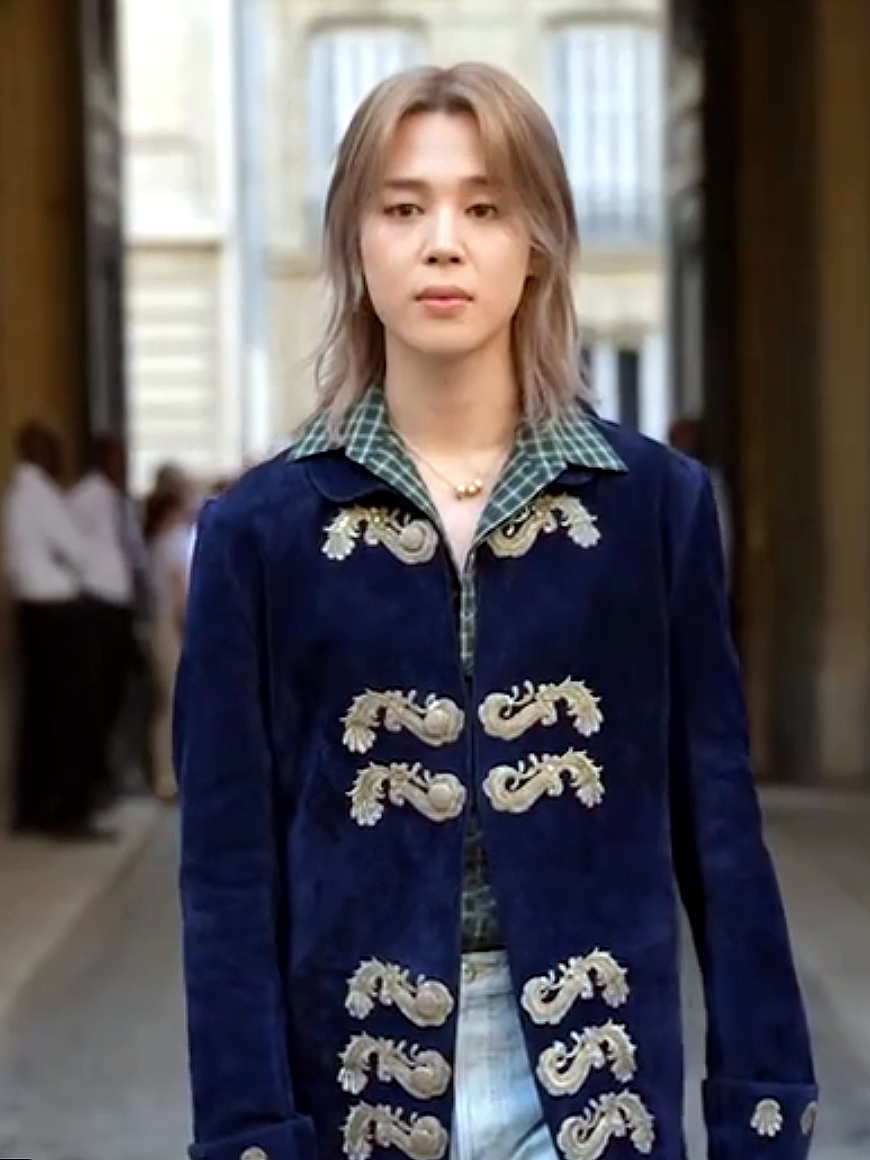
Jimin at the Dior men’s spring/summer show. Screen shot: mtvasia/YouTube
We habitually omit celebrities from our runway reports because there is already quite enough breathless coverage of them to go around. These days even trade paper WWD—at least it once was—hyperventilates about who wore what, when, and where, such as their gushing of Park Ji-min (everyone knows him as Jimin) in a recent editorial, headlined: “Jimin Brings the Heat to Dior’s Early-morning Show”. We note that the presentation itself was erased, even in the standfirst, which also mentioned other celebrities. The headline doesn’t acknowledge Dior’s collection, nor Jonathan Anderson’s direction, or tailoring. It’s about Jimin as the event. It’s designed for clicks, not for buyers or insiders. The headline does not bother to hide that it is not a summary, but an algorithm bait. In the 20-paragraph piece, Jimin is mentioned in only a single compound sentence. The headline is not a summary of the article. Like everything else enthusiastically shared online, it is a pure SEO device, stripped of any journalistic utility. Dior got their money’s worth.
The Dior Men spring/summer 2026 show was staged during what was considered the hottest early June in Paris. WWD did casually and euphemistically note that Jimin “managed to handle the weather in a blue velvet coat with an Edwardian air, and kept up the princely vibe by waving to fans from the balcony of the Musée Nissim de Camondo”. A coat in the 29°C heat is not only absurd, burnishing the suffering-for-fashion trope, it is impractical and this is really the point. To communicate on social media, spectacle is key. Brands don’t choose clothes, they pick costumes. As a brand ambassador of Dior, Jimin does not necessarily get to pick what he likes. He was given the outfit and it was his paid duty to make it work. This included standing on a balcony to wave at paens (Korean for ‘fans’). But every other celebrity stood on that very balustraded platform too. It was designated for waving at fans. The Dior show was tightly controlled, yet they deliberately left a fan‑vantage corridor so idols like Jimin could perform a wave. The balcony wave wasn’t some spontaneous “princely gesture” unique to Jimin. It was stage-managed by Dior as his Buckingham Palace moment.
A coat in the 29°C heat is not only absurd, burnishing the suffering-for-fashion trope, it is impractical and this is really the point
Wearing velvet in temperatures more conducive to fermentation is bizarre enough, but aura, quite clearly, trumped awareness. It is doubtful if Jimin was aware of what he endured for the sake of the lens: an 18th-century frogged coat, with no demonstrable connection to his personal aesthetic or the era it evokes. While the BTS member is known to favour outerwear that hints at military garb, there is no evidence of a genuine grasp of military heritage. But, Dior proved that ambassador Jimin doesn’t need to “know” the frogged coat’s history. Or that it is, in fact, a justaucorp, a French aristocratic outerwear circa late 1700s, with Brandenbourg-style frog fastenings. The media has been happy to coast along, mentioning that the velvet coat was inspired by one from the “Mark Wallace Collection”—a for-profit, vintage garment retailer known as The Dandy Dealer—without explaining why that is noteworthy. The ambiguity is deliberate since there is the possibility of mistaking that to mean The Wallace Collection, a museum that, like the former, is in London. That lends the garment an aura of institutional gravity it does not inherently have. Dior borrowed from crude commerce, not true scholarship.
But this not unique to legacy media. One internet-native hype blog, No Manners Magazine, filed a curiously mannered report that so delighted The Army they had to share on IG fan page Jimin Global. On top of describing the coat’s embellishments, the ‘mag’ added: “What was more impressive, however, was the coat’s inspiration: a 1775 piece from the Mark Wallis Collection, which the Victoria & Albert Museum “believes to be the largest private collection of historic menswear in the United Kingdom.” It does not state that Mark Wallis is a dealer who trades in historic garments; he is not a museum curator. Instead, the V&A’s words are treated as a stamp of legitimacy. The coat’s historical weight is validated by museum language, even though the piece itself came from a dealer’s stash, not a museum archive. This is just name‑dropping. The V&A is invoked like a talisman, not as a source of analysis. Heritage becomes superficial spectacle: a dealer’s frogged coat, worn in tropical heat, validated by a museum’s generic description, amplified by media that doesn’t bother to clarify. The garment’s meaning is imbued with royal vibes and period drama energy.
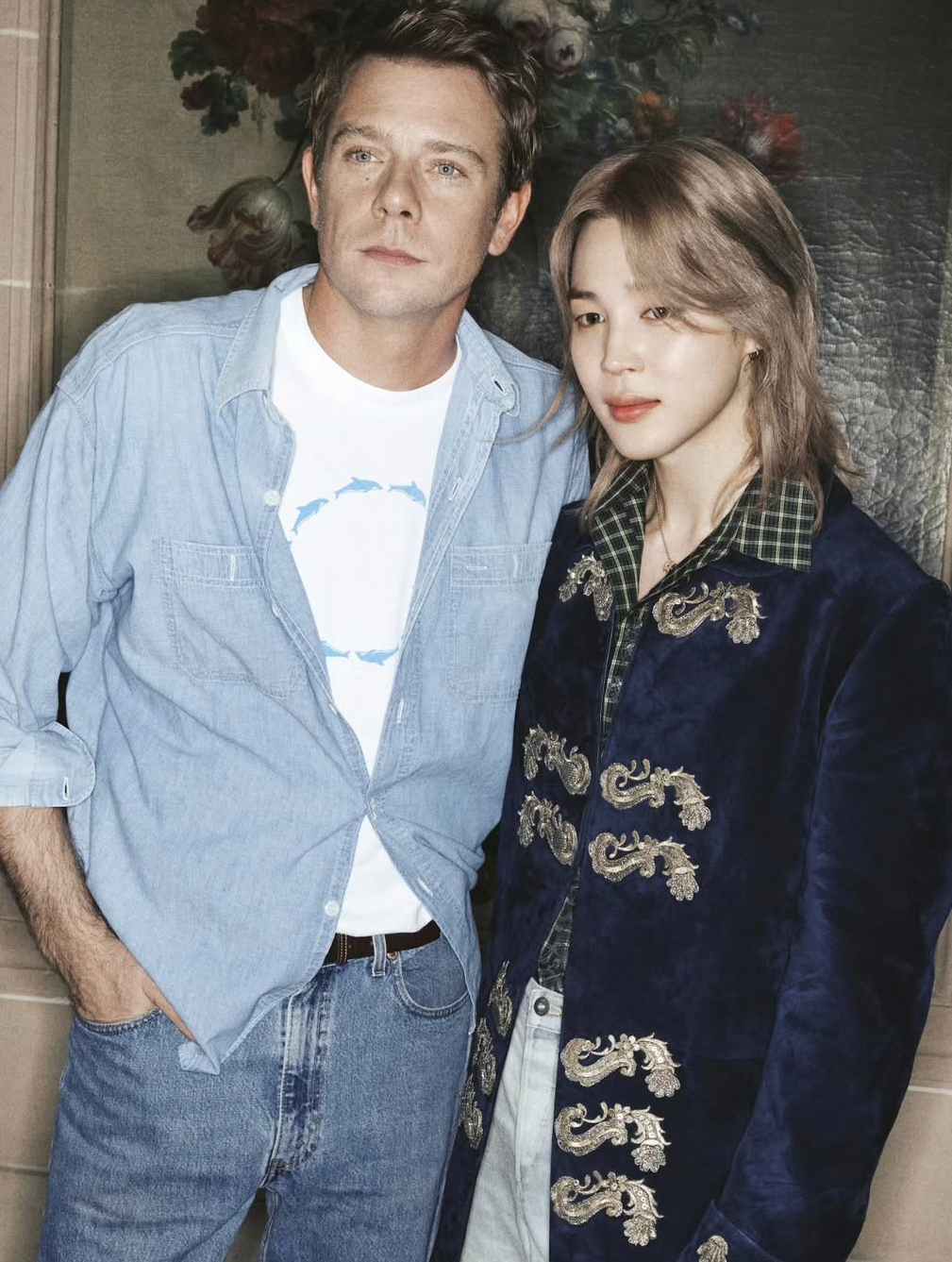
With Jonathan Anderson. Photo: j.m/Instagram
In that solo WWD paragraph on Jimin, an odd period comparison was made when they chimed, “Jimin managed to handle the weather in a blue velvet coat with an Edwardian air.” Was it a whiff or something gale force? The coat Jimin wore was widely reported to have been modeled on a late‑18th century French coat with velvet, embroidery, and frogging closures. To describe the vibe, the outfit projected as “Edwardian” is not only a historical mismatch, but also a geographical incongruity. WWD failed to explain how they saw Edwardian England in a garment that so clearly evoked the ancien régime. Edwardian England. Jimin wore it as Dior intended: a “modern-day flâneur” . A 19th century archetype, the flâneur is an idle stroller—a mobile lepak idler—observing French society and being observed in return. The defining style of the flâneur isn’t about a specific cut of coat or a fixed silhouette—it’s about attitude embodied through dress, clothes that signal refinement without effort. The flâneur strolls, he doesn’t hustle; his style must look leisurely, not utilitarian. Rather an antithesis of the attire of K-pop stars today, on stage or off.
A flâneur, as Charles Baudelaire delineated in his 1863 essay Le Peintre de la Vie Moderne (The Painter of Modern Life), appears effortless, an “incognito” camouflage. It contrasts directly with the rigid costume of the dandy. The Tate even describes him as “the connoisseur of the street”. The primary goal of the flâneur’s wardrobe is to achieve total invisibility within the urban crowd. However, dragging a 1775-style heavy velvet coat through the 29°C heat of a busy, stage-managed event became the very examplar of utilitarian and, regrettably, forced. Jimin wore the deliberately mismatched checked shirt beneath the coat assigned to him by Dior, with the collar purposely flipped over the outerwear’s own collar. This is resonant with the Black dandy. The look is, in contrast to the flâneur’s, hyper‑visible, sartorially excessive, and defined by its refusal to disappear. With his long bleached hair, Jimin was styled that Paris morning to personify the Ah Beng. The ghost in the crowd became the beacon of visibility, waving from a balcony. That collision is why the outfit feels, to us, unstable—aristocratic gravitas undone by street‑coded flamboyance. You can’t get more Beng than that.

