Any doubt that the “flower market” was anything but a piece of performance art has been erased. It was not a display of botanical talent, but an output of narcissism. Following the logistical trainwreck of her event’s making, the Australian artist CJ Hendry offered no apology, only a dismissive rebuttal: Can’t cope with the chaos? Stay away

CJ Hendry telling her viewers not to visit her flower market if they cannot handle the logistics problems. Screen shot: TikTok
Even in our highly kiasu society, those who attended the just-concluded CJ Hendry Flower Market did not just dash in; they arrived for a registered event with a promised time of entry (how some behaved inside is another scene). If the organisers were unable to manage the logistics of the event, that’s an operational hiccup, not a failing of the attendees. In a social media post two days ago, the Australian artist Catherine Jenna Hendry herself responded to the complaints, saying: “If you prefer, we can charge you to enter. It’d make a heck lot more expensive. That would make way more business, to be honest. But I don’t fuck want that… This is what it is. If you don’t like it, please don’t come. Please do not come. This event is just not for you.” Australian media has described Ms Hendry as a “self-described Brisbane bogan” (an Aussie slang term for an unrefined or working-class person). To us, the Ah Lian reared her ugly head and it gleamed.
Instead of apologising for the logistics hiccup, she asserted ownership of the event and set boundaries with attendees. To be certain, this is not a bold stance; this is solid arrogance. If the aim was a more tepid response, a method more efficient would have been to simply not confirm the time slots in the first place. Many shared online the hours-long waiting time even when they assigned a time. On social media, there was warning that, for those planning to simply walk in, the waiting time could be up to four hours. Treating a failure of basic event capacity as an act of boundary-setting is a fascinating performance. It reveals the raw posture of the event: unapologetically commercial, shamelessly exploitative, and deliberately antagonistic to critique. It suggests she prefers to curate the guests by exhaustion rather than by intent. And all for not-much-to-look-at polyester flowers?
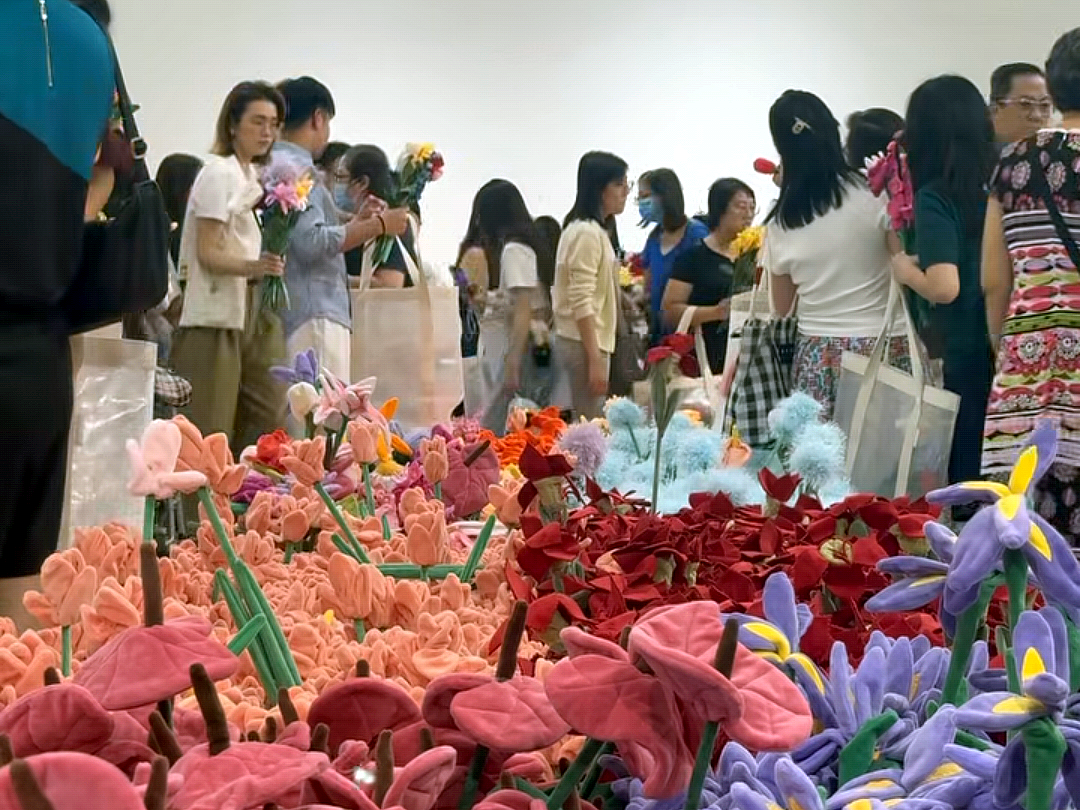
The CJ Hendry Flower Market. Screen shot: be.imba/Instagram
She says ”please don’t come”, twice. The repeat is not neutral dismissal. It is not even take it or leave it since there is no option of take. Ms Hendry has missed something crucial: people weren’t queueing for some rarefied “invitation” into an art world; they were in line because they had registered for a time slot, like one does for a ticketed attraction. It was very simple: sign up, show up, line up, buy up. Gardens by the Bay, IMBA, and media outlets perpetuate the fiction of “wandering through an installation,” but the mechanics are closer to a warehouse sale with timed entry. Ms Hendry’s deliberate phrasing is pure exclusion—bouncer-speak—that does not want dissenting voices near those flowers, which are as real as her brows. What we heard is sarcastic beseeching. The double utterance performs irritation, almost mocking the audience: a 虚情假意 (xuqing jiayi) or faux‑plea that is really a shove. Her words confirm what the plush blooms already suggested: the Flower Market is not an “installation” but a pop‑up product theatre.
There is an Instagram reel in the CJ Hendry Flower Market Instagram page that showed attendees ignorant of Ms Hendry’s identity, yet frenzied over the blooms. Her statement doubles down: she doesn’t care if they know her, doesn’t care if critics call it exploitative. The rush is the point, the frenzy is the art, and the profit is the payoff. Some have suggested that by deconstructing this spectacle, we have merely become a participant in it. This is a convenient defense for the hype-merchant: to equate the pathologist’s report with the sickness itself. But the observer is not the spectacle; the observer is the one holding the lens. The Flower Market offers the perfect mirror of our times: a hollow construct that demands our hours, taxes our patience, and ultimately expects our gratitude for the privilege of being sold to. If this is art—a transactional show piece where the inefficient merchant mocks the patrons and the products are little more than overpriced inventory—then we should choose to stay away. We might finally be all the better for it.

