Only now, after Usha Vance sat down for an interview with ABC did we realise that she is a spandex devotee
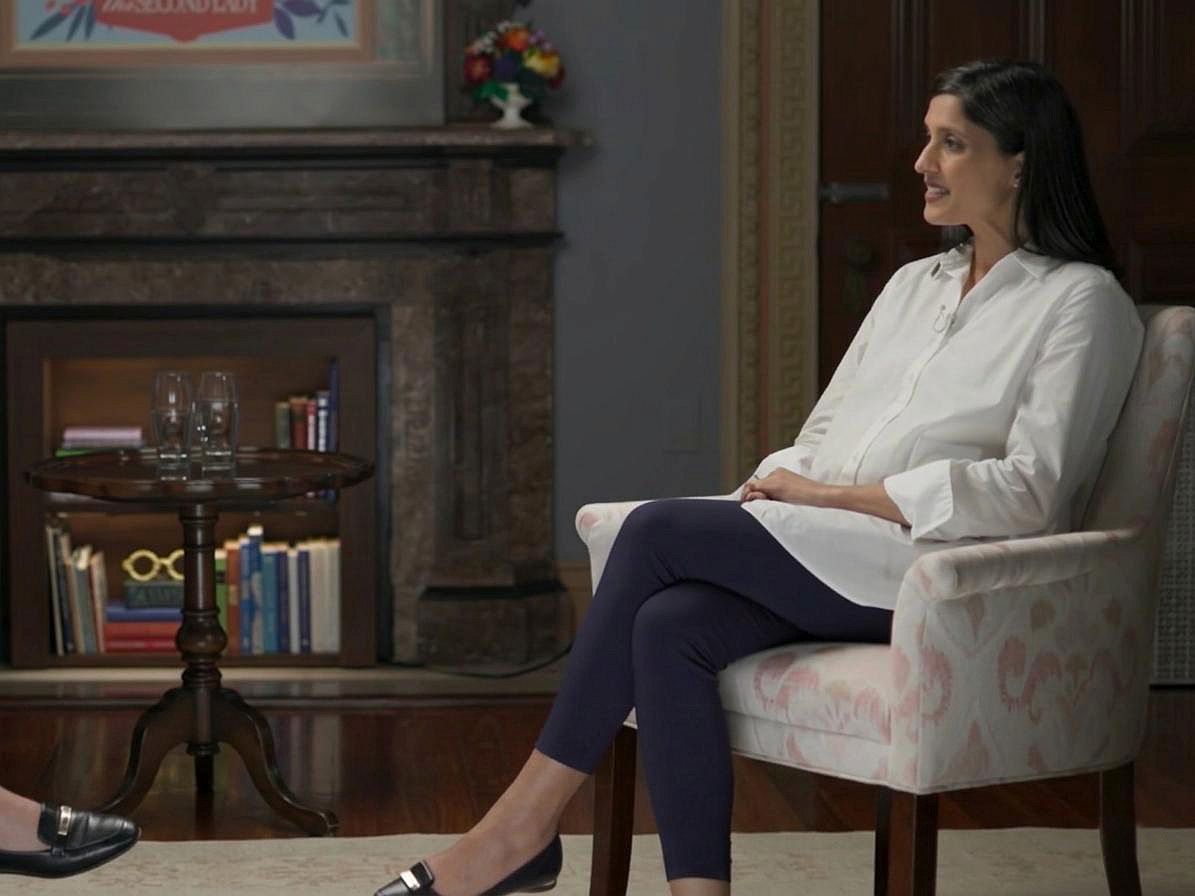
Usha Vance in the ABC interview
Usha Vance rarely gives one-to-one interviews. But in the past three months, she gave two. First, with NBC’s Kate Snow in late March and just this morning (our time), with ABC’s Lindsey Davis. For the ABC appearance, Mrs Vance ditched the skirt-suit she wore to the NBC studio. This time, it was a white shirt with standard collar, and a visible, skinny placket, but no other discernible design feature. If not for the right side overlapping the left when buttoned, it could have been her husband’s shirt. She wore the chemise untucked, the barrel cuffs of the sleeves folded back, as if she was about to lift a box of toner for the office printers. The shirt signaled an intent to get to work, but the lower half suggested a complete abandonment of the task: leggings. The form-fitting garment that ended just below the calves is unmistakable. It was not skinny pants. It was an act of unadulterated fashion surrender, specifically designed to ensure that nobody in the studio is quite sure whether she is heading to a corporate merger or a pilates retreat.
Many of her fans—including politically neutral woman—have defended her clothing choice by pointing out that she is pregnant. The pregnancy is not exactly a state secret that requires a press release to decode. So the popular take is that most pregnant women wear leggings. The prevailing assumption is that a baby bump necessitates a transition to leggings, and that Mrs. Vance is no exception. It hardly needs stating, yet here we are: The leap from comfort to spandex leggings is a stylistic decision, not a biological inevitability. To be certain, in pregnancy, or any physical circumstance, the body sets parameters, but the wardrobe interprets them. And the wardrobe is a woman’s choice. Choosing leggings for a televised interview is not some biological need tied to pregnancy; it’s a clothing choice, a rhetorical gamble. Comfort can be achieved in countless ways—jersey dresses, tailored maternity suits, even tented coats—without defaulting to testing the tensile strength of spandex.
It hardly needs stating, yet here we are: The leap from comfort to spandex leggings is a stylistic decision, not a biological inevitability
And many are also saying that she was trying to he relatable and nobody should read pregnancy as a fashion statement. If she did not want to be read, perhaps not coming before a TV crew and a recording device might be a better decision. If she didn’t mind being read, she probably thought she had to appear accessible, positive, and unencumbered by preferred formality. But as a second lady, she will never be accessible. People want her to stay up there, to be admired, to be aspirational, and to look better than them, even when pregnant. When Rihanna was expecting, her maternity fashion was dissected endlessly because she deliberately turned her body into spectacle. Every bump-baring dress was a statement, every sheer panel a provocation. That was fashion-as-narrative. Mrs Vance’s pregnancies have not been used as such, but her lazy excuse for choices are just that: I can’t be bothered. Her leggings are not destiny, they’re a decision. And decisions, especially in public, in a TV studio, on a political stage are always rhetorical.
Unlike the first lady, we do not expect the second to wear Dior haute couture. Mrs Vance could have effortlessly procured a smarter ensemble from Banana Republic, for all that we might deign to concern ourselves. But she preferred what could be described as ‘American casual’. It is also said that this makes her more “relatable”. In the U.S., leggings have become the default garment of extreme ease: airport wear, grocery runs, suburban errands. They signal comfort, informality, even a kind of I-don’t-need-to-dress-up-for-you sass. When that aesthetic crosses into politics, however, it carries all the baggage of American casual culture—the pancaking of decorum, the prioritisation of ease over polish, the collapse of the public into private. It’s not neutral, not at all. It’s a cultural code for dressing for everyday life, not for the stage. But Mrs Vance is not the neighbour you bumped into at Costco, even when she told Kate Snow in March that she is a Costco member. Nothing wrong with that, but is it really crucial to dress like she is one?

Usha Vance, make-up lite, under studio lights
The true misfortune here is not merely the legging itself, but a kinetic eyesore. Mrs Van was seated directly in front of Lindsey Davis; her profile faced the camera. She was ensconced in an armchair, her left leg crossed over to the right, with that knee serving as a sort of fulcrum. Intermittently throughout the interview (more so at the start), she shook her leg in a motion that was similar to a forward kick, directed at her interviewer. Many people have ascribed both psychological and physiological reasons to that beguiling action, but viewing the interview on our screen some 15,000 kilometres away, it was testing. And disheartening to see an Asian woman unaware that pointing the toe box of her shoe at the person in front of her and shaking it would incur disapproval. In Asia, gesturing with one’s foot is a vulgarity that suggests a singular lack of upbringing; to keep that foot in rhythmic, involuntary motion is not merely an anatomical indiscretion, but a proclamation of one’s own incurable vacancy. In America, it could be called “nervous energy”. But here in Asia, it is clearly a lack of self-awareness.
In China, there’s a common saying 男抖穷, 女抖贱 (nandouqiong, nudoujian), which translates to ‘a man who shakes his leg is poor, and a woman who shakes her leg is indecent’. It bears stating that this is an assessment of character, not a treatise on chromosomes. In India, where Ms Vance is held in exceptional high regard, the shaking of legs in such a manner carries connotations of disrespect, even spiritual consequence. It will incur the wrath of Lakshmi and prompt her to leave the premises, bringing along whatever riches she had intended to bestow. There is clearly this double bind of global visibility: every gesture is cross‑cultural text. Leggings already signal a necessary American casual assimilation for an Indian Hindu; the toe‑pointing leg-shake compounds it with a gesture that, in Asian contexts, risks spiritual and cultural offense. She may have thought she was signaling the much-vaulted accessibility, but from our side of the earth, Usha Vance’s behaviour reads as a lapse in dignity. One can only speculate why she opted to forgo the terrestrial stability of two feet on the ground—or, at the very least, a hemline long enough to mask her rhythmic agitation. The legging-clad icon chose the spectacle; she can hardly complain about the glare.
Screen shots: abcnewslive/YouTube

