What is essentially the Costume Institute Benefit has not only received a major public-facing rebrand under the watchful gaze of Anna Wintour, it has become the most derided in recent memory. The 2026 edition is an unflushable legacy
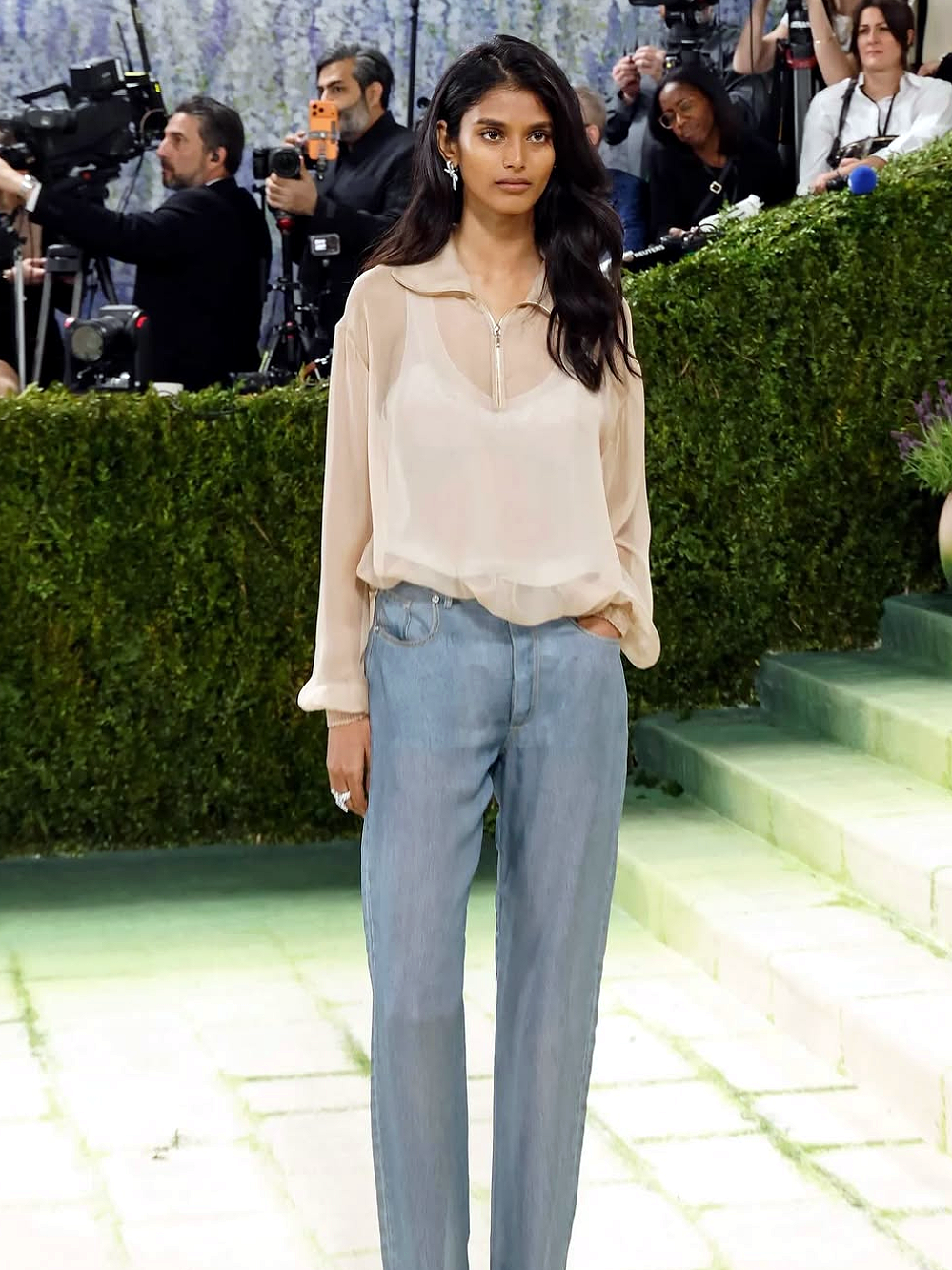
Bhavitjav Mandava standing on the Met Gala in what for India was an underwhelming outfit. Screen shot: bhavitjavmandava/Instagram
Who knew that the Met Gala this year is a gift that gives and gives, and gives. For some, fodder for gossip, for others, reason to be angry, even more, heartburn. We never thought we’d go beyond just one review. In fact, we thought we’d sit this ‘Art’ parade out, but here we are, with our 11th report on just one subject. A reader had pointed the number out to us. This is quite a record we did not set out to achieve. It’s the sort of milestone one acknowledges with a polite nod and a quick exit. But some things cannot escape the eye. Increasingly—and this year, it is especially so—a parochial American dress-up gala has successfully rebranded itself as the Supreme Court of Asian cultural validation. The Met Gala red carpet is no longer just about fashion; it is treated as a formal validation of a nation’s cultural export machine. It has somehow convinced half of Asia that it’s the ultimate performance review for cultural relevance. We have been there, thanks to a tuition centre, associated with one America-loving influencer. The latest to demand to be evaluated is India.
For quite a few years now, India has celebrated its major stars at the Met Gala—Priyanka Chopra, Deepika Padukone, Isha Ambani—women who arrived in resplendent couture armour and were hailed as national triumphs. Those appearances were framed as Indians “doing their nation proud”. This year, there was filmmaker Karan Johar, designer Manish Malhotra, businesswoman Isha Ambani, philanthropist Natasha Poonawalla, entrepreneur Ananya Birla, and socialites Sudha Reddy, Diya Mehta Jatia, Bhavitha Mandava, among others. The ‘Make India Proud’ memo reached their inboxes, too. But then suddenly, Indian pride discovered gravity—and it was a long way down. Standing at the center of the crater was Indian student-turned-model Bhavitjav Mandava, looking less like a beautiful Chanel-clad woman that she was and more like the inevitable physical law that had brought them there. The Mandava–Chanel moment is a prime example of how the Gala has become an unglamorous site of contested legitimacy.
The Met Gala red carpet is no longer just about fashion; it is treated as a formal validation of a nation’s cultural export machine. It has somehow convinced half of Asia that it’s the ultimate performance review for cultural relevance
India’s critique that quickly went viral wasn’t just about whether Ms Mandava looked “well-dressed”. It was about whether Chanel’s styling of her was a respectful engagement with India’s typically more dramatic aesthetics or a flattening of them into what is considered Western couture standards. But she was attending a largely Western event, representing a storied Western maison, yet she was also a bearer of her heritage that must not be a barely discernible footnote. India Today wrote that Ms Mandava “deserved a far stronger debut and Chanel did do her dirty”, using a colloquial phrase to suggest that the fashion house treated India’s model-daughter unfairly. In all likelihood, no one would have noticed if the Indian media did not make a hoo-ha about it. Mandava still looked beautiful. That’s the dynamic of the Met Gala now: it’s not just about aesthetics, it’s about symbolism. A casual outfit becomes a proxy for how India is “treated” on the global stage. The irony is that Mandava herself had no say—she was a model/brand ambassador fulfilling an obligation and Chanel’s vision, now unlike what it once stood for.
It was, after all a gala, which by definition is festal, glamorous, and, increasingly, showy. It is easy to see why Chanel’s choice of evening wear for Ms Mandaca was seen as a slight. Despite the seemingly strict evening wear/black tie dress code (even journalists had to rush to borrow gowns to attend), the model was given a sheer, dusty pink zip-front (!) pullover—a couture interpretation of a track top—teamed with what could be the most egregious of all—jeans. Chanel did quickly clarify that the five-pocket was not made of run-of-the-mill denim, but 250 hours of hand-printed muslin and silk. One hundred and sixty eight years of French couture and we are still being sold how many “many hours” a couture outfit typically takes to make. Those hours invested must automatically make it superior and aesthetically grand? What a sweat equity delusion, a charming little fallacy. The idea that if enough underpaid artisans squinted at a pair of fake jeans and apply paint by hand for more than ten days, the result must be a masterpiece rather than a very expensive nothing-to-see. Why should we be put through the minimalist fatigue at a notoriously meretricious Met Gala?
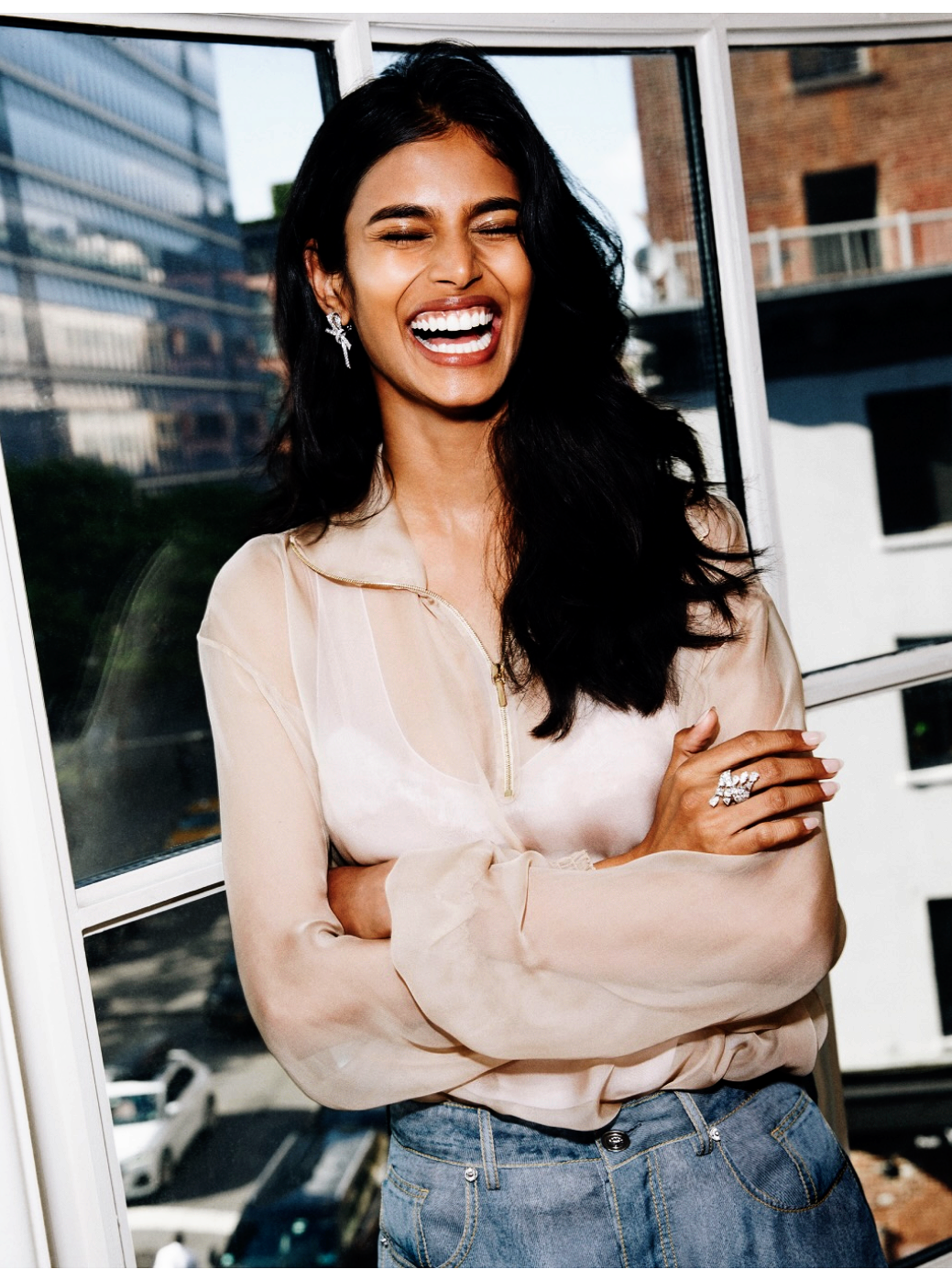
Ms Mandava being herself, off carpet. Photo: bhavitjavmandava/Instagram
On a red carpet where journalists are scrambling for gowns that desperately craved the approval of the devil-host’s and co-watchers’ hawk’s gaze, Chanel’s narrative comprised entirely of loose ends. It is hard to understand why the model-daughter of a nation was made to appear as if she was on her way to work at Chick-fil-A to pay for her university studies. Sure. Chanel wanted to evoke the subway ‘normalness’ of their Métiers d’Art show in New York, but why make Ms Mandava look aggressively under-dressed, even mundane, on this very night? Many Indians would not even wear jeans to a wedding, let alone a gala. Just look at the nuptials of Anant Ambani and Radhika Merchant. India doesn’t need to be taught how to dress up. We know Chanel is making drastic changes to the maison, with Matthieu Blazy seemingly going back to the original casualness of Coco herself, effecting a 1920s minimalism for our tenaciously attention-seeking times. Mr Blazy had attempted similar hand-painting effects at Bottega Veneta, then on leather. But on the red carpet, that sheer pair of mock jeans was really a trompe-l’œil of talent.
The Met Gala is quite a different beast today, despite its couture cloak. Its original purpose—raising money for the Costume Institute—has been eclipsed by its role as a global stage for celebrity branding and, now, national pride display. Narrative battles, who gets the “moment”, who is slighted, and how the press spins it, is the only high-stakes drama where the final cut is edited by people who weren’t actually in the room, yet somehow feel entitled to the last word. It really is a beast, more so that the one that accompanied Jordan Roth, that feeds on amplification, not just artistry. But this year, it frantically tried to be inclusive as well, with a guest list that included disabled model Aariana Rose Phipps, disability activist Sinéad Burke, the “girl with the golden legs” Lauren Wassse, and more, parading diverse bodies while still centering celebrity spectacle. We should have been impressed, but Singapore’s own DORS (former Design Orchard) staged an inclusivity-themed fashion show last year, as part of the LGBTQ-affirming Pink Fest. Representation was the point, not the accessory. Met Gala’s belated effort is noted
Mr Blazy had attempted similar hand-painting effects at Bottega Veneta, then on leather. But on the red carpet, that sheer pair of mock jeans was really a trompe-l’œil of talent
Why are we still so eager to align with America culturally, when so much of what is emerging from the U.S today is so unpalatable? It has been frequently said in Asia that this yearning is rooted in a mix of history, economics, and soft power. We cling on to it because it has been mythologised as a global dispenser of taste. Yet, it is no longer according reverence to an America that does not deserves it. Rather, it is more the concentrated moment of visibility institution such as the Costume Institute can still afford to give. The Met Gala may, on the surface, be about fashion, but our fascination with that event goes beyond it. It’s a form of cultural muscle memory that hasn’t caught up to the reality of the crude, messy, war-wrecked present. For decades, the U.S. successfully branded itself as the Arbiter of Cool. Even as the actual output has turned vulgar or distended, the institutional infrastructure—the Vogues, the Met Galas, the Ivy Leagues—still holds the keys to global visibility, even when the technical intelligence has clearly shifter East. We aren’t necessarily aligning with their values anymore, but with their far-reaching amplifier. India and Singapore have the craft, but America still owns the biggest and the loudest microphone.
The Indian press has seen fit to elevate Mandava’s blouse-and-jeans ensemble from a mere lapse in sartorial judgment to a full-scale affront against the dignity of the state. On social media, the narrative has moved beyond the garment itself, settling instead on the tiresome trope of cultural erosion, never mind that India is made of sterner stuff. Has the Met Gala become the Miss Universe stage, where a win is the only outcome to aim for? The Gala becomes a proxy contest? India’s fashion, cinema, and cultural exports thrive independently of Met Gala verdicts. Yet, in a waning year of the Met Gala, the event is still a symbolic weight that pulls nations into treating it like a tribunal, even as critics dismiss it as a bloated costume party, now made even more so by oligarchic inflation. As Vanessa Friedman rightly noted in The New York Times after the event, “the gala has increasingly been walking the line between elegant and absurd.” To India, where did their lauded model really land? Validation from an institution whose own legitimacy is fraying is not immediately comprehensible. To the Met Gala, Bhavitjav Mandava was just another pawn in the on-going spectacle’s quest for even more of the very salah.

