A Singaporean tuition centre teaches its followers how to turn in better GP essays by wading into the Met Gala hype via Instagram. Let’s grade the post: F
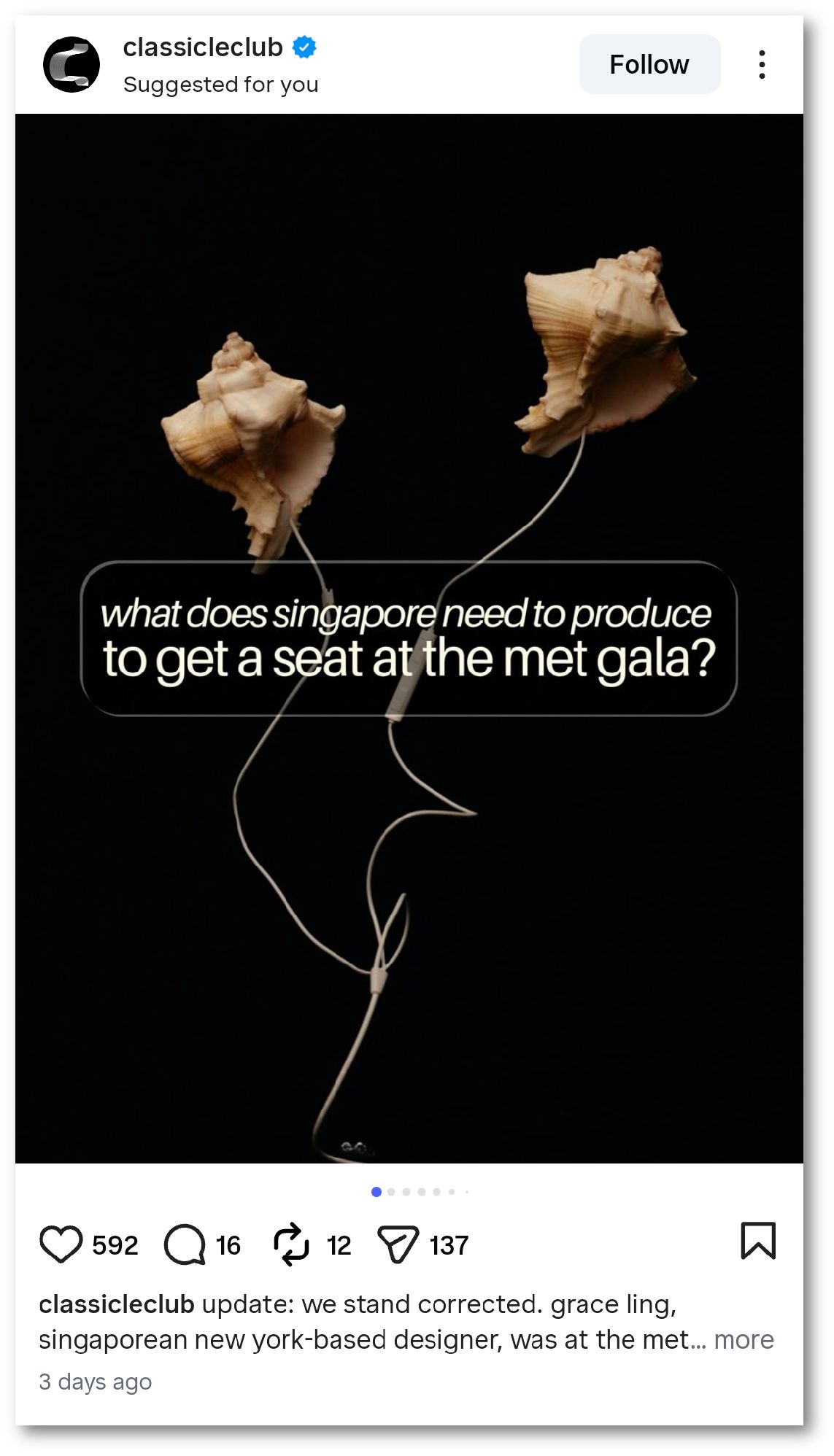
We might abhor the algorithm-churned sludge, but every so often, the swamp gas produces a surprisingly decent scent. It did this morning, and the sweetness that wafted to our attention was from the least expected source: a tuition centre. And none other than social-media darling, influencer Brooke Lim’s much-lauded Classicle Club, where it once, as the popular lore goes, used teaching materials developed by another tutor. Ms Lim is apparently pursuing further education in California, while, as her own Instagram posts show, living it up. Perhaps, because she is in the U.S., she was following the rhythm of the social pulse there, and the IG posts of her tuition centre have to reflect how topical and on-trend their teaching tools are. In a post shared three days ago, Classicle Club posed an urgent question of national importance (and we quote verbatim): “what does singapore need to produce to get a seat at the met gala?” Yes, an important question, in all lower case.
Refusing to be burdened by the shift key may show that you’re generationally tuned in and you use your socials well, but refusing to capitalise the name of the nation that provides your ‘tuition’ revenue is a supreme lack of decorum. Your students will prefer to say rude. but professional integrity will not catch your regular pupil’s attention. In fact, throughout the 17-slide post, not only do proper nouns stayed obstinately in lowercase, punctuation chooses MIA, grammar prefers to be malleable, and rhythm just stayed out of the way. The result is not clarity, but a kind of breathless sprawl, an adventure into the territory of the chin chye (凊彩, Hokkien for, in this context, anything goes). The poser on that first slide is similarly sloppy: Why is a people’s professional and social success pivoted to its ability to attend the Met Gala? Sure, the New York event hinges on three powerful currencies: visibility, cultural capital, and elite access. But how do they teach their GP students that one can conflate overseas cultural visibility with national achievement?
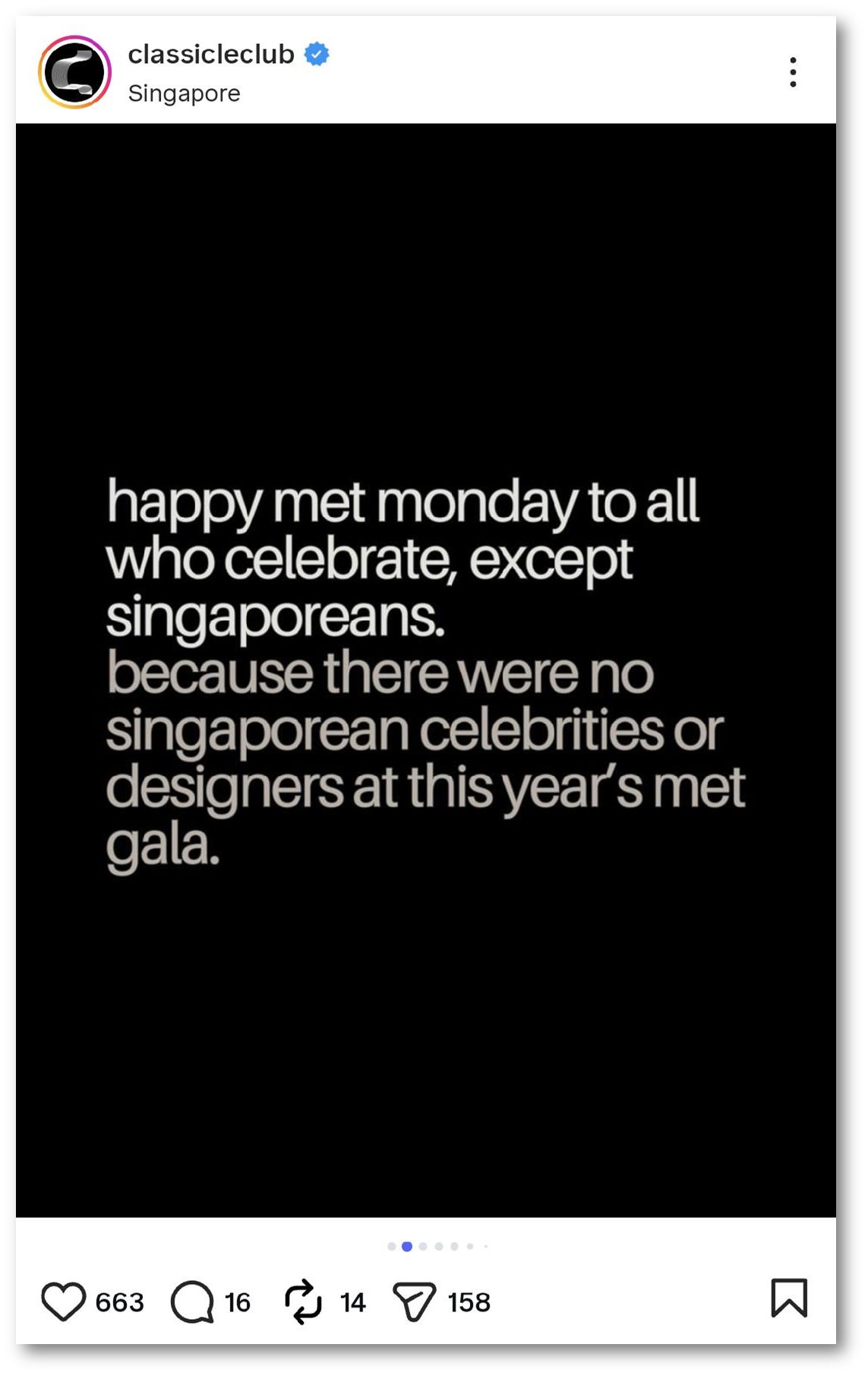
The answer to that opening poser was not answered in the next slide: “happy net monday to all who celebrate, except singaporeans. because there were no singaporean celebrities or designers at this year’s met gala.” This loose paragraph contained enough irregularities to make a seasoned copy editor drop their red pen, walk into traffic, and never look back. We’re totally glad that “happy” had a rendezvous with dreary “monday”, but after we woke up to the reality of the missing capital letters, we realised that the proper nouns had suffered a collective identity crisis too. Poor things. Met Monday is now like Good Friday? But that’s very much an American framing. Outside that bubble, there’s no obligation to adopt their cultural shorthand or elevate the Met Gala to quasi‑holiday status. Why did Classicle Club encourage their students to? In a GP context, this is a critique of register and context, and they get a benevolent F. Reading that short paragraph isn’t a task; it’s a resignation trigger.
The cultural cringe of an educational brand that critiques Western-centrism while simultaneously forcing its students to adopt American media slang as if it were a liturgical calendar aside, there is also the factual accuracy of that passage. It stated that “no Singaporean celebrities or designers” attended. Yes, they did eventually slap their own faces by mentioning TikTok’s Shou Zi Chew, but also included the diss—he was there “as a tech CEO, not as a cultural figure.” You see, he’s a bore that helms only the most influential cultural engine of the decade. Even later, in the comments, as erratum, not apology, they admitted to overlooking designer Grace Ling’s actual presence on the red carpet. Another F, for technical fail. These are misreported basic facts. For GP students, precision must not be optional, even if “alternative facts” are in American politics. Yet, they don’t tell the students and their parents who read the cringe-y post that once a GP paper is submitted, there is no chance for errata. In effect, the writing mirrors the spectacle it critiques—breathless, reactive, and structurally unsound.
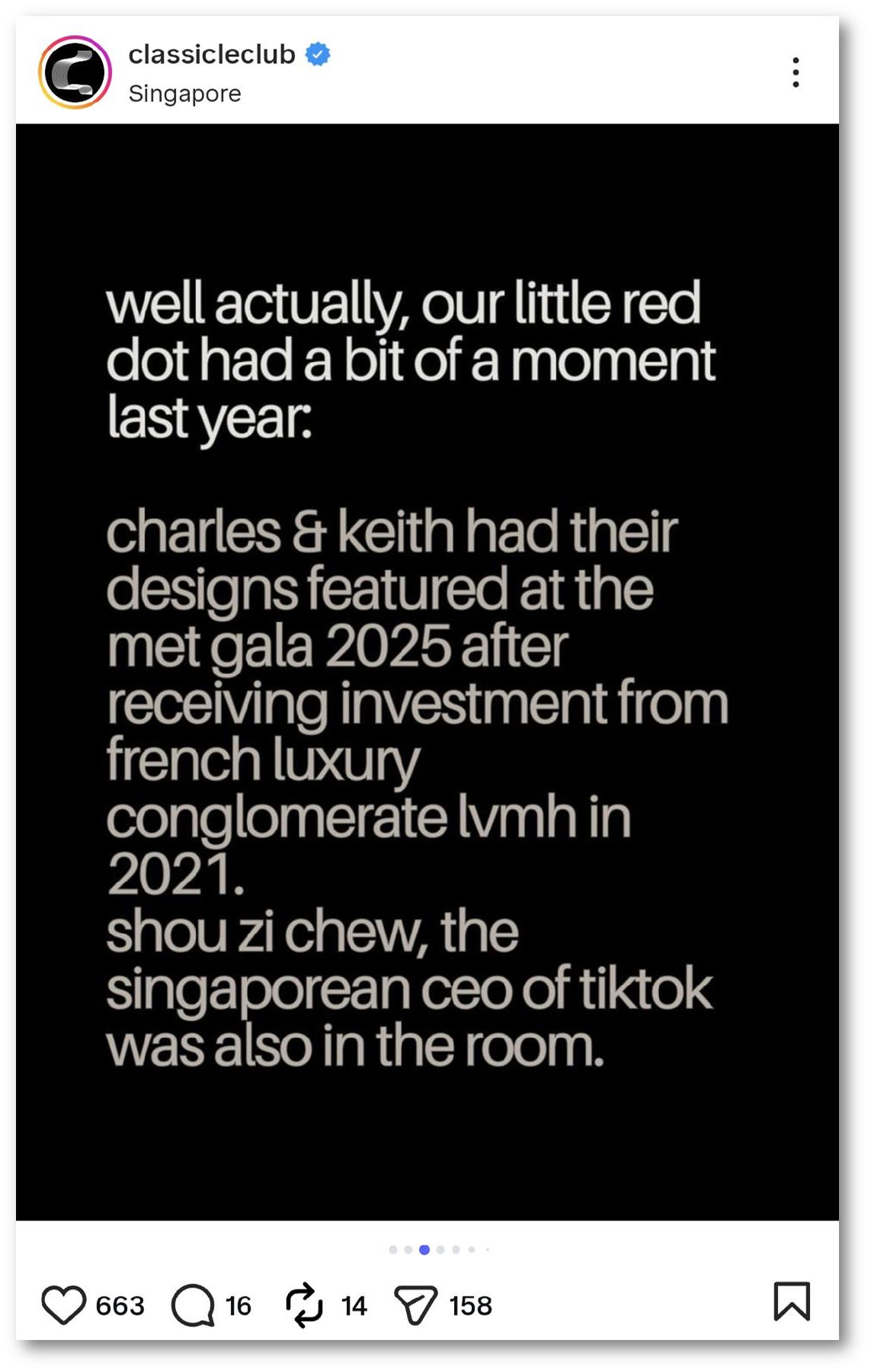
We were only on the second slide and already looking for the nearest emergency exit—or a toaster to throw in the bathtub. Not only did they leave out Grace Ling entirely, they failed to mention the 3D heels from Charles and Keith that she wore, but, to show what a sophist they are, stated in the next slide that “charles & keith had their designs featured at the met gala 2025 after receiving investment from french luxury conglomerate lvmh in 2021 (sic).” GP students, if you are reading this, that is a devastatingly clear example of how sentence structure and factual scaffolding can collapse at once. We are also certain that the world’s largest luxury conglomerate would not be amused that the initials of their company Louis Vuitton Moët Hennessy are shown in lower case. But most importantly the syntax: It implies a direct causal chain: LVMH invested (the tense is key here) in Charles & Keith and the designs appear at the Met Gala—when in reality the relationship is tenuous (suggestion: read up on L Capital Asia or L Catterton). And there is a ten-year gap in Classicle Club’s sweeping assertion. GP teachers, perhaps not tutors, would called that faulty reasoning and factually wrong. A big, fat F.
The linguistic and factual noise of the content of the subsequent slides were not enough to impress, so they generously took their followers on a global tour. We knew not of Classicle Club’s deep expertise in the anthropology of cultural influencers and the liturgy of labels hidden behind such a convincing façade of effortless simplicity. According to them, “singapore doesn’t have a globally recognisable creative signature.” Don’t strain your neck looking all the way down here. Forget the evidence, ignore parsing what recognition even means. So, which nation has? We learn that “japan has avant-garde”. The missing article ‘the’ delightfully turns a historically specific movement, with roots in early 20th‑century art and fashion, to a free-floating style category that Japan somehow “has”. It then cites examples: Comme des Garçons and Yohji Yamamoto. Suddenly we are back to Paris, 1982. Leap-frogging over everything from Ura-Harajuku to Goldwin’s technical innovation is a gaping knowledge gap. The beautiful classic of “vibe over veracity” treatment of fashion history.
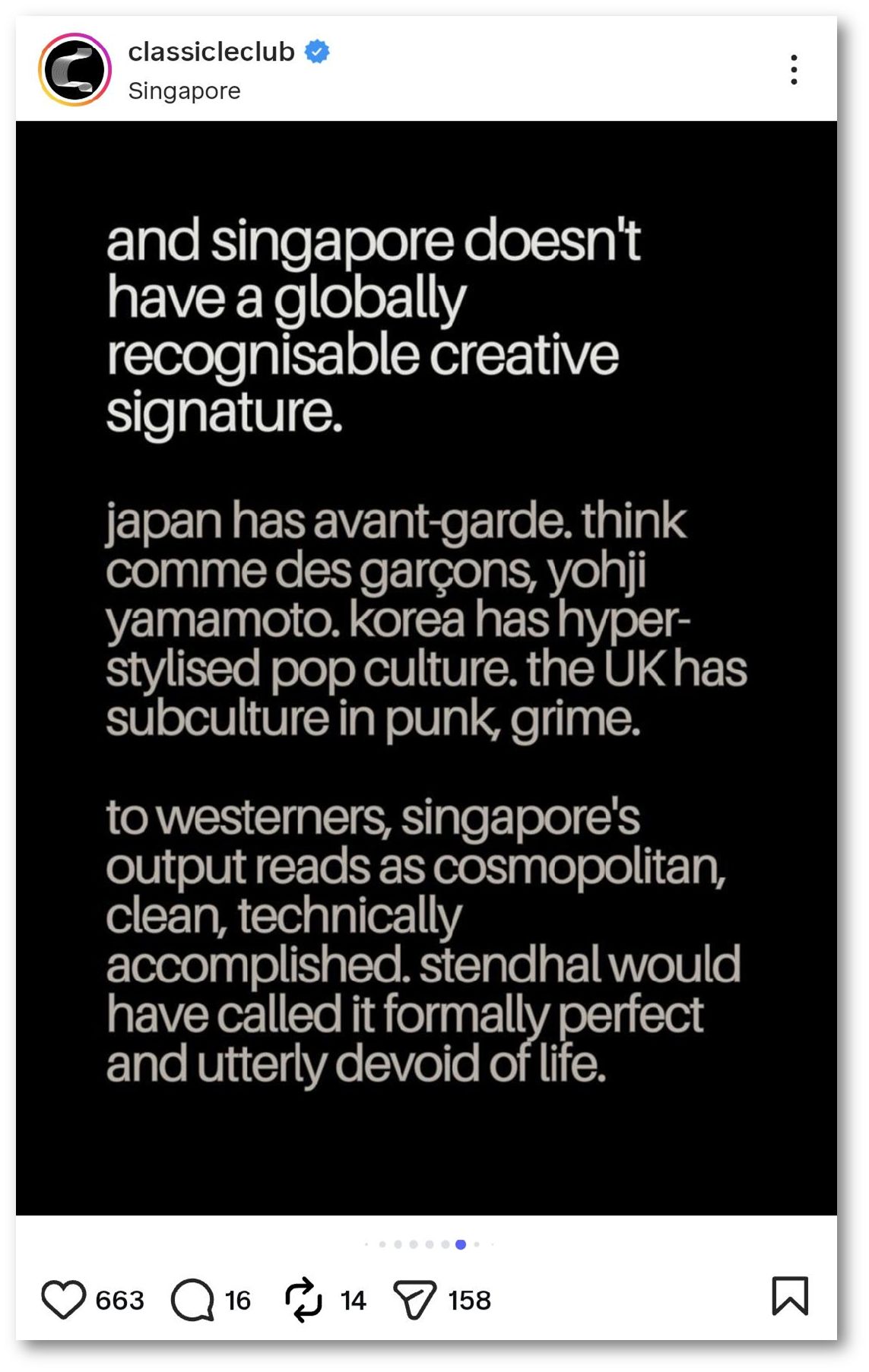
Why settle for the dry soil of the truth when you can thrive in the lush gardens of lore? The scenographic travel continues. They took us to Korea for “their hyper-stylised pop culture”. A brittle sentence fragment assuming the mantle of analysis is the peak of the Classicle arts. That declaration treats K-pop exports as a monolith and that they are all surface without depth. Good luck trying to convince their students that Korean culture is nothing but gloss. The cardboard cutouts as national identity is then shipped some 3,500 kilometres away to “the UK”. Suddenly the capital letters appear. This is the perfect artifact of rhetorical bias to teach GP students: Use typography to encode a hierarchy of respect. Do not explain why the United Kingdom deserve more respect than Japan, Korea, and Singapore. Say nothing that it’s because they are in the glorious West. Ignore the decades of artful ascent. In British pop music, there is nothing between the binary of punk and grime. As Britpop giant Blur sang in their 1994’s landmark album Parklife, “This is a low/But it won’t hurt you/When you’re alone/It will be there with you.” Yes, kids, alone in the exam hall.
That’s not quite past the halfway mark of the 17-slide balderdash. We realise that we have to treat ourselves better, amid an already relentless churn of algorithmic noise. We had a quick flick to the end and can confidently confirm that, while Classicle Club positions themselves as the fine dining of tuition classes, all of the slides in the post have the charisma of a brown paper bag and the intellectual depth of the Big Mac within. This cannot be a multi-volume encyclopedia of linguistic and factual fails. Every sentence is a loose thread that threatens to unravel the whole garment. We must not tug at them with the frantic energy of someone who thinks they can acutely sew. What makes this all the more surreal is the timing. The Met Gala itself, once the pinnacle of cultural legitimacy, is this year mired in controversy—its oligarchic sponsorship derided as tone deaf, its prestige questioned by boycotts and protests. Classicle Club does not explain why there’s a need to chase a seat at a table that many now regard to have collapsed. To pose the Gala as the measure of Singapore’s national success, then, is not just ironic, but spectacularly misaligned. And, frankly, really embarrassing.
Footnote: We love the capital letter for proper nouns—otherwise, ‘China’ is just a set of plates and ‘Mercury’ is just a thermometer’s bad day. We are champions of commas, especially the banisher of ambiguity, the Oxford comma—it’s the small but mighty line standing between a polite list and a chaotic group hug

