The narrative of the silhouette: can two be so similar?
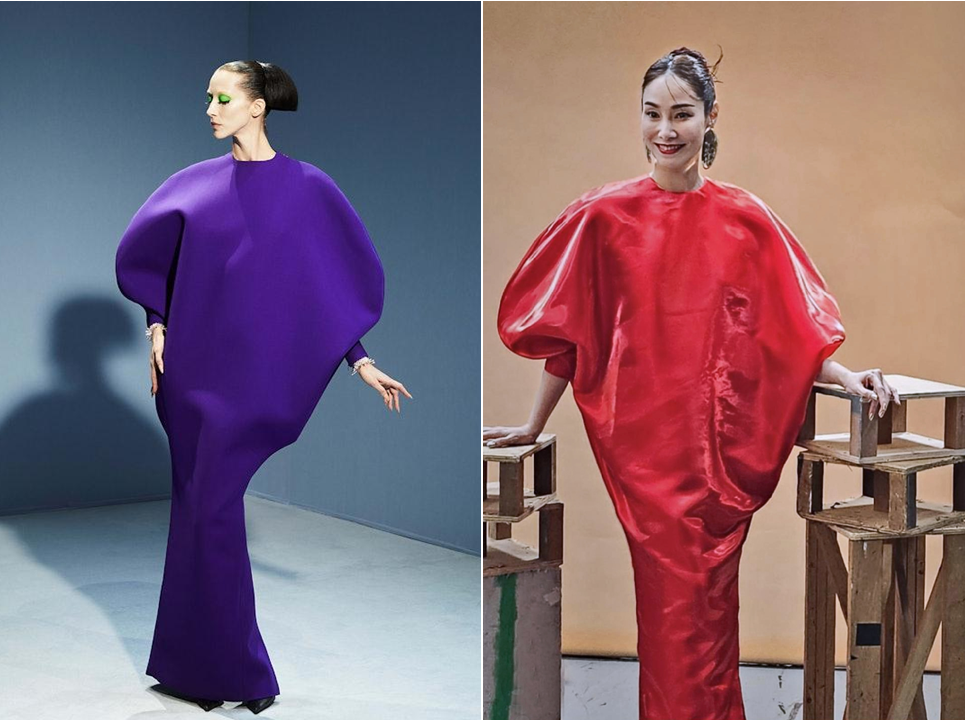
Displaced volume: Left, Haider Ackermann for Jean Paul Gaultier Haute Couture. Right, Frederick Lee Couture, worn by Gina Tan. Photos: Jean Paul Gaultier and ginatan/Instagram respectively
At the recent Star Awards, Gina Tan, the former model and then former singer of Mandarin pop (and mentee of Tracy Huang) who became a Channel 5 actress, attended television’s most important event in a red gown that looked rather deflated. Or, a victim of the muggy weather. The biomorphic piece was designed by Frederick Lee, who posted images of Ms Tan in it on his socials. It was, in fact, a collage of one photo over another, and it appeared on his Facebook page, twice. Bravo on the self-adulation. It is unfortunate that the garment looked to be in a state of clinical depression. Ms Tan probably did not wear the dress in the inconvenient presence of a mirror or she might have noticed that it has less air than an empty balloon, which is regrettable as the gown seemed to have been given a silhouette that shared a striking genealogy with Haider Ackermann’s recent work for Jean Paul Gaultier couture. It’s fascinating to see how the rigorous, architectural shape of the Gaultier 2023 spring/summer couture season continues to inform the visual language of evening wear, locally.
A triumph it was of spirit over the petty constraints of form, function, and red-carpet visual appeal. After all, a dress need not hold on to its intended rigidity, even when worn. Why be a parachute when it can be a kite? Why descend when you can soar? A rigid form is, after all, merely a suggestion until the fabric decides it would much rather surrender to gravity and settle into the shape of a burst blow-up fire hydrant. Or, like a typical 80-year-old face. In the world of aesthetics and design, deflated often translates to a loss of structural integrity, tension, or vitality. While volume is frequently equated with health or luxury, its absence—especially when unintended—in fashion usually signals pliable construction and a low commitment to the garment’s own existence. The beauty of Ms Tan’s dress was how the uneven neckline refused to stay flat and flatter her neck, as well as the stunning choreography of puckers, dents, and creases that was the antithesis of Mr Lee’s famed maximalist overdose, proving that those ‘wrinkle-free’ shirts loved by the Shenton Way bunch are marketing’s urban lore.
While volume is frequently equated with health or luxury, its absence—when unintended—usually signals pliable construction and a low commitment to the garment’s own existence
In the sanctuary of the atelier, the ‘line’ is a sacred signature. Mr Ackermann’s one-season contribution to the JPG canon was defined by a terrifyingly precise, almost razor-sharp rigidity. And we appreciate his work for the enfant terrible (still?) precisely because of it. As we wrote back then, “Mr Ackermann not only exhibited the aptitude and a keen discernment for haute couture, he understood its spirit.” The line he showed was of incredible sinew and geometric discipline. There was a deftness of hand that made us wonder if he wasn’t commanding the fabric to behave through sheer architecturally intimidating will. Of that dress, we remember it well. Worn by Raquel Zimmermann, it was, we noted, “elliptical at the top and an epitome of how couture can astound with shapes”. Not, disenchant. The form required immense structural tension to hold and stay pompously held. The volume is fluid yet controlled. It didn’t use internal cages; it relied on the weight and tension of the fabric itself to billow in specific areas. On Gina Tan, the Frederick Lee couture dress seemed to have imploded, and was, acutely, still collapsing inwards as she posed in an unmarked corridor, strewn with hacked wooden crates and, later, navigated the humidity-wrecked and guileless red carpet. All the while, the dress was dying.
The transplanting of a silhouette from the January 2023 couture show spaces to a MediaCorp red carpet in April this year suggested a belief that the public possesses the memory of a guppy. But this has happened before on the Walk of Fame. The most recent was in the same year as Haider Ackermann’s guest collection for Jean Paul Gaultier. Back then, the winner of the Best Actress trophy, Huang Biren, wore a Francis Cheong couture gown that was a dead ringer for one by Elie Saab, first seen in the Lebanese designer’s autumn/winter couture collection of 2021. The impact of a couture piece is not minimised by the passing of time since good design is largely immune to the clock. Instead, it persists as a permanent blueprint of technical mastery, where the silhouette remains as radical years later as it was the moment it first cleared the atelier doors. Admiring it is one thing, inspired by it is another, but attempting to replicate its specific alchemy often feels more like an imposition than an homage. For Frederick Lee, perhaps, that was enough. As 吉娜 (Jina), Gina Tan sang 妹妹你依然真美 or You are so Beautiful, Sister. Perhaps she looked in a mirror then, for the last time.
A Note on Style: Couture (French) and couture (rest of world) are not synonymous. We have preserved this distinction through italics to ensure our readers understand the disparity in both geography and gravity

