It’s a rebranding dictum inspired by a political slogan. Is Gucci courting the MAGA masses?
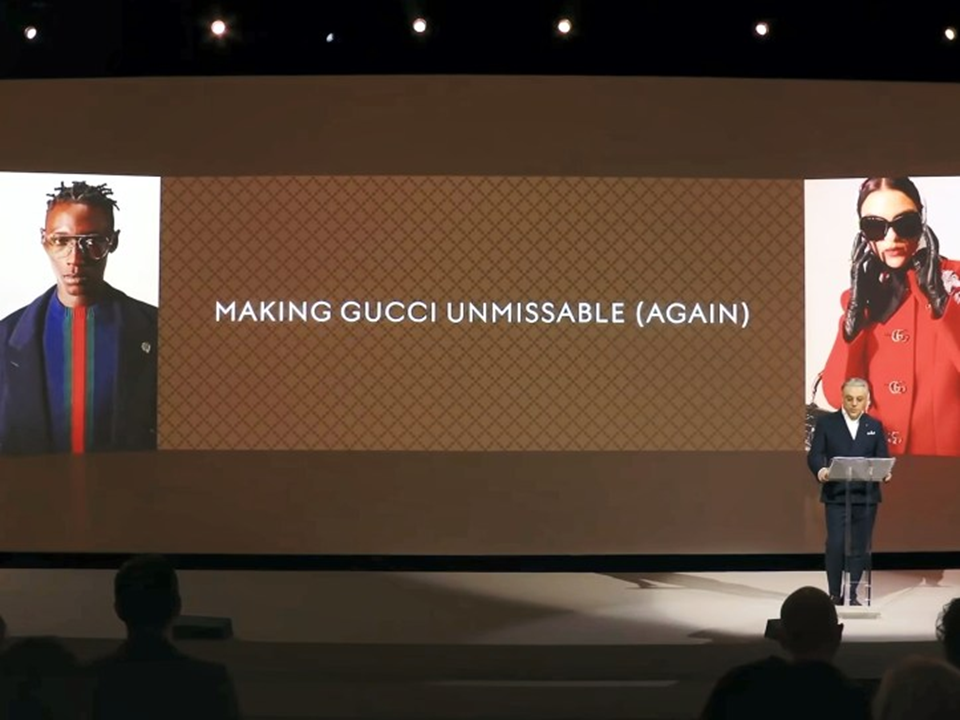
Luca de Meo, bottom right, announcing his plans for Gucci
Yesterday, during a four-hour-plus presentation of Kering’s Capital Markets Day in sunny Florence, seven-month old CEO Luca de Meo talked about the company’s strategies to revive their brands. In the segment on Gucci, Mr de Meo, formerly from the world of automobiles (specifically as CEO of the Renault Group), was defining what the beleaguered brand meant today. Behind him appeared a four-word dictum: “Making Gucci Unmissable (Again)”. We do not remember much of that rambling speech, at least not enough to produce a ‘five takeaways from the Kering briefing’ piece, but one thing that was about as subtle as a neon sign in the nearby Duomo were those words in full caps up there. The first thing that came to our mind was how similar the phrasing of the rallying call was to possibly the world’s most famous and powerful political slogan: Make America Great Again. But why that slogan phrasing? Was this simple mimicry or just brand psychology? Everyone knows who that phrasing is associated with. And that man is not exactly the charmer of the century.
When Gucci echoed the cadence of MAGA with “Making Gucci Unmissable (Again)”, they’re borrowing a structure, as well as brushing against a linguistic brand that has already transcended politics. Make America Great Again is not only a slogan that inspired, it has spawned an acronym that has become more than a word. It functions as a noun and and a proper noun, and an adjective. MAGA is now a meme template, a cultural shorthand, and, tragically, a linguistic contagion. It has gone from Make America Great Again to Make America Gay Again, to Make Advertising Great Again. It has also become the antonym of politics as usual, a shorthand for political behaviour and response that are divisive. It has gone from inspiration to stigma. No one, for example, wishes to be associated with the MAGA brand of beauty, as seen on two very publicly-ousted public officials, Kristi Noem and Pam Bondi. The acronym-as-word has become quick script for insidious norm violation, shaping discourse far beyond its original campaign.
Everyone knows who that phrasing is associated with. And that man is not exactly the charmer of the century
It is not clear why Gucci came up with a slogan that looked and sounded as if it was imported on a cargo ship from a Florida rally. “Making Gucci Unmissable (Again) offered a lot in that short, seemingly concise phrase. They chose “Making” rather than the assertive command “make”. It implied Gucci isn’t inherently unmissable right now; it must be made so. A work in progress. Then the name, declarative and as iconic as America. The curious part was the “Unmissable”. It was not luxurious; it was not innovative; it was not even aspirational. Rather, it was about being seen. You mustn’t miss it, anywhere, everywhere. It has to be unavoidable. When something is that “Unmissable”, it cannot be discreet or quiet. It calls out to you, raucously. “Unmissable” is the language of a traffic hazard or Don Donki. And there was the visually intrusive parenthesis of “(again)”. The close bracket softened the claim. Without them, “Again” would sound blunt, certainly desperate. In parentheses, it became a whispered aside, acknowledging history while suggesting a cyclical revival, but hiding in plain sight. It also created a self-aware wink: Gucci was unmissable, fell from the pedestal, and now must be reclaimed. There was also a subtle admission of decline. You don’t say “Again” unless you concede that the brand has lost its cultural sheen, just like America.
Mr de Meo then said that, “in the U.S., people say ‘I feel Gucci’ to mean they feel good, attractive, optimistic, upbeat. In short, Gucci is a feeling, not just a logo.” The cultural dissonance is not the least subtle. On one hand, Gucci is an Italian heritage brand, steeped in Florentine craft and Catholic‑inflected European tradition. On the other, the American political climate today is dominated by a president who has just likened himself to Jesus and attacked the Pope. Just days later, Kering’s aligning itself with Americans’ ‘I Feel Gucci’ was disturbingly jarring. The phrase itself is a slang that emerged in U.S. hip-hop and street culture, meaning “I feel good” or “I’m doing well.” It wasn’t invented by Gucci, and it certainly doesn’t mean the brand itself has organically become a “feeling”. Luxury brands often rely on exclusivity, but slang like ‘I feel Gucci’ comes from communities far outside the luxury consumer base. So the brand is trying to claim cultural ownership of something that wasn’t theirs to begin with. We sensed that there was more than a whiff of the Flora of desperation.
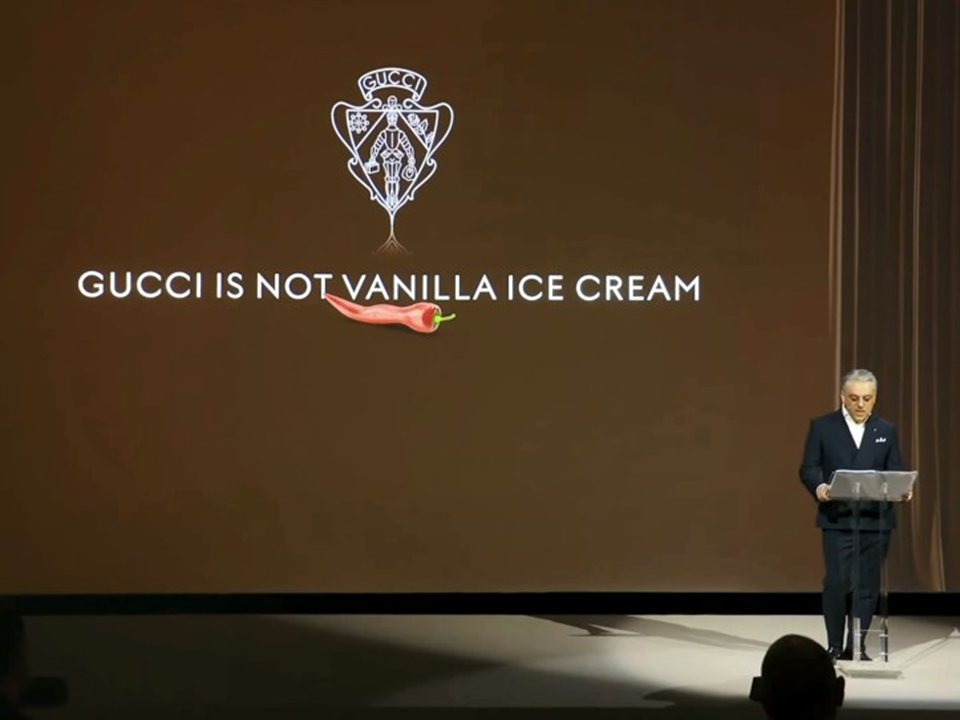
As Luca de Meo made more Gucci proclamations, he waded into the territory of food
This was the moment an Italian industrialist’s attempt to harvest American street slang to validate a strongman reclamation project, to be inspired by a fellow who is currently at war with the very center of Italian spiritual culture. Gucci’s slogan “Make Gucci Unmissable (Again)” borrows revivalist cadence at the very moment American politics is using religious imagery in divisive ways. And there were more contradictory posturing. Before this politics-leaning mumbo jumbo, Mr de Meo likened Gucci to chilli, sambal belacan it is, however, not. It is far more complex, as he suggested, saying. “sorry, but Gucci is not vanilla ice cream. It is spicy, sometimes bitter, sometimes bittersweet.” On the screen, it even showed the fruit, but was he not just referring to peperoncino—a hint of spice? No one thinks of Gucci as vanilla ice cream, not even during the Tom Ford era, not through the forgettable years of John Ray, Alessandro Facchineti and definitely not Frieda Giannini. Most definitely not when Alessandro Michele reigned, nor entirely during Sabato de Sarno’s brief tenure. And even less so now with Demna Gvasalia at the helm. Vanilla had never been in the Gucci pantry. Oddly, despite the comparison of Gucci to chilli, he later said that the brand had to be made “unmistakable (again)” while behind him the text in reverse white read “unmissable”. He added, “being unmistakable can also be quiet, discreet and refined.”
It is hard to understand why Mr de Meo set the table with a culinary critique and then smashed it with a political mallet. Or is this just an Italian corporate pathology: the use of food as convenient shorthand for cultural superiority, which inevitably leads to a tonal car crash. We recall that in 2018, Dolce & Gabbana used food as commentary that resulted in an ugly posturing that caused them to lose the customer base of an entire nation that happened to be the second largest economy of the world. Italy has a long tradition of mixing food and politics rhetorically. Speeches often employ culinary imagery to make abstract ideas tangible. But the Dolce & Gabbana case showed the danger: their campaign featuring chopsticks and Italian food in China was read as patronising and culturally tone‑deaf. The backlash truly cost the brand, not that they were bothered with it as they have the continued support of the first lady of the United States. Perhaps Gucci’s sharing of a rhetorical bed with an aesthetic—and a slogan—so clearly linked to the current American administration is where the safest pillow for an Italian brand seeking U.S. relevance lay. ”Unmissable” isn’t a fashion statement more than saying, we are with you.
Screen shots: keringgroup/YouTube
 Style on the Dot