Bless your heart, Karoline Leavitt. It is so charming when someone can find such scant elegance in a word they can’t even pronounce
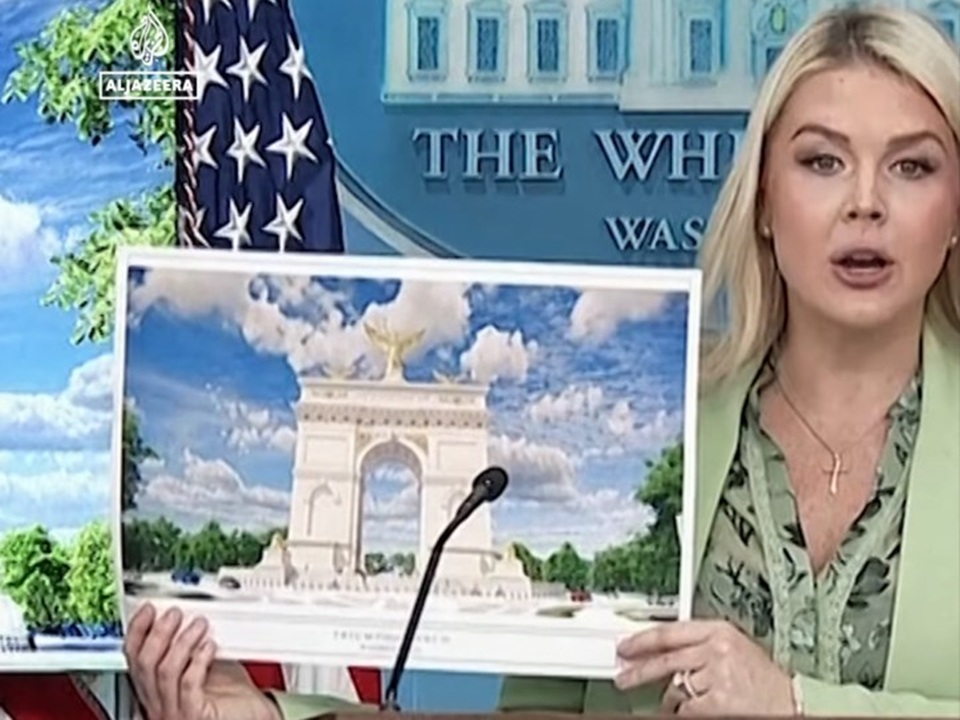
It’s such marvelous irony for a press secretary (not the first lady!) to paint a vivid, authoritative picture of the administration’s vision with phonetic freestyle and ‘thingy’ enthusiasm. Karoline Leavitt, the patron saint of close enough, was behind the lectern in the James S Brady press briefing room to promote Donald Trump’s United States Triumphal Arch, beautifully pronounced as ‘arc’. Dressed in a suit of a pablum sage that’s between mint green and pistachio, or the top of kueh salat, she was disturbingly perky as she described the colossus of conceit her boss desperately needs to erect. At first, we thought she mispronounced ‘arch’, but it kept coming back, as least three times, as “arc”. Finally she did say “arch” towards the end of the segment of her speech. Online, Americans had a field day with it.
Her supporters believed that she chose “arc” because it sounds smoother and more approachable than arch, which could evoke empire and permanence—is that not what Mr Trump deeply desires? The forgiving ones defended her, saying that “in the heat of public speaking, slips like this happen more often than you’d expect.” Some even said that she was referring to an “Arc de Trump”.To us, she possesses the rare, breathtaking talent of being oblivious to the difference between arc and arch: One is a curve, or metaphorical trajectory (such as the arc of this observation), the other, a physical structure, an architectural form. Or, for many women, an eyebrow description. By substituting one for the other repeatedly, she demonstrates a remarkable lack of distinction. The press secretary treated a monument as if it were a storyline. Picturesque.
She was disturbingly perky as she described the colossus of conceit her boss desperately needs to erec
This was the sound of a prosaic mind. When you knock on a potato, surely you don’t expect to hear the chime of bells. It was not just her pronunciation that was topsy-turvy. As she lifted an artist’s impression to show her rapt audience, she exhibited an arch that was literally upside-down. For a fleeting, surreal moment, the $400 million monument appeared not as an imposing tribute to American longevity, but as a white-washed magnet—a U-turn desperately attracting a foundation and admiration. It took the frantic gesticulations of the front-row press corps to alert the secretary that her ‘arc’ was currently defying both gravity and common sense. She flipped the board with a perfunctory smile and thanked whoever alerted her. She then resumed her sales pitch, blissfully unaware that she had just provided one big beautiful metaphor for the administration’s architectural ambitions: a grand vision held together by someone who also can’t tell the sky from the sidewalk.
For someone who had to sell an egotistical expression in stone; a premature headstone for a legacy so many wish to forget, Ms Leavitt was surprisingly limp in her choice of adverb. Commenting on the illustration, now right side up, she said. “It’s quite a beautiful arc, as you can see.” As if to set the record straight, Mr Trump, later on Truth Social, was more generous: “MOST BEAUTIFUL”, he wrote, and, yes, in full caps. The reaction is understandable. “Quite” is so tepid that one would avoid it unless one has the spine of a wet napkin and finds ‘very’ an act of aggression. It is not quite a word; it is a strategic retreat for those too timid to commit to an adverb and too unimaginative to find a better one. It is as if she was unacquainted with Donald Trump’s brand of superlative dominance. Even her use of “beautiful” was pure laziness. It was “beautiful” in the way a Trump hotel lobby is “grand”: technically inoffensive, entirely devoid of spirit. One suspects that if you stripped away the curated layers and the PR-managed silhouette, you would find not a definitive character, but a stony void, nonchalantly dressed in the no-trend of the week.
Screen shot: c-spanlYouTube

