When looking for a map ends up setting the forest on fire
Back in the very, very old days, when hawkers actually peddled on the streets, you ate at their stalls, seated at tables on the tarmac, and then you left. If you enjoyed the food, you returned. If you did not, you go elsewhere. If the hawker deserved to be criticised, you do it among your friends or relatives. You don’t broadcast the perceived badness up and down the lorong until their small business is not tenable, their livelihood crushed, like garlic. You leave that to the 三牲仔 (samseng kia, Hokkien for street thug). Back then, these gangsters patrolled hawker streets and alleys to extort money for so-called “protection”. Against what or who, it was never clear. But, at least the hawkers, protected, get to continue their businesses. In the traditional protection racket, there was a perverse logic of sustainability. The gangster needed the hawker to stay in business so they could keep collecting their 保护费 (baohufei) or protection money. Sure, it was parasitic, but the parasite didn’t want the host to die. The old-school gangster at least understood sustainability, before it became a buzzword for over-consumption.
Today, a small grumble easily goes viral, and the country collectively loses its mind, forgetting that a loud keyboard is just din. The most recent case: the Eat First (食之为鲜) saga. We don’t need to repeat the whole story here What should have been a very common gripe became national indignation when popular news site Mothership ran a story about the affected family’s disgruntlement of what they saw to be “unreasonable and unexpected”, even when they emphasised that the family had been patronising the establishment for over 20 years. The ‘no outside food/drinks’ policy has been a strict “matter of principle” for the owner of the restaurant since he opened his first solo outlet in 2016. It’s the PR equivalent of a wardrobe malfunction: one loose thread of a dispute, and suddenly the whole brand is standing naked in front of the restaurant. By leading with the family’s shock and focusing on the $2 charge for home water, and children thrown into the mix, the Mothership narrative was primed for outrage, even before the restaurant had a chance to provide context. The article concluded with: “He [a member of the family] added that he has not been back to the restaurant since the incident.” By ending on the family’s hint of exile, the article shifts from reporting a dispute to narratively excommunicating the restaurant.
Today, a small grumble easily goes viral, and the country collectively loses its mind, forgetting that a loud keyboard is just din
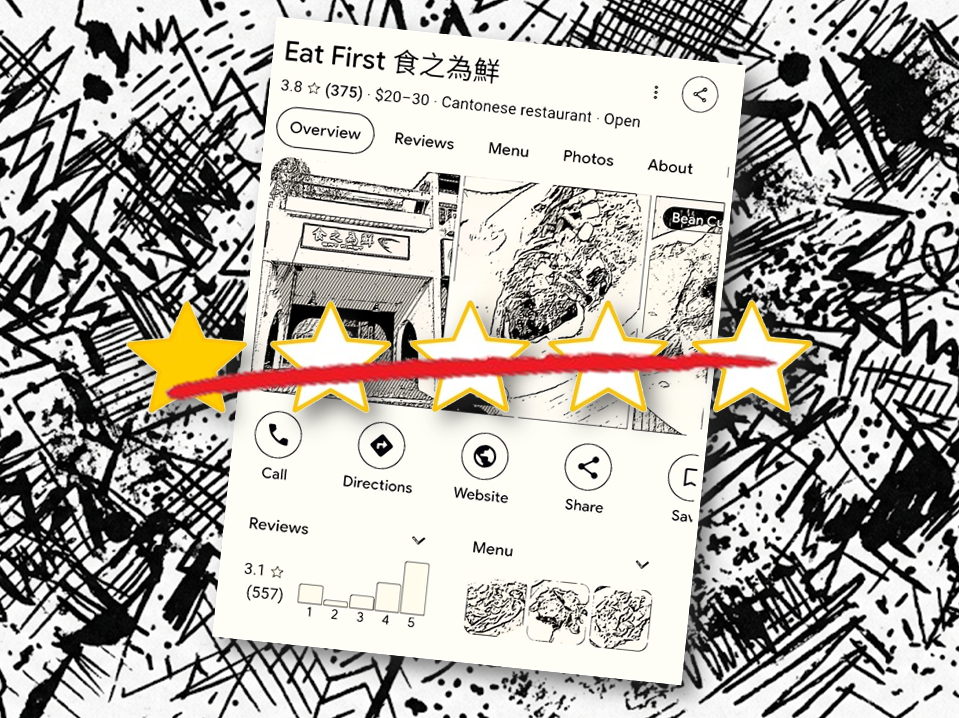
Enter the Google Map: a tool designed to help us find our way, but has instead become a digital hit list for the modern mob. If the last line in the Mothership article appeared led to be a directive to its readers to do the same as the aggrieved diner, the one-star Google Review that was subsequently hurled at Eat First was a prompt for the mob to finish the job. It is more than disturbing. Google Maps has transformed from a geographical utility to a judicial one. To protest a restaurant physically, you have to show up. To get the job done on Google Map, the rabid mob doesn’t even need to have tasted the food, let alone anyone’s water. The digital native news sites of today are not about a serious record of culinary history (or any history). Rather, it is pure click bait. But what is worse is the ratings platform such as Google Review: it is just velocity and vibration. According to a CNA report, “Eat First’s Google rating plunged from 4.2 to 2.5 within 24 hours, with scores of one-star reviews criticising the [water] policy”. It has been described as “review bombing”. The metaphor is truly telling: complaints aren’t seen as feedback anymore, but as weapons of mass destruction—an obsession we thought peaked in 2003, but which has become the main character of 2026.
Clearly, the bombing is good for Google’s traffic, but it’s terminal for the restaurant. Now, everything is ‘weaponised’—a term we recoil from as it suggests that the tools of civil society have been co-opted for combat. This linguistic shift is what transformed a mundane dispute over a S$2 water charge into a cultural war. The owners of Eat First attempted to use logic, citing policies from 2016, visible signage right on the door, and the presence of a “1.5L bottle” used to pour water into bowls the restaurant provided. But logic is useless against a weaponised narrative. When the mob has already been prompted to destroy, the facts are not proof; they’re just enemy fire. For Google, it was traffic-gold-as-shrapnel: spikes in searches, clicks, and engagement. Every one‑star review is another data point, another page view, another ad impression. The algorithm doesn’t care if you’re dancing or dying, as long as it gets to watch, unmoved. By framing everything as a weapon, the nuance of a forty-year restaurant legacy is flattened into a tactical objective. Once the Google Map becomes a hit list, the restaurant was not just fighting for customers; it was locked in a war of attrition against an algorithm and an audience that has been taught to see ‘corkage’ as a crime.
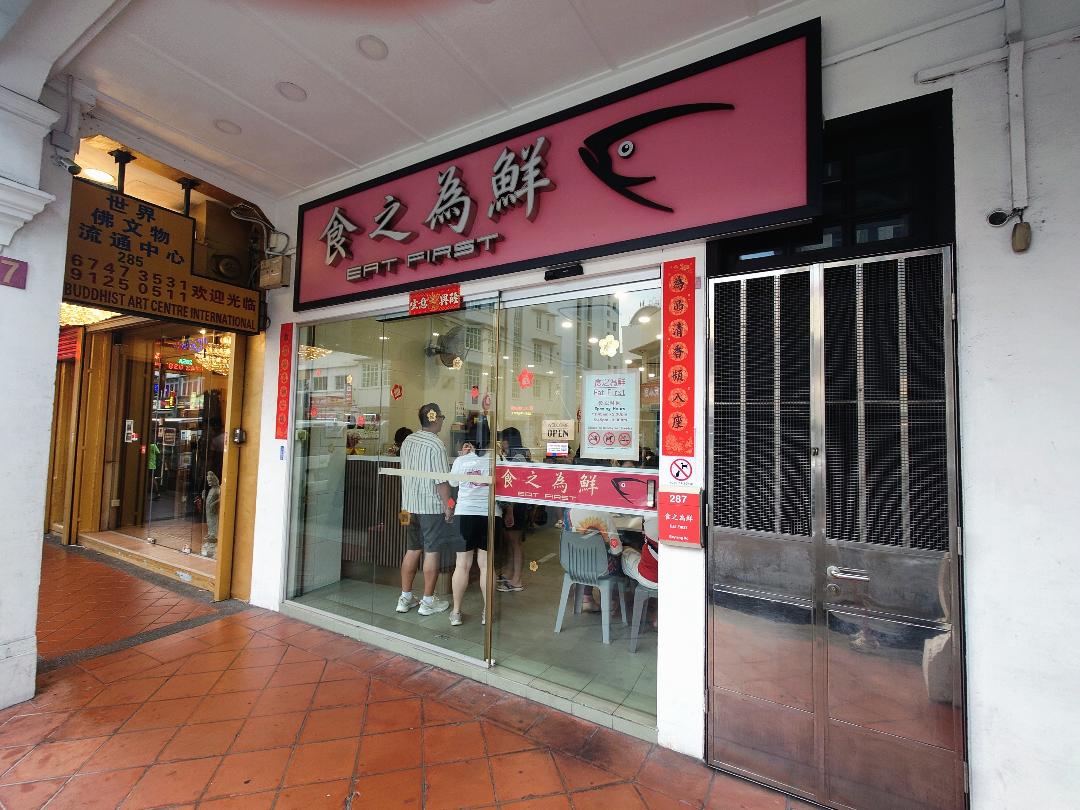
The restaurant in Geylang. Photo: Chin Boh Kay
This is the Stomp-ification of the Singaporean social fabric. We’ve replaced the living room—where disputes were settled with a conversation—with the ‘arena’. The Mothership article functioned as the gate-keeper, deciding which David to arm and which Goliath to blindside. In the economy of Singaporean food culture, where loyalty and heritage are the primary currencies, framing a 20-year regular as being driven away over $2 was a calculated move to trigger maximum public indignation. And then Google’s review system provided the terrain for combat. The line between a “brutally honest review” and a platform for trolls is increasingly as thin as a crispy ban chiang kueh (曼煎粿), especially in the high-stakes world of food and beverage. To be certain, Google has in place a new moderation system that uses AI to flag sudden spikes of negative reviews, detect suspicious clusters of activity, and remove crudely written posts that violate harassment or obscenity policies. But the system has inherent flaws that favour the attacker over the audited. Google makes it hard for businesses to fight back: owners must prove a review violates policy, pseudonyms embolden hurtful critiques, and the algorithm’s hunger for “fresh” reviews means a week of trolling can bury years of legacy.
In the digital gangsterism of the rage economy, we have moved towards total reputational scorched-earth. The gangster is still alive. It’s just that he has traded his Montagut shirt and a pack of Marlboros for a ring light and 5-G connectivity. You used to be able to recognize his face. Now, you don’t even know if your attacker is he or she. Why break a restaurant’s window when you can just shame them to oblivion from the comfort of your shared bedroom, with your little brother/sister watching? In the past, when a business owner was being threatened by a person, they could call the authorities or hand over the fee. But how do you now pay for protection against a decentralised mob of Redditors who are Googling to be enraged? Conversely, the mob does not want money; they want a sacrifice and an apology, and the reversal of a $2 policy to satisfy their sense of Ah Beng entitlement. The Google Map and its attendant Review are supposed to guide us to a good meal, but has become a veritable hit list. By Googling, many are seeking agitation that is already brewing. The digitally-bent consumer has become more destructive than the street thugs of the past, now with Google as the 三牲头 (samseng tau) or mob head. But the old gangsters at least let the hawkers keep their stoves burning. These new ones won’t stop until the gas is cut off.
Illustration: Just So

