Donald Trump truly believes he is Jesus. In a now-deleted image shared on his Truth Social page, he showed himself to be a miracle healer. His ability to remain unbothered by what that could mean is truly a structural marvel: his thick skin
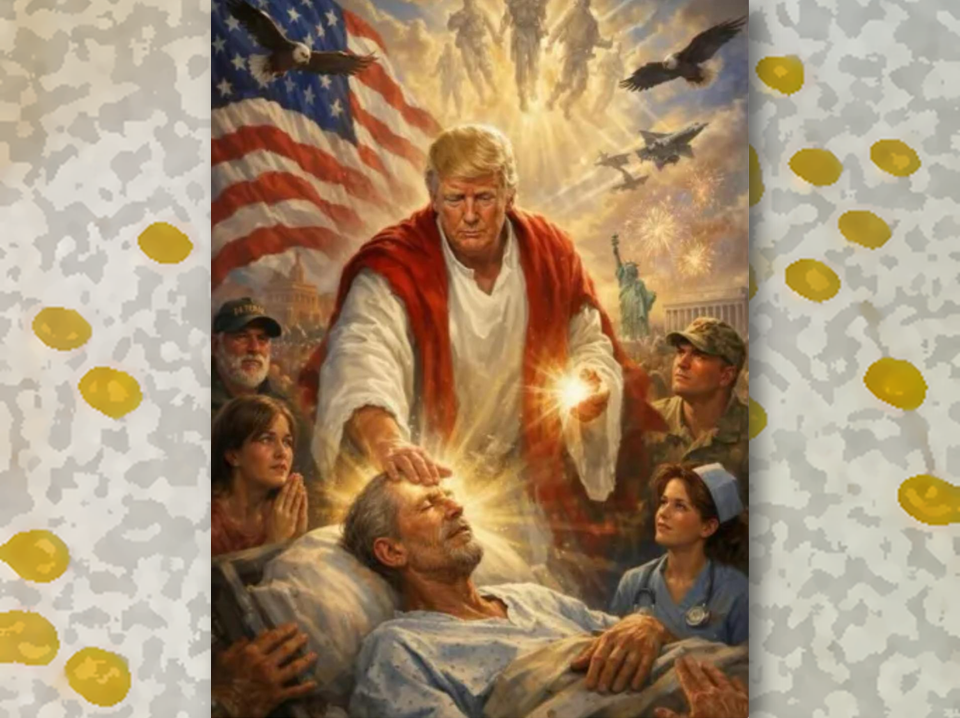
Donald Trump shared a profane illustration of himself as a healer. Main image: donaldtrump/Truth Social
No, he was not playing a medical professional from Doctors Without Borders. In a now-deleted AI-enabled illustration shared on his Truth Social page two days ago, just after publicly attacking Pope Leo XIV for daring to choose peace, Donald Trump was depicted as Jesus, or a Jesus-like individual. He has aggressively toyed with kingly delineation and religious imagery before (even Elon Musk, who has likened himself to Buddha!), but this latest AI-enabled illustration was a leap into outright, outrageous religious cosplay. It did not scrimp on the sacred iconography: the garment, divine light, healing gesture that traditionally belong to beatific iconography of Christ, effectively hijacking two thousand years of sacred art. Dressing oneself in king symbols is political theatre; dressing as Jesus is auditioning for divinity then even Mother Theresa did not dare suggest throughout her apostolic career. It shifts from power fantasy to spiritual appropriation. Donning a crown is political theatre, Halloween-ed as Jesus is spiritual identity theft. One is a reach for the throne, the other is a reach for divinity he will never understand or be blessed with. One is destiny; the other is just desperate.
Mr Trump’s lurid sartorial sacrilege is a modernist interpretation of the Jesus archetype. He wore what appeared to be a chiton in white, over which was a red himation, draped like a Ralph Lauren sweater over his shoulders, in a style the Japanese would call “Ivy style”. Or, collegiate chic in jaunty Judean style of the 1st century AD. It was an ensemble that could have been put together by his wife’s favourite bespoke tailor Hervé Pierre. Or Adam Lippes, although it could have come from a cheap costume shop in Palm Beach. Jesus, as described in the bible, was not dressed regally or fancifully, but in the everyday dress of a working man from Galilee, a region of fishing villages and small towns. Mark 6:3 refers to Jesus as a tekton (Greek for carpenter or builder). His clothing would have reflected that modest trade. Unlike priests or the wealthy elite, Jesus did not wear ornate robes or jewelry. His clothes did not telegraph messenger or healer, or saviour, least of all, warmonger. They were, simply, tekton-ic.
Donning a crown is political theatre, Halloween-ed as Jesus is spiritual identity theft
In the era of the Roman ruling class, most of Jesus’s audience wore functional workwear made of rough wool or linen. Durability was key. Jesus travelled on foot throughout the land. His clothes must be able to resist the wear, and the tear. In the AI image of Mr Trump as a historical figure, he was not so practically attired. The chiton especially was rendered with a pristine, voile-like sheerness that belonged more in a bustling souq of today than on the body of a carpenter-turned-preacher of the distant past. In the composition of the image, Mr Trump’s hands were aglow as a healer, but they looked like a juvenile attempt at delineating Pyro showing off his ‘gift’. Around him were individuals that looked like staffers of a field hospital in a war zone. They have abandoned their position to deify a man, just as Pete Hegseth or Paula White-Cain has traded civil service for messianic devotion. The American flag flapped above him, so did a sole nationalistic eagle. There were fighter jets and military men seemingly descending to carry out what the president had said he would not do: “put boots on the ground”. The message was clear. The war Mr Trump started has not ended, but he emerges as a saviour, the only one who could deliver the world through it.
After that bold religious impersonation and adventurism that generated rapid outcry, especially from church leaders. Mr Trump said to the press at the White House the day after: “I thought it was me as a doctor, and had to do with Red Cross, as a Red Cross worker there.” There was not a single caduceus, stethoscope, or crimson cross in sight. By claiming he was a “doctor” after the fact, he is essentially asking the public to ignore the primary evidence of their own eyes. Just like that, the theological fan fiction became a promotion of humanitarian proclivities. You can’t say that is not an unexpected sleight of hand—his next-day routine. Was it amusing? In the world of cosplay, one can play more than a single character. Suddenly wearing an imaginary “Red Cross” vest is the fastest unseen costume change. But there was cruel irony built into his words. A “worker” implies humility, effort, and one of the people, but Donald Trump’s persona has always been the opposite: a figure of arrogance, resistance, and at odds with the citizenry. By saying “Red Cross worker”, he borrowed the aura of neutral humanitarian labour without embodying its reality. And “there”, but where? Leaving the location undefined weakens specificity, but adds conversational looseness. Come tomorrow, it can be anywhere or anything. And most definitely anyone. As long as he is divine.

